In today’s rapidly evolving business landscape, staying ahead of the competition requires more than just a great product or service. It demands a deep understanding of the market, consumer behavior, and emerging trends. This is where the market research process becomes invaluable. In this blog post, we will delve more into market research and explore...
There is never a wrong time to do market research. However, most research projects are birthed because a company or organization is at a crossroads. Whether you’re a startup or Fortune 500 company, you’ll have critical decisions to make. This blog will detail common market research examples and how our clients have used them to...
How to Recruit Participants for Qualitative Market Research
Ashley Reynolds
Qualitative recruitment is the process of finding, screening, and scheduling people to take part in research like focus groups, interviews, and in-home usage tests.
If you’re here, you’ve probably already got that part figured out for your own study, and you’re looking for help with the part that actually stalls projects: finding enough of the right people before your deadline hits.
This guide walks through how we do that at Drive Research: the process behind our 95% average show rate, what separates a qualified participant from a useful one, realistic costs and timelines, and specific tactics for hard-to-reach audiences.
Recruiting for a qualitative study breaks down into three stages: sourcing candidates, screening and qualifying them, and confirming and reminding them until the study date. Skipping depth on any one stage is usually where a recruit starts to fall apart.
The same principles apply across the full range of qualitative methods that depend on recruited participants, focus groups, in-depth interviews, usability and UX studies, in-home usage tests, and ethnographic or diary-style research.
The screening criteria and touchpoints shift slightly by format, but the recruiting fundamentals don’t.
Stage 1: Sourcing
Candidates come from a mix of channels, typically some combination of targeted social advertising, an in-house research panel, vetted third-party panels, and grassroots outreach for especially narrow audiences. Which mix makes sense depends heavily on the audience, which is covered in more detail later in this guide.
Stage 2: Screening and Qualifying for Quality, Not Just Eligibility
Regardless of where candidates are sourced from, that pool takes a recruitment screener next. This is a survey used to narrow the group down and confirm who actually qualifies for the study based on different qualifiers (demographics, purchasing habits, etc.).
Though, the majority of the legwork is getting someone who can actually give you something useful once they’re an actual participant. Ironically, this is the stage where a lot of self-managed recruits go wrong.
Why a screener alone isn’t enough
A screener can let the wrong person through in two different ways:
The question gets softened. A taste test screener might ask which snack products someone has purchased and consumed in the last six months. Read out loud as “have you had chips recently,” it lets in someone who ate a handful at a party once and never bought a bag, and the whole session ends up full of off-target answers.
The criteria go beyond demographics. For a utility company’s focus groups on a home energy assistance program, participants had to be the person actually responsible for household energy decisions, couldn’t work in the energy industry, and couldn’t sit at either political extreme, since that could skew a discussion tied to public policy. None of that shows up on a standard age-and-income screener unless it’s built in on purpose.
The phone re-screen
Everyone who qualifies from the recruitment screener gets a live phone call before they’re scheduled, both to re-verify their answers and to gauge whether they can articulate anything beyond a one-word response.
That difference is audible within the first thirty seconds. A flat “yeah, I guess” versus someone actually explaining their reasoning.
The call also builds a small relationship too. Once someone’s talked to a real person, they’re less likely to blow it off, since now they’d be letting a person down, not just missing a link in their inbox.
⚠️ One rule worth adopting regardless of who’s doing the recruiting:
If a participant shows any hesitation on that call, even a long pause before answering a basic logistics question, don’t place them on the study.
A participant who seems dis phone tends to be the same participant who cancels two days before the session, or doesn’t show at all. Replacing someone before they’re scheduled is far cheaper than replacing them after a no-show.
Verifying B2B participants
Anyone can claim to be a director of IT on an online form, so professional recruits need a verification layer the phone screen alone doesn’t cover.
Our recruitment team cross-checks a participant’s company, work email, website listing, and LinkedIn profile against the role they’ve claimed.
That process has made it possible to source highly specific roles from direct competitors for a blind competitive intelligence study, keeping full confidentiality around both the study sponsor and the research intent.
Stage 3: Scheduling and Reminding
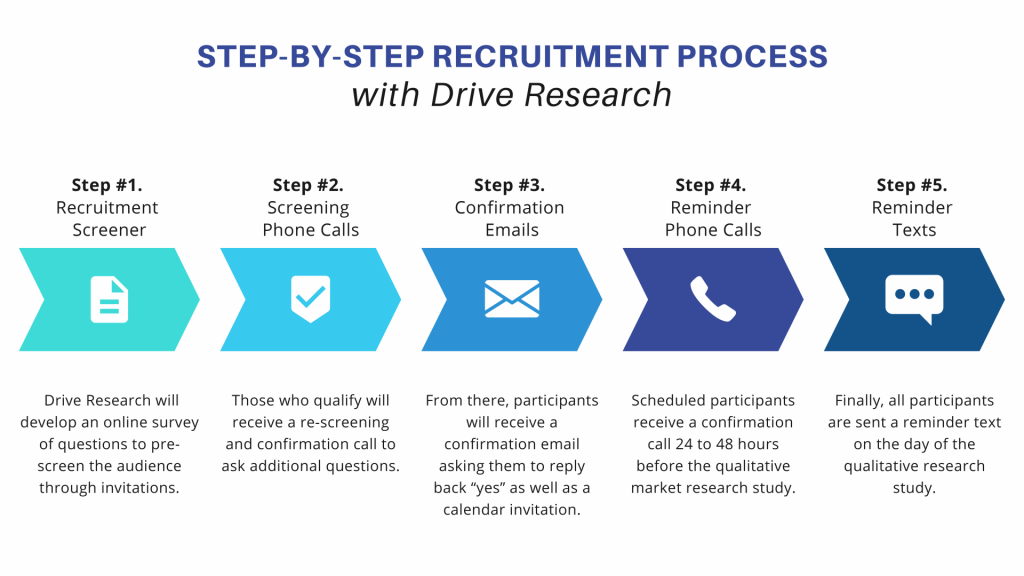
This stage is done best when it includes multiple communication touchpoints.
Our scheduled participants receive:
Confirmation email they have to reply to
Reminder call 24 to 48 hours out
Reminder text the day of the study
We also recommend assigning a single recruiter to a project from first outreach through the study date, reachable by phone, email, or text. Doing so gives participants one real point of contact instead of a support ticket.
If a participant’s link goes missing four minutes before an interview, they can text their recruiter and have it resent immediately rather than digging through a help center.
That kind of responsiveness is a big part of why our qualitative recruiting company lands show rates in the 90 to 100 percent range, even though the average across all projects is 95 percent.
How Long Does It Take to Recruit Participants for Qualitative Research?
Two to three weeks is a reasonable planning window for a standard recruit, from kickoff to a fully scheduled group.
That timeframe covers:
Building and testing the screener
Sourcing and screening a pool of candidates
Placing re-screening calls
Getting everyone confirmed and reminded before the study date
Research tip: If a hard deadline is likely, decide in advance which quota would get loosened first if it came down to it. That decision made calmly at kickoff almost always produces a better outcome than the same decision made under pressure three days before a facility date.
The alternative, holding every quota exactly as strictly as originally planned and hoping the timeline works out anyway, tends to end one of two ways:
Accepting participants who don’t quite fit
Running a group with six people instead of ten because the runway ran out.
Neither gives research that can be fully trusted. One of our healthcare recruits went from sign-off to final interview in eight days and still delivered a 100 percent show rate, largely because sourcing and screening ran in parallel instead of one after the other.
How Much Does Market Research Recruiting Cost?
Cost depends on a handful of specific factors, not a flat rate per participant. In general, we recommend earmarking 15% to 25% of a total qualitative research project budget.
Here are the more specific components that impact costs.
What drives the cost
Why
Audience specificity
A general population of adults in a metro area is far cheaper to recruit than a narrow professional or behavioral profile. B2B audiences in particular tend to cost more, since they’re less likely to participate without a stronger incentive.
Number of quotas
One or two demographic quotas is manageable. Stack five or six specific quotas (age, region, product ownership, income, a behavioral trait) onto one audience and the difficulty multiplies, even if each quota seems reasonable on its own.
Timeline
A typical recruit takes about two to three weeks. A one-week turnaround is possible, but usually means reprioritizing other work, which shows up in the estimate.
Study complexity
Recruiting for a single 20-minute interview is simpler than recruiting for a multi-phase study with a screener, a week-long diary, and a follow-up focus group. Each additional phase adds a drop-off risk that has to be planned for.
The factor that surprises people most is the incentive amount.
When a quote comes back higher than expected, the instinct is usually to cut market research incentives first. That’s almost always backwards.
A lower incentive means fewer willing participants, which means more time spent recruiting to hit the same number, which usually costs more in labor than the incentive would have cost in the first place.
If the budget is tight, it’s often better to relax a quota than to lower what participants are paid for their time.
Research tip: Before locking in quotas, sort them into “must-have” and “nice-to-have.” A recruiter can usually tell within a day which combination of criteria is going to strain the budget or the timeline, and that’s a much easier conversation to have before scope is finalized than after a quote comes back higher than expected.
Where to Source Participants for Qualitative Research
Most people who’ve run research before already know panels, social media, and customer lists exist as options. The more useful question is which source actually reaches your specific quota without wasting the budget getting there.
Source
Works best for
Why
Targeted social advertising
Fresh, unconditioned consumer audiences, zip code-level targeting
Reaches people who aren’t professional survey-takers and haven’t been conditioned to know how to answer screeners “correctly.” It also targets by demographics, interests, behaviors, and location, rather than relying only on self-reported panel profile data.
In-house and outsourced research panels
B2B audiences, healthcare professionals, clearly defined qualifications
A practical way to recruit against specific credentials when the audience requirements are well understood. Drive Research draws from 250-plus sample sources globally, including an in-house panel of more than 11 million U.S. members.
Grassroots outreach
Influencers, niche audiences, highly specific professional roles
Direct outreach, referrals, and trusted networks reach participants who are difficult to find through traditional recruiting sources alone.
Client or prospect lists
Existing customers, current or former clients, known contacts
Often the fastest and least expensive option when the audience already exists in a CRM, since it requires screening and scheduling rather than cold sourcing.
Most recruits work best with a custom mix rather than a single source.
For one 600-plus family recruitment project spanning seven major U.S. cities over eight weeks, that combination of sourcing depth and targeting made it possible for our team to coordinate 664 families across every market without leaning on a single panel source.
⚠️ One method worth avoiding: cold-calling a purchased list.
Roughly 80% of people don’t answer calls from unrecognized numbers. Gatekeepers exist specifically to screen out calls like this, and even when someone does pick up, they’re being asked to trust a brand they’ve had zero prior contact with, which makes skepticism the default reaction.
It rarely outperforms a well-targeted panel or social campaign for the time it takes.
Best Practices for Recruiting Qualified Participants
Here are a handful of habits we do that consistently separates a recruit that hits its numbers from one that falls short.
Screen on more than demographics
Targeting by profiling variables goes well past age, gender, and income.
On the consumer side, that includes purchase behaviors, brand and competitor usage, loyalty program membership, and customer journey stage.
On the B2B side, it includes job title, seniority, decision-making authority, budget responsibility, company revenue, and years of experience in a role.
That depth is what makes it possible to build a screener around the two or three qualifiers that actually matter to the research, instead of a screener that tries to filter for everything at once and ends up filtering out the whole pool.
Use a mix of sourcing channels instead of relying on one
A single source rarely covers a narrow audience well. Combining an in-house panel with targeted social advertising, or adding grassroots outreach on top of a panel search, usually surfaces a stronger pool than any one channel alone.
The sourcing comparison earlier in this guide breaks down which channel tends to fit which kind of audience.
What this looks like in practice:
A product design company once needed outdoor power equipment owners for a mobile ethnography study, and not just anyone who owns a leaf blower.
They needed people who’d bought new equipment from Lowe’s or Home Depot within the last five years, took care of their own lawn, and owned a chainsaw or leaf blower specifically.
Seventeen qualified participants were recruited against a goal of 12, using a mix of targeted social advertising and in-house panel outreach, since a generic screener wasn’t going to surface that audience efficiently on its own.
An underfilled session isn’t a smaller version of the same research.
If a focus group was supposed to have ten people and five show up, that’s a materially different conversation. Now it’s fewer perspectives and a moderator working with half the input they planned around. Not to mention with a facility booked and executives set aside to observe, it gets expensive and embarrassing fast.
A typical focus group show rate runs between 75 and 85 percent, which is why most firms recruit more people than the session actually needs.
The math is simple: Divide the seats needed by the expected show rate to get the recruit target. At an industry-typical 80 percent, filling eight seats means recruiting ten.
Mistakes to Avoid When Recruiting Participants
Someone once called me a “beggar with a clipboard” on an intercept project. Not exactly flattering, but not entirely wrong either, and it’s stuck with me because recruiting looks simple from the outside and rarely is.
Most bad recruits don’t come down to bad luck. They come down to a handful of habits, whether the recruiting is happening in-house or through a partner.
Waiting for participants to come to you
In this work, you’re a hunter, not a farmer. No matter how appealing the study is, participants don’t show up on their own, and a “no” isn’t a signal to back off, it’s just the norm.
Recruiting only pays off with active, repeated outreach: Following up on panel candidates who’ve gone quiet, pushing social campaigns that have stalled, re-approaching a source that isn’t responding.
Treating every rejection as a reason to slow down is one of the fastest ways to fall short of a quota.
Relying on automated, self-schedule recruiting
Automated platforms let participants log in, pick a time slot, and confirm without ever talking to a real person. It’s convenient upfront, but it also means the only touchpoint before the study is a click, not a conversation.
This makes it far easier for someone to lose track of a link, forget the project entirely, or need to reschedule at the last minute. There’s also no one listening in real time for an answer that sounds dishonest, exaggerated, or inconsistent with something said earlier, since there’s no live conversation happening at all.
A short live screening call trades a bit of convenience for the ability to actually catch those things before someone’s scheduled, not after they’ve already dropped off.
Placing a participant just to hit a quota
A bad participant is worse than no participant at all. It’s tempting, I get it. It’s easy to rationalize a borderline recruit when a quota is three people short and the deadline is close. But one disengaged or dishonest participant can throw off an entire session.
This is the same logic behind not placing anyone who hesitates on a re-screening call, covered earlier in this guide. When in doubt, leave them out, and solve the shortfall with sourcing or timeline instead.
Qualitative Recruiting FAQs
How long does it take to recruit participants for qualitative research? Plan on two to three weeks for a standard recruit. Faster turnarounds are possible, usually by loosening a quota or expanding the budget for broader sourcing.
How much does qualitative recruiting cost? It depends mainly on how specific the audience is, how many quotas need to be met, the timeline, and how many phases the study involves. B2B and highly niche consumer audiences generally cost more than general population recruits.
What’s a good incentive to offer participants? Enough that people don’t drop out mid-recruit once they realize what’s actually being asked of them. Cutting the incentive to save money on a project usually backfires, since low interest means more time and effort spent finding enough qualified people.
How do you verify B2B participants are who they say they are? Cross-checking company, work email, website listing, and LinkedIn profile against the role claimed on the screener, on top of the standard phone re-screen. That extra layer matters most for confidential or competitive studies, where recruiting the wrong person isn’t just a bad session, it’s a real risk.
What happens if a participant doesn’t show up? Building backup capacity into every recruit and keeping standby participants ready keeps a no-show from derailing the schedule. It’s also why live phone screening and multiple reminder touchpoints matter more than a single automated confirmation.
Recruiting well comes down to a handful of decisions: how specific the audience really needs to be, what to screen for beyond demographics, how much runway to build in, and how much discipline goes into confirming people before the study date. Get those right and the rest of the research has a real chance of holding up.
For help running that process, or a second set of eyes on a recruit already underway, our recruiting team is glad to help.
We analyze more than data—we also track how our site is used to improve your experience. Cookies help us understand what’s working so we can deliver the most relevant insights. Click “Accept” to enable full functionality.
Functional
Always active
The technical storage or access is strictly necessary for the legitimate purpose of enabling the use of a specific service explicitly requested by the subscriber or user, or for the sole purpose of carrying out the transmission of a communication over an electronic communications network.
Preferences
The technical storage or access is necessary for the legitimate purpose of storing preferences that are not requested by the subscriber or user.
Statistics
The technical storage or access that is used exclusively for statistical purposes.The technical storage or access that is used exclusively for anonymous statistical purposes. Without a subpoena, voluntary compliance on the part of your Internet Service Provider, or additional records from a third party, information stored or retrieved for this purpose alone cannot usually be used to identify you.
Marketing
The technical storage or access is required to create user profiles to send advertising, or to track the user on a website or across several websites for similar marketing purposes.