In today’s rapidly evolving business landscape, staying ahead of the competition requires more than just a great product or service. It demands a deep understanding of the market, consumer behavior, and emerging trends. This is where the market research process becomes invaluable. In this blog post, we will delve more into market research and explore...
There is never a wrong time to do market research. However, most research projects are birthed because a company or organization is at a crossroads. Whether you’re a startup or Fortune 500 company, you’ll have critical decisions to make. This blog will detail common market research examples and how our clients have used them to...
Product Usage Research: What It Is and How to Conduct It
Chris Coville
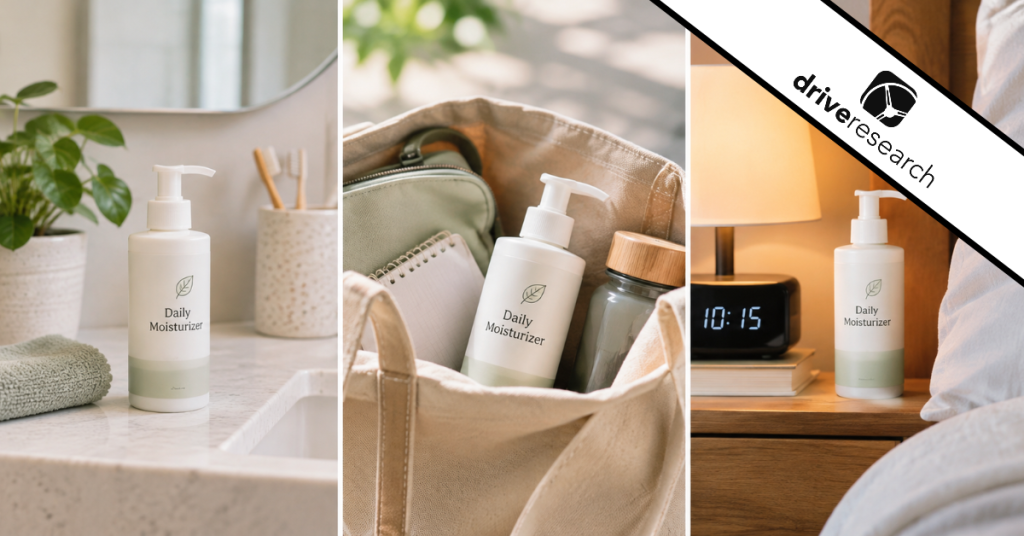
Product usage research in short: Product usage research reveals how customers interact with your product once it enters their homes and routines. Most studies pair an in-home usage test (IHUT) with interviews, diaries or surveys. Spotting hidden habits and friction points early helps teams make smarter updates before a launch or redesign.
We at Drive Research often find that the most important things brands learn about their products only become obvious once consumers start using them in real life.
A skincare product that is ditched after a week because it peels under makeup.
A household cooking appliance that can’t be plugged in alongside other kitchen essentials without causing problems.
An electronic device that requires too many buttons pushed to navigate to certain features.
Product usage research lets teams examine these interactions and see how people actually use their products.
This covers when and where people use the product, how often they reach for it, and which features make their lives easier. That evidence shows teams what to fix before a launch or redesign.
In this guide, we’ll cover the fundamentals of product usage research, including what it measures, how it’s different from product experience research, the methods behind it, and how to conduct a study from start to finish.
What Is Product Usage Research?
Product usage research is a type of market research that tracks how consumers actually interact with a product in their daily lives.
Rather than stopping at the point of purchase, it measures everyday habits, like how often people reach for the product, which features they rely on, and what friction points cause them to stop using it.
For example, a consumer may purchase a new skincare product with the intention of using it every morning and night. In reality, they may find that they’re only using it a few times a week, skipping it as a step, or have preferences for competing products due to issues like breakouts or tacky residue.
Day-to-day behavior reveals smaller details that even consumers themselves may not immediately recognize or think to mention. In this skincare example, researchers can see how a bad formula frustrates consumers and pushes them toward competing brands.
What Product Usage Research Measures
Product usage research measures four things: how often people use a product, the context they use it in, which features they adopt or avoid, and the barriers that get in the way.
Spotting these patterns early gives brands the opportunity to refine everything from instructions and packaging to features and the overall experience.
Here is a quick look at some common areas that are measured:
Areas of Product Usage
What It Can Reveal
Frequency of use
How often and consistently consumers use the product
Usage context and setting
The four W’s: where, when, why, and under what circumstances usage happens
Feature adoption and avoidance
Which features consumers regularly use, ignore, or abandon entirely
Usage barriers and pain points
Problems or frustrations that make the product difficult to use
Frequency of Use
Frequency measures how often a consumer uses a product over a specific period of time. Depending on the product, this could mean several times per day, once a week, or only on special occasions.
Tracking frequency reveals changes over time, especially when initial excitement fades. A product might see heavy use at first, then drop off once flaws disrupt routines or consumers realize it doesn’t hold up against competitors.
Usage Context and Setting
When and where a product is used matters just as much as how often it gets used. Usage research adds context to consumer behavior by examining the occasion, time of day, location, and whether other products or people are involved, often uncovering use cases a brand never considered.
Feature Adoption and Avoidance
For products with multiple features, usage research shows brands which tools customers love and which ones they avoid. Low adoption doesn’t mean a feature lacks value, though. People might simply not know it exists or how to fit it into their routine, giving brands a clear opportunity to improve onboarding and education.
Usage Barriers and Pain Points
Usage research can also reveal when a product becomes inefficient within a routine. This can be small moments where a feature feels confusing, or larger flaws that disrupt the whole routine.
Individual barriers might seem small at first, but over time they determine whether customers stick with a product or switch to a competitor.
Product Usage Research vs. Product Experience Research
While both methods evaluate how customers interact with a product, product usage research tracks actual behavior (what people do), whereas product experience research measures perception (how people feel about it).
Types of Research
Pros
Cons
Product Usage Research
Captures real life behaviors and usage patterns
Identifies adoption, frequency, and barriers
Uncovers gaps between intended and actual use
May not fully explain the emotions or perceptions behind a behavior
Some methods require longer observation periods
Product Experience Research
Provides deeper insight into satisfaction, perceptions, preferences, and expectations
Helps explain why consumers react positively or negatively
Self-reported feedback may not always match actual behavior
Provides less visibility into long-term use patterns
You rarely have to choose between the two. For example, product usage data might show that customers stop using a specific kitchen appliance feature after week one, while experience feedback reveals why, such as a confusing interface or lack of perceived value.
Common methods include in-home usage tests (IHUTs), in-depth interviews (IDIs), diary studies and usage logs, online surveys, and ethnographic observation.
Each method captures a different angle of how customers interact with a product in the real world:
In-Home Usage Tests
In-home usage tests (IHUTs) capture product usage by placing a product directly into consumers’ homes rather than a controlled testing facility. Testing in a natural environment over several days or weeks lets brands collect feedback across multiple stages of the consumer experience. Across 50+ IHUTs, our IHUT team has averaged a 95% completion rate.
Here is a recent case study showing how Drive Research used IHUTs to assess product usage:
Ahead of a product relaunch, a national online retailer needed to verify that its updated dishwasher pod formula resolved past residue and dissolving issues.
Drive Research conducted a blind IHUT with 125 households, prioritizing hard-water areas to measure cleaning performance, film, and handling across multiple wash cycles.
The findings confirmed strong core cleaning performance and highlighted exact consumer phrasing to feature in relaunch ads.
We run product usage studies in real homes. Let's plan yours.
In-depth interviews (IDIs) are one-on-one conversations that explore individual product habits and the motivations behind them.
Because researchers can ask follow-up questions in real time, IDIs pair especially well with behavioral or quantitative studies to explain why consumers act a certain way.
For example, an electronics brand might use an IDI to follow up after an IHUT to better understand why users relied on certain device features every day while abandoning others completely.
Diary Studies and Usage Logs
Diary studies and usage logs ask participants to document their product interactions over a set period.
Recording feedback while the experience is still fresh helps researchers spot usage frequency, occasions, and habit shifts that are easy to miss in a one-time survey.
A two-week study for a fitness app might ask participants to log what time of day they use the app, which other items they reach for during use, and how their exercise routine changes over time.
Online surveys collect structured usage feedback from a larger sample size, making it easy to compare behaviors like frequency, barriers, and preferences across different consumer groups. Including open-ended questions adds helpful context behind the numbers.
A beverage company might run an online survey to measure how often customers buy a drink, where they usually consume it, and which flavors drive repeat purchases.
Ethnographic Observation
Ethnographic observation involves watching consumers use a product in their natural environment to see their interactions firsthand. Observing real-time behavior uncovers subtle habits, workarounds, and pain points that people rarely think to mention in an interview.
When watching consumers prepare meals at home, researchers might notice that awkward packaging or confusing cooking instructions slow them down, even if participants never bring it up themselves.
How to Conduct a Product Usage Study
To run a product usage study, teams set clear goals, pick the right research method, find qualified users, track how people use the product over time, and turn those habits into product updates.
At Drive Research, we handle the entire process from start to finish, including finding participants, shipping products, and checking in with users, so your team gets honest feedback.
1. Define the research objectives
Start by deciding what product decision this study needs to answer, like testing a new recipe, fixing confusing setup steps, or figuring out why repeat sales are dropping. Knowing your exact goal from day one keeps the study focused so every question leads to a clear product fix.
2. Pick the right method
Choose a research method that matches what you need to see in action rather than defaulting to a basic survey. For instance, sending a product to people’s homes for an IHUT and following up with one-on-one interviews lets you see any challenges first and then ask why they happened.
3. Recruit target users
Look for participants based on their actual shopping and product habits, not just their age or location. At Drive Research, we combine online screeners with live re-screening phone calls and build in backup participants to protect your study and timeline against drop-offs.
Look for participants based on their actual shopping and product habits, not just their age or location.
For our market research firm, every recruit passes an online screener and a live phone rescreen, and we build in backups to protect your timeline against drop-offs. For an IHUT, we typically recruit 120 to 125 participants per product to make sure about 100 complete the test.
On every rescreen call, we ask open-ended questions like ‘What size trash bags do you buy?’ instead of giving people a list to pick from. Someone who actually buys the product answers right away. Someone guessing their way into a study can’t.
Ashley Reynolds
Director of Qualitative Services
4. Collect usage data
Collect feedback over a timeframe that matches how the product is normally used, whether that is a few days for a snack or a few weeks for skincare. Quick check-ins during the test capture small frustrations right as they happen, rather than relying on what people remember weeks later. For most IHUT-based usage studies, that adds up to 6 to 8 weeks from kickoff to final report.
5. Analyze and apply findings
Look beyond general satisfaction scores to spot when people stop using the product, where they get stuck, or which features they ignore. The best next steps separate quick fixes, like rewriting confusing instructions, from bigger changes to the product itself.
Work With Our Product Usage Research Company
Drive Research helps brands test how products perform in everyday life, from screening the right users to shipping products and checking in during the test. Our own team handles kitting, blinding and shipping, tracks every delivery and follows up the same week if a participant hasn’t started testing.
If a launch or product update is coming up, let’s talk about what you need to learn from real users.
Real-World Product Testing: What It Is and Why It Matters
Blog Posts
Explaining In-Home Interviews in Market Research
Case Studies
Incontinence Products In-Home Usage Test Case Study
When You Give Us A Cookie
We analyze more than data—we also track how our site is used to improve your experience. Cookies help us understand what’s working so we can deliver the most relevant insights. Click “Accept” to enable full functionality.
Functional
Always active
The technical storage or access is strictly necessary for the legitimate purpose of enabling the use of a specific service explicitly requested by the subscriber or user, or for the sole purpose of carrying out the transmission of a communication over an electronic communications network.
Preferences
The technical storage or access is necessary for the legitimate purpose of storing preferences that are not requested by the subscriber or user.
Statistics
The technical storage or access that is used exclusively for statistical purposes.The technical storage or access that is used exclusively for anonymous statistical purposes. Without a subpoena, voluntary compliance on the part of your Internet Service Provider, or additional records from a third party, information stored or retrieved for this purpose alone cannot usually be used to identify you.
Marketing
The technical storage or access is required to create user profiles to send advertising, or to track the user on a website or across several websites for similar marketing purposes.