In today’s rapidly evolving business landscape, staying ahead of the competition requires more than just a great product or service. It demands a deep understanding of the market, consumer behavior, and emerging trends. This is where the market research process becomes invaluable. In this blog post, we will delve more into market research and explore...
There is never a wrong time to do market research. However, most research projects are birthed because a company or organization is at a crossroads. Whether you’re a startup or Fortune 500 company, you’ll have critical decisions to make. This blog will detail common market research examples and how our clients have used them to...
How CPG Brands Can Optimize Their Customer Journey
Austin Parker
In summary: Optimizing the CPG customer journey means using ongoing research to understand and improve every stage a shopper moves through: awareness, consideration, purchase, loyalty, and advocacy. Because CPG decisions are fast, habitual, and easy to switch, sales data alone cannot tell you why consumers buy or leave. The strongest programs combine surveys, tracking studies, shelf testing, qualitative research, and advanced analytics to map the journey across in-store, online, and omnichannel touchpoints, then track how it shifts over time.
The CPG customer journey is the full path a shopper takes from first discovering a product to buying it repeatedly and, ideally, recommending it to others. What makes it different from almost every other industry is speed.
Decisions happen fast, often on autopilot, and with very low switching costs. Shoppers reach for the familiar option until something disrupts the habit, and then they stop reaching for yours.
What separates the brands that catch that shift early from the ones that read about it in a quarterly sales report is simple: research.
Specifically, structured, ongoing research that maps how consumers discover, evaluate, buy, and stay loyal to consumer goods products, and flags the moments that push them toward a competitor.
This guide walks through how to do that, stage by stage. We will cover:
Why sales data alone will mislead you
The research methods that give you the clearest read at each stage
How often you should be running this kind of study
At Drive Research, we have run CPG market research for food and beverage brands, dairy companies, beverage manufacturers, produce companies, and retailers nationwide. The patterns in this guide come straight out of that work.
Ready to map your customer journey? Contact Drive Research to discuss a custom research study.
The CPG customer journey is the path a consumer takes from first becoming aware of a product to making a repeat purchase and potentially becoming a brand advocate. Customer journey mapping is the process of consolidating all touchpoints and interactions a shopper has with your brand into a single, clear path to purchase.
For consumer brands, that path looks different than it does almost anywhere else. A shopper is making a split-second decision at the shelf or scrolling past your product online, usually without much conscious thought.
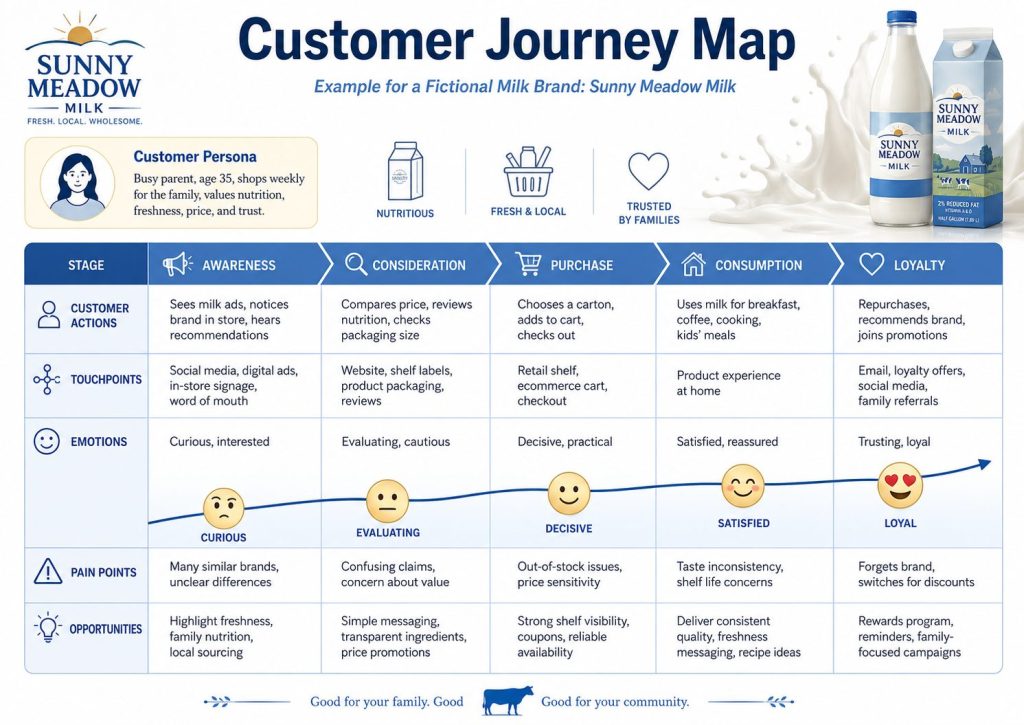
Example customer journey map for a milk brand
Why CPG Journeys Are Different
Unlike high-consideration categories, CPG journeys are typically short, habitual, and low-involvement, but they can be disrupted at any point.
Factors like competitive promotions, out-of-stocks, price changes, or shifting preferences can affect a brand’s customer journey.
That disruption is exactly why research is so important. Journey mapping helps organizations understand the entire customer experience, including every touchpoint along the way and points often missed by quantitative surveys alone.
Unlike high-consideration categories, CPG journeys are typically short, habitual, and low-involvement, but they can be disrupted at any point. A competitor promotion, an out-of-stock, a price increase, or a shift in preferences can break the habit in a single trip.
That fragility is exactly why research matters.
Journey mapping captures the full experience, including the touchpoints that quantitative sales data often overlooks.
It also does something useful inside your own organization. When marketing, product, and sales each hold a different picture of the consumer, a shared journey map aligns them around a single view of how people actually buy.
The Journey Is Now Omnichannel
The modern CPG journey almost never happens through a single channel. A shopper might discover a product on social media, read reviews in a retailer’s app, and then buy it in a physical store three weeks later.
This blend of physical and digital, sometimes called “phygital,” is the central challenge of mapping a CPG journey today.
The in-store shelf and the online product page are two halves of the same decision.
Research has to account for both, and we will come back to how to measure each one in the purchase stage.
Why Sales Data Alone Will Mislead You
There is a real gap between what consumers say and what they do. A shopper might tell you price is not a major factor, and then their purchase data shows volume dropping every time the price ticks up.
Sales data tells you what happened. It does not tell you why.
The most effective CPG journey research pairs what consumers report with what their behavior actually shows.
The Key Takeaway: The CPG customer journey is fast, habitual, and easy to disrupt, and it now spans in-store, online, and omnichannel touchpoints. Sales data shows you what happened; research shows you why.
Stages of the CPG Customer Journey
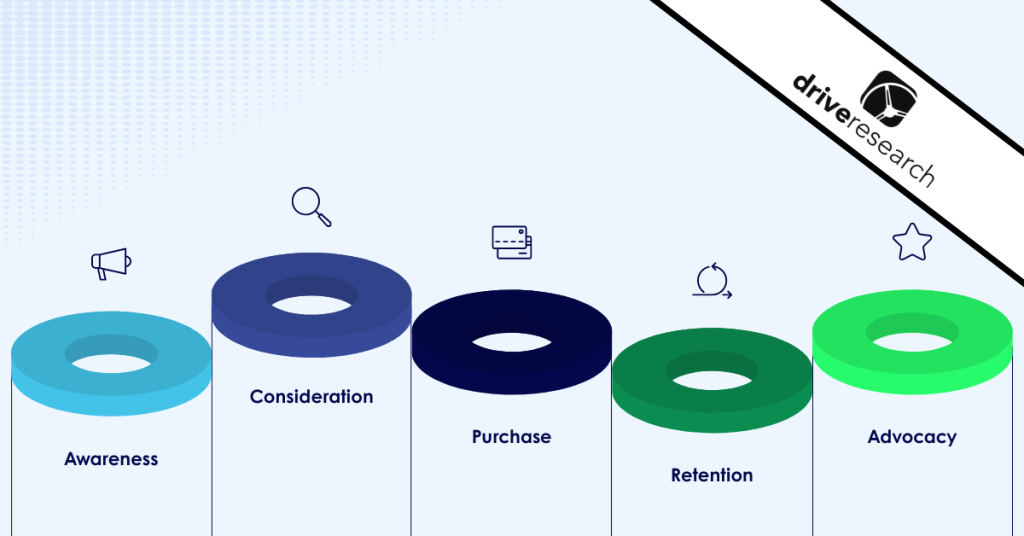
The CPG journey is not a straight line. Most frameworks draw it as a funnel from awareness to purchase, but that misses what makes this sector different.
Here it works more like a loop.
Consumers discover a product, try it, decide whether to keep buying it, and then either settle into a habit or drift away. The loop can break at any point, and knowing where your consumers sit in it is the foundation of smarter marketing and higher retention.
Stage 1: Awareness and Discovery
Consumers can not buy what they do not know exists. Discovery happens across a wide mix of touchpoints, and that mix shifts a lot by category.
Social media and TV dominate discovery in beauty, food and beverage, and OTC health, but the platform that matters most depends heavily on who you are trying to reach.
At this stage, the question is simple: do your target consumers even know you exist?
It measures unaided and aided awareness, word associations, competitive awareness, and initial perceptions, giving you a baseline to measure against as your marketing evolves.
Stage 2: Consideration and Research
Once a consumer is aware of a product, they shift into evaluation mode, though in CPG that process is often compressed or even subconscious. Reviews tend to be the most influential element on a product page, followed by ratings, photos, and comparisons. People want social proof, and they want to see the product in action, especially in sensory categories like beauty.
The practical question for brands is how to measure that influence. We usually build it into awareness and consideration surveys: where did you first hear about this product, which sources did you trust, and did a creator or review actually change your mind? That turns “influencers matter” into something you can quantify and act on.
Stage 3: Purchase Decision
This is where the shelf wins or loses, and for brands selling through retail, the moment is largely out of your control unless you have researched it.
Placement matters. Most shoppers treat the middle shelf, closest to eye level, as the premium position. But placement is only part of it. Packaging design, shelf presence, price, and promotional signage all feed the split-second choice a shopper makes.
Online, the equivalent is the product detail page: the title, images, number of reviews, and the buy box determine conversion just as much as organic traffic does. And because most journeys are now omnichannel, the purchase stage has to be measured in both places at once.
This is where in-home usage tests (IHUTs) and online surveys earn their keep. IHUTs put the product in a real consumer’s hands and home to capture genuine in-context use, while online surveys and simulated shelf tests measure how packaging and price perform on the digital shelf. Together they cover both halves of the phygital decision.
How Research Helped Refine the Purchase Decision Step For Trail Mix Brand
We conducted a study for a brand that wanted to launch new packaging for their trail mix. The goal was to improve the packaging design to maximize purchases in-store.
We tested four package designs in two formats: a clear plastic tub and a stand-up resealable pouch, across trail mix and dried fruit.
The market research study addressed the following objective:
Which packaging format and design delivered best to consumers?
What positioning or tagline was the most compelling and relevant?
How does the brand’s private label differentiate itself from the competition?
The results showed a clear winner:
Key Takeaway
Details
The best-performing client SUP (Stand-Up Pouch) package was SUP 4, followed by SUP 1.
SUP 4 tied for first in the MaxDiff analysis among the 4 client packages and was the best-performing tested package in the competitive shelf-set comparison using MaxDiff.
Although the stand-up-pouch was predominantly preferred by buyers over tubs, the best-performing client tub was Tub 4.
Client Tub 4 performed the best in the MaxDiff analysis among the 4 client tub packages. It performed second best to Mariani in the competitive shelf-set MaxDiff analysis.
Although the stand-up pouch was predominantly preferred by buyers over tubs, the best-performing client tub was Tub 4.
Taste/flavor, high quality, value for the money, and the ability to see the product appealed to 99% of respondents. This means at least one of those factors resonated with nearly all buyers. Featuring only taste/flavor and high quality resonates with 93% of the buyers.
More likely to purchase if it supports environmental causes.
Supporting environmental causes was not a top factor in buyers’ consideration sets compared with taste/flavor, high quality, etc. However, when probed, it is a secondary influencer and presents an opportunity to differentiate from the competition.
Stage 4: Post-Purchase and Loyalty
The purchase is not the end of the journey. It is where the cycle restarts or continues. In CPG, repurchase rates and brand loyalty are the metrics that actually drive business value. According to McKinsey, in advanced markets, more than a third of consumers have tried different brands, and roughly 40% have switched retailers chasing better prices.
That is the reality of CPG loyalty.
Most shoppers are not deeply committed, and switching is easy. Real loyalty shows up as habitual repurchase: the shopper who insists on your product even when a substitute is cheaper, closer, or on promotion.
Building it means understanding the rational and emotional factors that bring people back, and the early warning signs that predict churn.
Post-purchase research usually combines NPS and CSAT to track satisfaction and advocacy, loyalty-tracking studies to monitor repeat-purchase intent over time, and qualitative work like focus groups, in-depth interviews, and mobile diaries to get at the emotional connection.
The goal is to catch drifting consumers before they switch to another brand (not after they switch).
Stage 5 – Advocacy and Brand Ambassadors
Loyalty is not the last stage. Your best customers do not just repurchase, they recommend. In a category where word-of-mouth and social proof shape decisions at every stage, advocacy is a growth engine with no direct media cost.
Advocacy is where your NPS promoters become measurable. Research tracks who they are, what turned them into advocates, and how their recommendations spread through reviews, social sharing, and referrals.
A high concentration of promoters also strengthens your hand with retailers, because it signals the sales velocity buyers want on the shelf.
The practical move is to tie advocacy metrics back to the rest of the journey: which discovery channels, packaging decisions, or post-purchase experiences actually create advocates. That closes the loop and tells you where to invest to make more of them.
The Key Takeaway: The CPG journey is a loop of five stages: awareness, consideration, purchase, loyalty, and advocacy. The most underinvested stages are the last two, and they tend to deliver the highest research ROI.
Key Metrics to Track When Doing CPG Customer Journey Research
Mapping the journey is only useful if you are tracking the right metrics at each stage. Three do the heaviest lifting in CPG.
Brand Awareness and Perception
This measures whether consumers know you exist (brand awareness) and what they associate with you when prompted.
You cannot convert someone who has never heard of you, and someone who knows you for the wrong reasons is just as hard to win.
Brand equity surveys set your baseline and track how marketing moves it. Run one at least annually, and include NPS for your brand and key competitors in the same study for a richer read.
Net Promoter Score (NPS) for CPG
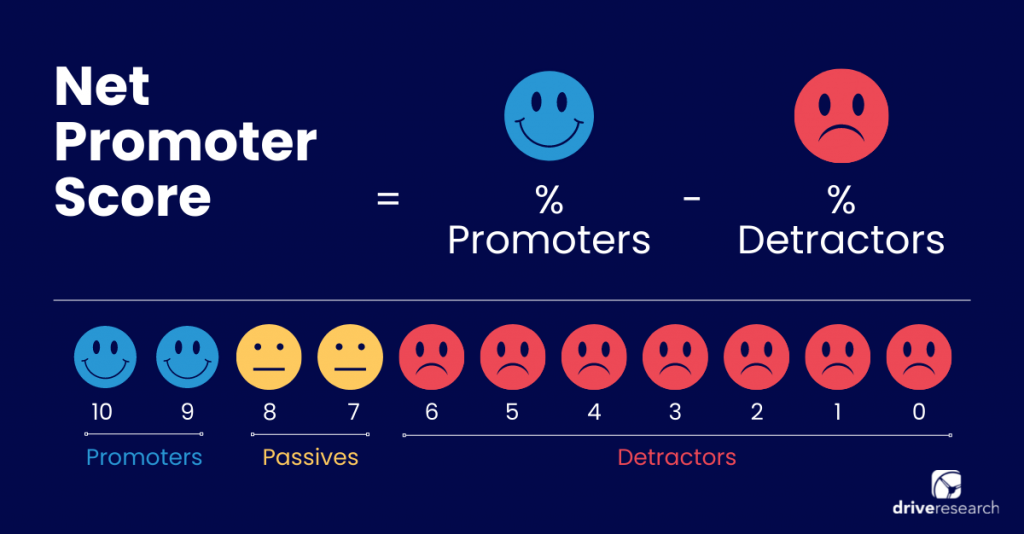
NPS for CPG brands is a 0 to 10 likelihood-to-recommend scale that divides consumers into Promoters (9–10), Passives (7–8), and Detractors (0–6).
Your NPS is the percentage of Promoters minus the percentage of Detractors, ranging from -100 to +100.
In a word-of-mouth-driven category, NPS tells you whether buyers are actively advocating for you, and a strong score gives you leverage in retailer negotiations.
Useful resourcesand tips For category context, see our CPG NPS benchmarks. And whatever you do, always pair the NPS question with an open-ended “why.” The score tells you where you stand and the follow-up tells you what to fix.
Customer Satisfaction (CSAT)
CSAT measures satisfaction at specific touchpoints, such as after using the product, interacting with the brand online, or contacting customer service. Where NPS is a broader loyalty metric, CSAT zooms in on individual moments.
Here is the catch worth remembering.
A consumer can be perfectly satisfied with one purchase and still grab a competitor’s deal next time.
That is why we always pair CSAT with behavioral metrics rather than treating it as a loyalty guarantee.
Research Methods for Customer Journey Mapping
Customer journey mapping is only as useful as the research methods behind it. Different stages of the journey require different methodologies, and the most complete picture comes from combining them.
Stage
Key question
Best research methods
What you get
Awareness
Do consumers know we exist?
Brand equity survey
Awareness baseline and competitive benchmark
Consideration
How do they evaluate us vs. competitors?
Surveys, mobile ethnography
Decision drivers and trusted sources
Purchase
What wins at the shelf and online?
Shelf testing, IHUTs, online surveys
Packaging, price, and placement that lift conversion
Loyalty
Will they buy again, and why?
Tracking surveys, NPS and CSAT
Repurchase drivers and churn warning signs
Advocacy
Who recommends us, and how?
NPS, segmentation
Promoter profile and word-of-mouth growth levers
Surveys
Surveys are the foundation of any CPG journey research program.
They are scalable, quantifiable, and when designed well, they tell you exactly how consumers think and feel at each stage of the funnel.
For customer journey work, we typically deploy surveys at two moments:
Pre-purchase surveys to understand discovery channels, consideration factors, and purchase drivers, capturing the attitudes that lead to a buy decision.
Post-purchase surveys to measure satisfaction, identify friction points, and track likelihood to repurchase, capturing the experience that determines whether the loop continues.
A well-designed CPG survey uses a mix of closed-ended questions (for benchmarking and trend analysis) and open-ended questions (to surface the nuance behind the numbers).
We always recommend pairing a satisfaction rating with an open-ended follow-up: “What’s the primary reason for your score?” because the qualitative response is often where the most actionable findings live.
Tracking Surveys
A one-time survey gives you a snapshot. A tracking survey gives you a trend line — and in CPG, the trend is often the most important finding.
Tracking studies run the same core questionnaire at regular intervals (typically quarterly or biannually) with a fresh representative sample each wave. Because the questions remain consistent, you can measure how metrics such as NPS, brand awareness, purchase intent, and CSAT change over time in response to marketing activity, competitive pressure, pricing changes, or product launches.
For CPG brands, tracking surveys are particularly valuable because:
Seasonal purchase patterns make point-in-time data misleading. You need multiple waves to understand baseline versus seasonal lift
Competitive launches and promotions can shift brand preference quickly, tracking catches these shifts early
Campaign effectiveness is nearly impossible to assess without a pre- and post-wave to measure movement
In our work with CPG clients, we often see that the second or third wave of a tracking study is where the real strategic value kicks in. That’s when the trend data starts to tell a story that a single survey never could.
Mobile Ethnography
Mobile ethnography is a qualitative research method in which participants use their smartphones to capture video, photos, and audio of their real-time shopping experience (in-store or online).
Rather than asking consumers to recall their experience after the fact, mobile ethnography captures the path-to-purchase moment as it actually happens.
For CPG brands, this is especially useful at the consideration and purchase stages, where the gap between what consumers say in surveys and what they actually do at the shelf is often wide.
We’ve used mobile ethnography with clients to uncover path-to-purchase behaviors that completely reframed how they thought about shelf presence and promotional strategy.
It’s most powerful when combined with a follow-up quantitative survey. The ethnography generates the hypotheses, and the survey tests them at scale.
Watch the video below to learn more about the benefits of conducting a mobile ethnography study.
Shelf Testing
Shelf testing, also called shelf placement research or simulated shelf studies, gives CPG brands a research-backed read on how their product performs in a competitive retail context before committing to packaging changes, new SKUs, or distribution decisions.
In a shelf testing study, the idea is to present respondents with a simulated shelf set, either digitally rendered or physically constructed, that replicates the actual retail environment.
Key metrics (under real shelf conditions) to measure are:
Purchase likelihood
Brand noticeability
Packaging appeal
Performance vs competitors
This type of research is especially valuable before a packaging redesign, a new product launch, or when a brand is negotiating for better shelf positioning with a retail partner.
It gives you quantitative evidence of what works and what doesn’t, before you invest in production runs or retail placement fees.
Consumer Segmentation
Not all CPG consumers are the same, and treating them as one audience produces messaging that resonates with no one. Segmentation divides your buyer base into distinct groups by attitudes, behaviors, needs, and demographics so you can prioritize the segments that matter most.
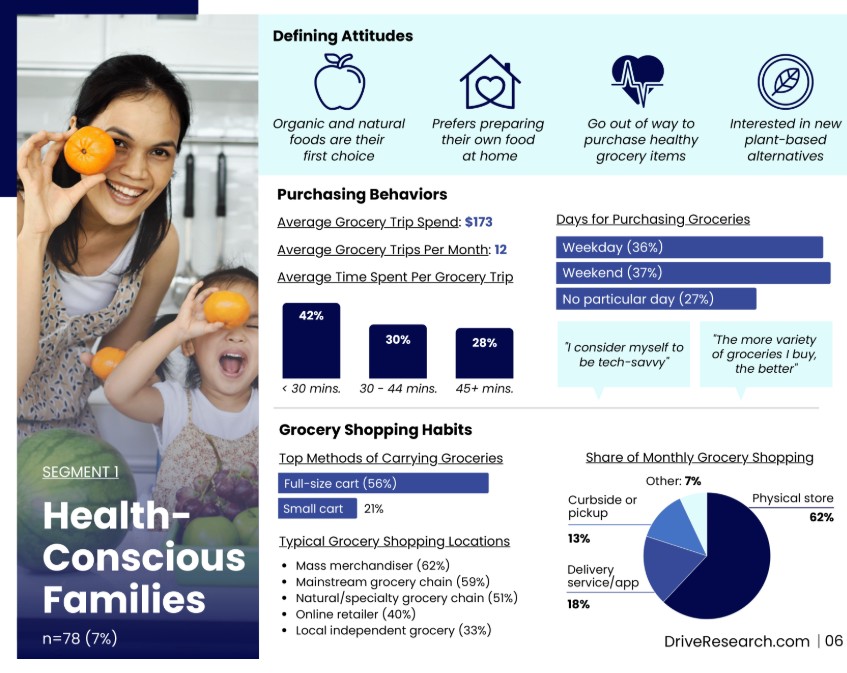
Take for example our shopper segment we created after surveying 1,000+ grocery shoppers. This segment has clear cut differences from the other 6 that derived from the research. You can learn more by downloading our State of Grocery Shopping Report.
For journey mapping specifically, segmentation answers a critical question: does the journey look the same for your loyalists as it does for occasional or lapsed buyers? In our experience, it almost never does. Heavy buyers discover the brand differently, weigh different factors at the shelf, and respond to different retention triggers than light or trial buyers.
Advanced Analytics
Once you have a solid foundation of survey data and behavioral tracking, advanced analytics allow you to go beyond “what is happening” to “why it is happening” and “what should we do about it.”
We often recommend these three techniques as they are particularly powerful for consumer packaged goods brands:
MaxDiff is a choice-based survey technique that identifies the true order of importance for product features, brand attributes, or marketing messages. Rather than rating everything as “very important” (which most consumers do when asked directly), MaxDiff forces trade-offs that reveal what consumers genuinely value most. This is particularly useful for prioritizing packaging claims, ranking potential new product features, and identifying which brand attributes drive the most loyalty.
Conjoint analysis takes the trade-off logic further by simulating real purchase scenarios. Respondents see multiple product configurations (different combinations of price, format, flavor, size, or claims) and select their preferences. The output tells you precisely how much each attribute contributes to the purchase decision and what combination maximizes purchase intent. These insights are critical for pricing strategy and new product development.
Regression analysis identifies which factors are the strongest statistical predictors of a key outcome, such as repurchase intent. This surfaces the unstated drivers that explain behavior better than anything consumers report directly. In a CPG loyalty study, regression might reveal that perceived product quality and packaging trust predict repurchase far more strongly than price (even among consumers who say price is their top concern). That kind of finding completely reframes where a brand should invest.
Where AI and Machine Learning Fit
AI has become genuinely useful in CPG journey research, and we use it ourselves. Machine learning models can predict churn by flagging the behavioral patterns that tend to precede a switch, and natural language processing can run real-time sentiment analysis across thousands of reviews and social posts to catch a perception problem while it is still small.
What AI does not do is replace the primary research that feeds it. A model can tell you a segment is likely to churn; it cannot tell you why, or what message would win them back. The brands getting the most out of AI treat it as a layer on top of solid survey and behavioral data, not a substitute for asking real consumers real questions.
⚠️ One number to protect: sample size. It is tempting to slice journey data into smaller and smaller subgroups, but a finding is only reliable if the subgroup behind it is large enough. If you plan to analyze competitor users, a specific demographic, or non-buyers separately, you need a full sample for each group, not a handful of responses carved out of the total.
Reveal where shoppers drop off and what drives repeat purchases with a custom research study.
How Often Should CPG Brands Research The Company Journey?
One of the most common questions we hear from CPG brand teams is: How often do we actually need to conduct CPG customer journey research?
The honest answer is: it depends on your category, your competitive environment, and your business stage. We use a practical framework with our clients.
Cadence
Best for
Monthly / Ongoing
New product launches, major price changes, high competitive pressure
Quarterly
Most active CPG categories — tracks NPS, CSAT, purchase intent, churn signals
Annually
Full brand equity study, competitive benchmarking, deep segmentation refresh
Quarterly Tracking
For brands in highly competitive categories (such as food and beverage, personal care, beauty, retail, and more), quarterly pulse surveys are the right cadence. Quarterly tracking gives you visibility into:
Seasonal shifts in purchase behavior and brand preference
The impact of media campaigns and promotional activity
Competitive response and new product launches
Early warning signs of churn before they hit the sales report
Quarterly studies do not need to be large.
A focused pulse survey of 400 completed responses (our recommended minimum for statistically significant results at a ±5% margin of error) is enough to track NPS, satisfaction, and key behavioral indicators across your core segment.
Annual Tracking
Most CPG brands also benefit from a single comprehensive study per year that combines quantitative and qualitative components:
A full brand equity survey with competitive NPS benchmarks
A segmentation refresh if your consumer base has shifted
Qualitative research (focus groups or in-depth interviews) to understand the drivers behind what the numbers show
Shelf testing or packaging evaluation if new products are in development
This annual study resets your benchmark and provides your team with the strategic context to interpret quarterly data accurately throughout the year.
For Launches and Pivots
New product launches, significant price changes, major packaging redesigns, and aggressive competitive activity all warrant more intensive research.
In these situations, monthly pulse surveys can capture real-time consumer response as the market absorbs the change.
The worst thing a CPG brand can do is make a significant product or pricing decision, then wait six months to see what happens. Research should be running before, during, and after high-stakes changes.
Useful tip: If budget is the constraint, start with an annual study and add quarterly pulse surveys as the value compounds. The trend data that builds over time, watching NPS or purchase intent move across waves, is where the strategic insight really lives.
Frequently Asked Questions About CPG Customer Journey Research
What is the most important stage of the CPG customer journey to research?
All stages matter, but the post-purchase and loyalty stage is where most brands underinvest. Brands tend to spend heavily on awareness and acquisition research while undertracking what happens after the first purchase. Given that retaining an existing customer is almost always cheaper than acquiring a new one, understanding what drives repeat purchase (and what causes churn) delivers some of the highest ROI of any CPG research investment.
What sample size do I need for CPG customer journey research?
We typically recommend a minimum of 400 completed responses to achieve statistically significant results at a 95% confidence interval and a ±5% margin of error. If you want to analyze distinct subgroups (competitor users, a specific demographic segment, or non-buyers), you need 400 responses per group. Under-sampling a key segment leads to unreliable results that cannot support confident decisions.
How is CPG customer journey research different from a standard consumer survey?
A standard consumer survey is usually a single snapshot of attitudes. Journey research maps the full path across stages and channels, combines multiple methods (surveys, qualitative, behavioral, and analytics), and often tracks over time. It is built to show not just what consumers think, but where and why their behavior changes from discovery through advocacy.
How often should CPG brands run customer journey research?
It depends on your category and stage, but most active CPG brands land on quarterly pulse tracking plus one deeper annual study, with monthly research around launches or major changes. See the cadence framework above for the full breakdown.
Can AI replace CPG customer journey research?
Not yet, and probably not for any question that depends on why consumers behave the way they do. AI is excellent for predicting churn, analyzing sentiment at scale, and speeding up analysis, but it works from data that primary research generates. For decisions that hinge on understanding real consumers, surveys, qualitative work, and analytics still do the heavy lifting, with AI layered on top.
At Drive Research, we are a full-service CPG market research company specializing in customer journey research. We design and execute custom customer-journey research and deliver findings in clear, actionable reports your team can use.
We work with CPG brands of all sizes, from emerging food and beverage companies to established consumer goods brands with national distribution. Every study we conduct is tailored to your specific goals, your target audience, and your decision timeline.
We analyze more than data—we also track how our site is used to improve your experience. Cookies help us understand what’s working so we can deliver the most relevant insights. Click “Accept” to enable full functionality.
Functional
Always active
The technical storage or access is strictly necessary for the legitimate purpose of enabling the use of a specific service explicitly requested by the subscriber or user, or for the sole purpose of carrying out the transmission of a communication over an electronic communications network.
Preferences
The technical storage or access is necessary for the legitimate purpose of storing preferences that are not requested by the subscriber or user.
Statistics
The technical storage or access that is used exclusively for statistical purposes.The technical storage or access that is used exclusively for anonymous statistical purposes. Without a subpoena, voluntary compliance on the part of your Internet Service Provider, or additional records from a third party, information stored or retrieved for this purpose alone cannot usually be used to identify you.
Marketing
The technical storage or access is required to create user profiles to send advertising, or to track the user on a website or across several websites for similar marketing purposes.