In today’s rapidly evolving business landscape, staying ahead of the competition requires more than just a great product or service. It demands a deep understanding of the market, consumer behavior, and emerging trends. This is where the market research process becomes invaluable. In this blog post, we will delve more into market research and explore...
There is never a wrong time to do market research. However, most research projects are birthed because a company or organization is at a crossroads. Whether you’re a startup or Fortune 500 company, you’ll have critical decisions to make. This blog will detail common market research examples and how our clients have used them to...
Product Optimization Research: How Brands Lock in Features, Pricing & Performance
Chris Coville
In short: A product optimization study uses consumer research to decide a product’s final feature set, price, and real-world performance before launch or relaunch. Most combine a trade-off method like conjoint analysis, a pricing model like Van Westendorp, and an in-home usage test. Concept testing tells you whether to build a product; optimization tells you how to build it.
You’ve probably heard that 95% of new products fail, a figure often attributed to Harvard Business School professor Clayton Christensen. The exact number is debated, but the pattern behind it isn’t: teams commit to features and a price before they’ve heard from buyers.
We see the same thing in our own optimization work. Features, pricing, and packaging are usually chosen by the people who built the product, and buyers see those choices for the first time at launch.
In our experience, a slow launch or underwhelming sales usually signal one thing: consumer feedback wasn’t built into the development process early enough.
By combining buyer feedback with real-world testing, product optimization research helps you settle the feature set, price, and performance before you invest in manufacturing or marketing. Below, we cover the methods behind each decision, the five steps we follow, and when concept testing is the better choice.
What Is a Product Optimization Study?
A product optimization study is a research method that uses consumer feedback to identify the ideal combination of features, price, and performance for a product.
Here’s a simple example of product optimization market research:
A beverage brand narrowing down new flavors could test flavor preference, price, and at-home use with target shoppers before a national grocery rollout.
If buyers will only pay about $1 less than the planned price and struggle to open the bottle, the brand can fix both before production.
Both fixes cost far less before production than after customers find the problems.
Why Product Optimization Research Matters
Product optimization research matters because the people who build a product are too close to it to judge what buyers will value or pay, and those blind spots get expensive after launch.
Here’s what we’ve seen in our own studies.
Consumer Preferences Are Not Always What Internal Teams Assume
Internal teams live with a product for months or years before it reaches a single customer. While that closeness is useful, it also creates major blind spots.
A team might pour time into a complex feature that shoppers find confusing, or settle on a price that feels fair internally but is higher than buyers will actually pay.
Product optimization research replaces internal assumptions with direct feedback from buyers before final decisions are made.
Optimization Before Launch Costs Far Less Than Fixing It After
Research from LA NPDT shows that testing your product, pricing, and strategy early costs a fraction of fixing a mistake after launch.
Changing a product post-launch involves significant rework, such as adjusting already scaled-up production processes, changing the product packaging, adjusting marketing and communication strategies, or asking sales teams to explain why the product is suddenly different to consumers.
Optimization Data Aligns Product, Marketing, and Pricing Decisions
Product, marketing, and pricing teams don’t always align on priorities. A product team might want more features, while marketing wants a clear story, and pricing wants higher margins.
Instead of assuming which attributes are most valuable, product optimization research gives every stakeholder the same buyer data, gathered by a third party with no stake in whose idea wins.
Which Research Methods Are Used in a Product Optimization Study?
Most product optimization studies combine a trade-off method to prioritize features, a pricing model to set the price range, and an in-home usage test to check real-world performance. Brands often run all of them in a single study. The table below summarizes each method, and the sections that follow explain when we use it.
Method
What It Measures
Conjoint Analysis
How much each feature and price point contributes to a purchase decision
MaxDiff Analysis
Ranks the most and least important items from a set of features or claims, repeated across several sets
Van Westendorp Price Sensitivity Meter (PSM)
The range of acceptable prices and the optimal price point for a specific product
In-Home Usage Test (IHUT)
How well the product performs with consumers in a real-world setting
Feature Priorities: Conjoint Analysis and MaxDiff
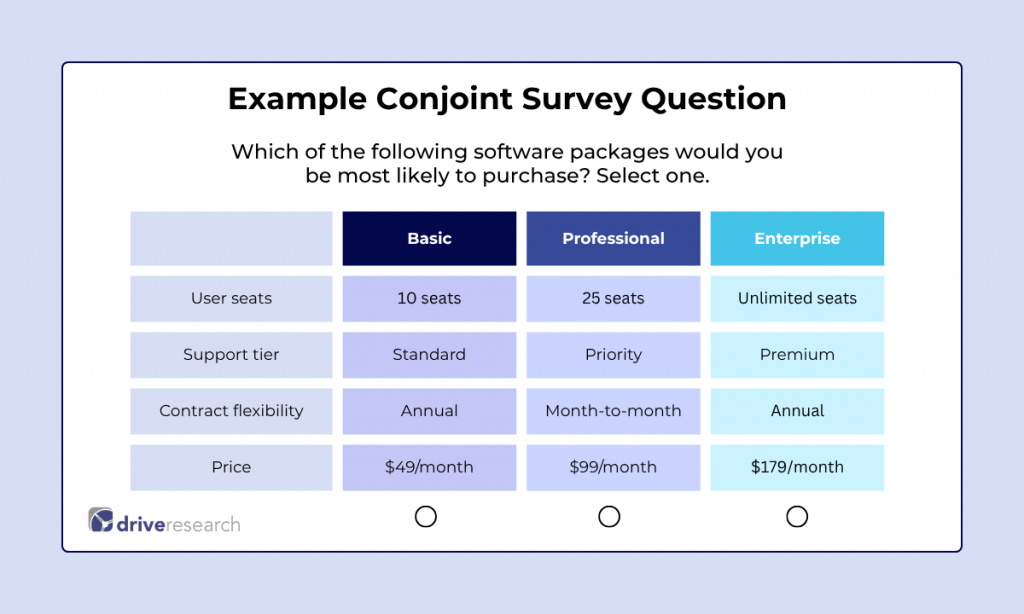
Conjoint analysis is the research method most commonly used to optimize a feature set. In a conjoint exercise, respondents are shown different product configurations, each with a unique mix of features and prices, and asked to choose which one they would buy.
They repeat this exercise across several rounds as the combinations change. Rather than asking people to simply rate features on a list, which often makes everything seem equally important, a conjoint analysis simulates real-world shopping by forcing respondents to make trade-offs.
Because those choices mirror how people actually shop, the resulting data shows how much each feature is truly worth to your target buyer. This allows your team to prioritize the attributes that are most likely to drive sales.
Price: The Van Westendorp Price Sensitivity Meter
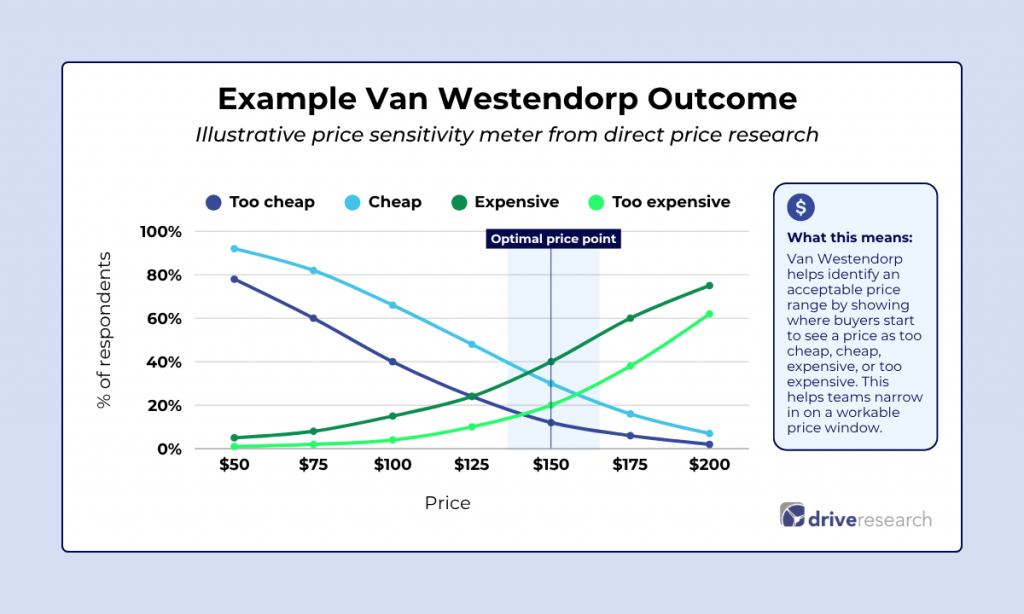
Even the best product won’t succeed on the shelf if the price is off. To set a defensible price range, researchers use the Van Westendorp Price Sensitivity Meter (PSM) to measure what target shoppers are actually willing to pay.
The Van Westendorp PSM asks respondents four questions about a product:
At what price would this product be so cheap that you’d question its quality?
At what price would this product be a bargain?
At what price would this product start to feel expensive?
At what price would this product be too expensive to consider?
By plotting these answers, researchers can identify a range of acceptable price points along with an optimal price point, where the share of shoppers who call the price too cheap equals the share who call it too expensive. Even though this approach uses just a few simple questions, it gives brands a defensible price range instead of relying on a single internal guess.
Van Westendorp works best when the product is already defined. If the right price depends on which features you include, conjoint is the better tool because it measures price and features together.
While features and pricing can be perfect on paper, a product can still underperform in the real world. This part of the study involves making sure the product actually works the way it’s supposed to, and there are no critical or overlooked issues.
An in-home usage test (IHUT) is a useful method for testing product performance. These studies allow respondents to use the product in their own environment, so any usability issues that might have been missed in a lab setting or conference room demo can come to the surface.
Here’s a recent real-world example of how Drive Research conducted an IHUT study for product optimization:
To launch a competitive private-label pregnancy test, a national online retailer needed to benchmark supplier prototypes against leading brands and identify key purchase drivers.
We conducted a blinded, nationwide IHUT in which 125 participants each tested four products. The results revealed performance gaps between digital and analog formats alongside critical packaging and usability friction points.
The retailer used these insights to refine physical features, prioritize high-performing formats, and optimize its pricing strategy.
“In our experience, IHUTs almost always reveal issues that a product team may have initially overlooked. That makes it a must-have step before new or updated products become available for purchase.”
Chris Coville
Research Principal
How to Conduct a Product Optimization Study
A product optimization study follows five steps: define what you’re optimizing, choose the methods, design the study, field it with real target buyers, and turn the results into a recommended configuration.
Most product optimization studies take 8 to 12 weeks from kickoff to final report. A study that adds an IHUT usually runs longer, often 10 to 16 weeks, because recruiting, shipping, and the at-home usage period add time.
Here’s what happens at each step.
Step 1: Define What You’re Optimizing and Why
Every product optimization study starts with clear objectives built around the decisions covered above: which features matter, what price makes sense, and how the product performs in real life. Your goals will also depend on where the product sits in its lifecycle, since building a brand-new product from scratch takes a different approach than updating an item already available for purchase.
Step 2: Choose the Right Research Methodology
Choose your research methods based on the specific goals you set in Step 1, since most product optimization studies combine more than one approach.
If you need to see how buyers trade features against price, conjoint is the right tool. If the feature list is long, start with MaxDiff and run conjoint on the finalists.
For price, Van Westendorp is faster when the feature set is settled, while conjoint handles price and features together. If you’re unsure which fits, our pricing research team can help you choose. And if the product has to prove itself in a real home, add an IHUT before launch.
Step 3: Design the Study Instrument
Build your study around the exact methods you selected in Step 2 so the data maps back to your core goals. Every feature, price point, and product configuration you put in front of respondents should be realistic and something your team can actually produce and sell.
Step 4: Field the Study With Your Target Audience
Recruit participants who match your product’s actual target buyer profile rather than relying on a broad general-population sample. The feature trade-offs people make in a conjoint analysis or the price points they consider fair only hold value if they come from people who would realistically buy your product. Screening for niche-category buyers or shipping physical products for an IHUT can add a couple of weeks to fieldwork, so building in proper recruiting time upfront protects your data quality.
Step 5: Analyze Results and Build the Optimal Product Configuration
Once fieldwork wraps up, the research team turns raw responses into clear, actionable recommendations. For quantitative trade-off and pricing data, that means modeling the exact combination of features and price points that maximizes market share and revenue. If you also run an IHUT, the usage data will assess whether the product holds up in everyday life or help unveil any tweaks needed before launch.
Make Optimization Research Part of Your Product Development Process.
Product Optimization Study vs. Concept Testing: What’s the Difference?
Concept testing evaluates whether a high-level product idea has market appeal before you build it, while a product optimization study fine-tunes the exact features, price, and physical performance of a developed product before launch or during a product refresh.
A simpler way to think of the difference is: Concept testing validates if an idea is worth pursuing, whereas product optimization determines how to configure that product to maximize sales and margins.
Comparison Factor
Concept Testing
Product Optimization Study
Product Lifecycle Stage
Early ideation, before investing in R&D or prototypes
Pre-launch (after the concept is validated) or post-launch (when fixing an underperforming SKU)
Core Question Answered
Does this product idea have enough buyer demand to build?
Which exact features, price point, and physical execution will maximize success?
What Respondents Evaluate
High-level ideas, value propositions, positioning statements, or early mockups
Specific feature sets, concrete price points, packaging, and working prototypes
Common Research Methods
Concept screening surveys, monadic/sequential monadic testing, focus groups
Conjoint analysis, MaxDiff analysis, Van Westendorp PSM, IHUTs
When to Conduct a Product Optimization Study
The best time for a product optimization study is after the concept is validated but before production, or after launch when a product isn’t selling as expected.
Here’s what the study answers at each point:
Before launching a product, when they have the concept validated but need to settle the final feature set and price point.
After launching a product, when an existing product isn’t performing as well as expected. In this case, the optimization study reveals whether the issues are truly related to the feature set, the price, product performance, or some combination of the three. That was the situation in a dishwasher pod relaunch, where an IHUT with 125 participants helped diagnose what was holding the product back before it returned to market.
These studies provide clear direction on what needs to be adjusted to maximize market performance.
Plan Your Product Optimization Study With Drive Research
At Drive Research, we run custom primary research, from conjoint analysis and Van Westendorp pricing studies to nationwide IHUT programs, so your team can validate decisions before locking in production.
Learn more about our product testing and optimization research. 72% of our 2025 work came from repeat clients, and our analysts manually review every dataset for survey fraud.
Share a bit about your product and what you’re trying to optimize, and we’ll recommend the right approach for your team.
How To Find the Optimal Price Point For Your Product or Service (With Research)
When You Give Us A Cookie
We analyze more than data—we also track how our site is used to improve your experience. Cookies help us understand what’s working so we can deliver the most relevant insights. Click “Accept” to enable full functionality.
Functional
Always active
The technical storage or access is strictly necessary for the legitimate purpose of enabling the use of a specific service explicitly requested by the subscriber or user, or for the sole purpose of carrying out the transmission of a communication over an electronic communications network.
Preferences
The technical storage or access is necessary for the legitimate purpose of storing preferences that are not requested by the subscriber or user.
Statistics
The technical storage or access that is used exclusively for statistical purposes.The technical storage or access that is used exclusively for anonymous statistical purposes. Without a subpoena, voluntary compliance on the part of your Internet Service Provider, or additional records from a third party, information stored or retrieved for this purpose alone cannot usually be used to identify you.
Marketing
The technical storage or access is required to create user profiles to send advertising, or to track the user on a website or across several websites for similar marketing purposes.