In today’s rapidly evolving business landscape, staying ahead of the competition requires more than just a great product or service. It demands a deep understanding of the market, consumer behavior, and emerging trends. This is where the market research process becomes invaluable. In this blog post, we will delve more into market research and explore...
There is never a wrong time to do market research. However, most research projects are birthed because a company or organization is at a crossroads. Whether you’re a startup or Fortune 500 company, you’ll have critical decisions to make. This blog will detail common market research examples and how our clients have used them to...
How To Find the Optimal Price Point For Your Product or Service (With Research)
Emily Taylor
Finding the Optimal Price Point in Short: With product research, finding the optimal price isn’t about choosing a number that “feels right.” It’s about understanding where demand for your offering begins to shift, how customers perceive value, and what pricing strategy would best support your business goals. With the right pricing research methodology, organizations can make more confident decisions around their profitability and growth with real customer insights instead of assumptions.
Finding the optimal price point can feel like a monumental task. Pricing influences everything from customer acquisition and revenue to long-term profitability and scalability, making it one of the most important strategic decisions a business can make because it literally affects every aspect within an organization.
So, it’s no wonder as to why the question, “What is my product’s/service’s best price point?” Luckily, research in general can help to answer this, but there’s also so much nuance and strategy that go into choosing the right pricing research methodology to answer this question in depth.
Whether you’re launching a new product, evaluating an existing service, or adjusting pricing to stay competitive, different research methods answer different questions. And understanding which approach best fits your objectives is key to collecting meaningful data that keeps you progressing (not digressing) with your business goals.
In a previous post, we discussed how price optimization can be loosely defined as the process of defining a value that considers your offering and how it fits into the marketplace along with competitors, with the goal of maximizing profit/revenue.
However, it’s important to remember that the “optimal” price isn’t always the highest or lowest price available. Instead, it’s the price that best balances customer demand, perceived value, competitive position, and business objective. It’s one that finds the happy medium between meeting your target audience’s needs without impacting your business growth.
For example, two nearly identical products can have very different price points depending on factors like brand reputation, product features, and even overall buying experience. Pricing research helps explain why customers may willingly pay more for one option versus the other, helping brands better understand where they stand within their market and how they can make their pricing more competitive while still giving their customers what they want.
So, it’s safe to say there are a lot of different ways to define an optimal price point, and primary research is a great way to understand decision makers, who they are, what they are looking for, and (of course) their threshold for price/value.
Why You Can’t Guess Your Way to the Right Price
Oftentimes in pricing research, market research teams are assessing a product or service that has some sort of quirk or is novel to the market (i.e., a new B2B service, a new CPG product, a new/different children’s camp approach).
Without customer feedback, pricing these offerings comes down to educated guesses based on internal assumptions, competitor pricing, or production costs alone. Basing costs off these isn’t entirely wrong and they can provide direction, but they don’t always reflect how buyers perceive value or what they are actually willing to pay.
From our experience, pricing studies and conversations often uncover insights that extend well beyond the price itself. Researchers constantly learn more about what concerns influence buying, what features buyers value most, how consumers buy based on certain trends, and how specific factors justify a higher or lower willingness to pay.
So, for these types of offerings, understanding who your consumers are, what’s important to them and why, their level of interest, and their perception of value is crucial to understand before going to market.
Research Tip: It can be tempting to just use competitor pricing to set your own. While understanding the competitive landscape is important, primary research better reveals your specific offering’s strengths and weaknesses and long-term value with consumers, which allows you make more informed decisions on your pricing strategy.
Choosing the Right Pricing Research Method
Market research offers several methodologies to inform pricing strategy. Depending on your goals and objectives, researchers can guide you on the best approach to meet your needs.
The right methodology depends on the questions you need answered. Some methods are designed specifically for willingness to pay or evaluating how product features influence purchasing decisions, while others are built for identifying an acceptable price range.
Below we’ll discuss a few different approaches, including Gabor-Granger, Van Westendorp, and choice-based conjoint analysis.
As a note, brands don’t necessarily need to execute each of the topics outlined in the summary below. Most brands may do some or all of the pricing research methodologies depending on the need or what stage their product/service is.
Key Takeaway: There is no one-size-fits-all research methodology for pricing. The best approach depends on your research purposes and what insights will ultimately help support your business goals.
How to Find the Optimal Price Point
Safe to say, finding the optimal price point can be a bit of a loaded question and can mean different things depending on the goals and objectives of the brand. Some organizations are launching entire new products while others are evaluating pricing strategies or responding to market changes. Because each scenario requires different insights, choosing the right research methodology is just as important as the results themselves. Here’s more on choosing the right price research methodology.
Understand the Current Pricing Context
A first step to understanding price is to get a lay of the land. This can include secondary research to understand how competitors with similar products/service offerings and pricing strategies compare, as well as learning more about decision makers.
It’s important to keep in mind though competitor pricing only tells part of the story, and more context is needed to build a more well-rounded pricing understanding.
The secondary research, of course, feels highly tangible and useful. Understanding decision-makers is equally important and should be a primary consideration in creating a strong pricing strategy.
This can include understanding factors such as:
Who decision-makers are
Demographics/firmographics (i.e., information to help profile and create look-alike audiences to understand buyer personas)
Understanding how buyers budget for the product/service
Who is involved in the vetting/decision-making process
Who is the final decision maker
How long do buyers anticipate the buying process to take
How do buyers anticipate their budget will change
How have buyers’ budgets changed
Simply put, identifying the right price is only half the battle.Understanding why buyers are willing to pay that price provides the context needed to build a stronger pricing strategy.
As a note, a brand’s product or service is developed with no true comparisons in the market. In this situation, primary research with no aided price levels, typically Van Westendorp or qualitative research may be used to establish the ballpark for expected pricing, before using Gabor Granger with fixed pricing levels to test.
Identify Willingness to Pay Using Gabor-Granger
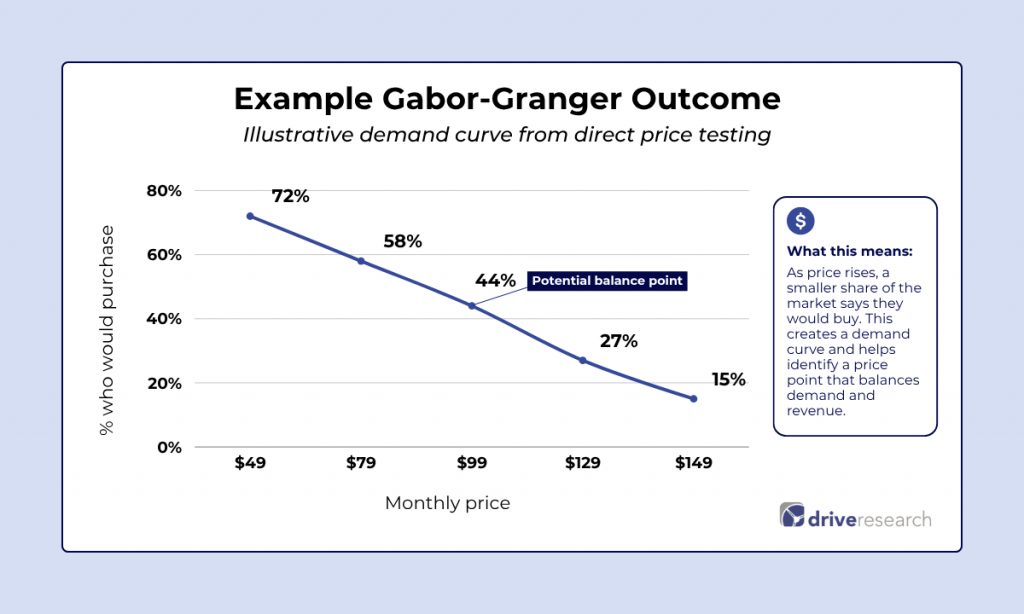
Gabor-Granger is a pricing research approach that researchers use to understand price elasticity. This methodology is particularly useful when organizations already have a few possible pricing points in mind and want to conduct research to understand how demand might affect those points.
The results of the data gathered create a revenue-versus-demand curve to understand the level of “reasonableness” buyers are willing to pay for the product/service.
The two questions this method answers are 1) at what price do customers find your price reasonable versus unreasonable, and 2) to what degree changing price will impact sales.
In simple terms, here are three example questions:
How reasonable is the product/service at $$ price?
[If $$ unreasonable] How reasonable is the product/service at $ price?
[If $$ reasonable] How reasonable is the product/service at $$$ price?
Map the Optimal Price Range Using Van Westendorp
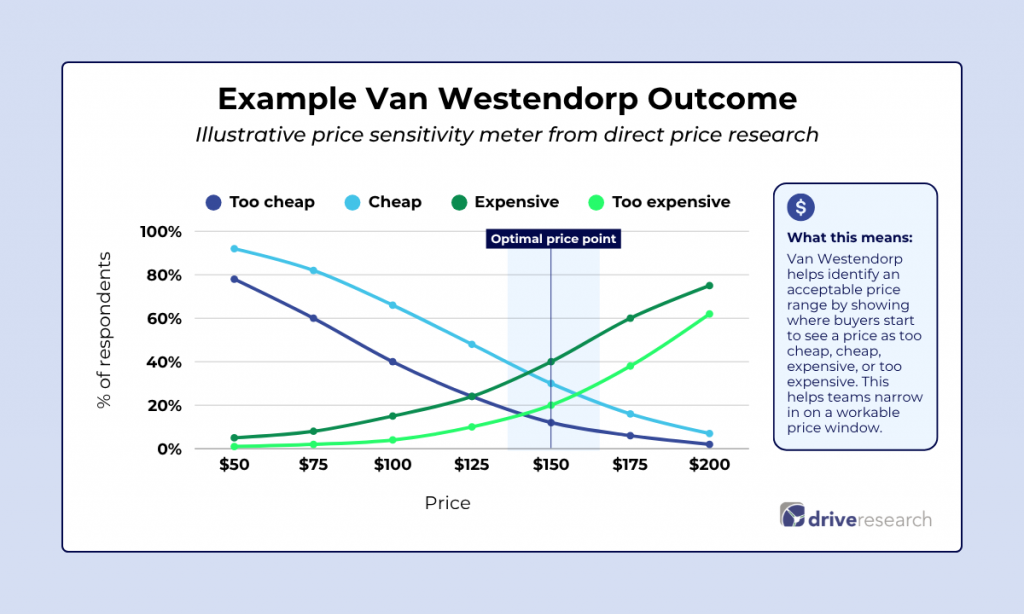
Van Westendorp takes a different route and explores more nuance or a psychological approach to how buyers perceive the value of a product or service. This method answers what price (or price range) buyers are willing to pay.
In simple terms, here are four example questions:
At what price do you think the product is priced so low that it makes you question its quality?
At what price do you think the product is a bargain?
At what price do you think the product begins to seem expensive?
At what price do you think the product is too expensive?
Validate Pricing Strategy With Conjoint Analysis
Choice-based conjoint analysis takes pricing research a step further. For this approach, buyers are presented with cards that display several core features along with a price point. Respondents then select the card with the options and price point they deem most attractive/valuable.
This approach adds a layer of complexity to the mix. Buyers are not only testing price, but also various factors of the product/service and how that impacts their perceived value.
Segment Your Pricing Research Results
Depending on the research results, it may be helpful to understand how different segments/buyer personas respond to the pricing methodology tested.
For example:
Is one type of buyer more or less price sensitive than another?
Do they begin the process at different times?
How do they anticipate their budgets changing?
How does the level of involvement of other team members impact price?
Monitor and Revisit Pricing Over Time
Things change. Customer expectations, competitive landscapes, and economic conditions are constantly evolving. Revisiting pricing research periodically helps organizations ensure their pricing strategy continues to reflect how buyers perceive value instead of relying on outdated assumptions.
As the marketplace dynamic shifts, staying ahead of how buyers perceive the value of your product or service provides key information to stay ahead in the market.
Pricing Research Method Comparison
Method
Best Used When…
Primary Insight
Secondary Research
You’re understanding the competitive landscape before testing prices.
Market trends, competitor pricing, and buyer context.
Gabor-Granger
You already have price points you’d like to evaluate.
Identifies willingness to pay and price flexibility.
Van Westendorp
You’re exploring an acceptable price range for a new offering.
Reveals perceived value thresholds and optimal pricing range.
Choice-Based Conjoint
You need to understand trade-offs between price and product features.
Measures how features and pricing influence purchase.
Segmentation Analysis
Different customer groups may behave differently.
Identifies pricing differences across buyer personas or audiences.
Ongoing Pricing Research
Market or customer expectations have changed.
Keeps pricing aligned with evolving market conditions.
Finding the optimal pricing point requires more than just looking at what competitors are doing or choosing numbers based on internal research and assumptions. Be combining the right pricing research methodology with a deep understanding of your buyers, organizations can make more informed pricing decisions that support every level of their business.
Need help with pricing research? Drive Research is here to help with expert market research that helps you uncover actionable insights and get the most out of pricing research. We always ask for more out of research, so you should be able to also. Contact us today!
15+ Product Concept Development Example Survey Questions to Steal
Blog Posts
A Guide to Product Testing Research For Consumer Goods
Blog Posts
6 Steps to Conducting a Market Survey
When You Give Us A Cookie
We analyze more than data—we also track how our site is used to improve your experience. Cookies help us understand what’s working so we can deliver the most relevant insights. Click “Accept” to enable full functionality.
Functional
Always active
The technical storage or access is strictly necessary for the legitimate purpose of enabling the use of a specific service explicitly requested by the subscriber or user, or for the sole purpose of carrying out the transmission of a communication over an electronic communications network.
Preferences
The technical storage or access is necessary for the legitimate purpose of storing preferences that are not requested by the subscriber or user.
Statistics
The technical storage or access that is used exclusively for statistical purposes.The technical storage or access that is used exclusively for anonymous statistical purposes. Without a subpoena, voluntary compliance on the part of your Internet Service Provider, or additional records from a third party, information stored or retrieved for this purpose alone cannot usually be used to identify you.
Marketing
The technical storage or access is required to create user profiles to send advertising, or to track the user on a website or across several websites for similar marketing purposes.