In today’s rapidly evolving business landscape, staying ahead of the competition requires more than just a great product or service. It demands a deep understanding of the market, consumer behavior, and emerging trends. This is where the market research process becomes invaluable. In this blog post, we will delve more into market research and explore...
There is never a wrong time to do market research. However, most research projects are birthed because a company or organization is at a crossroads. Whether you’re a startup or Fortune 500 company, you’ll have critical decisions to make. This blog will detail common market research examples and how our clients have used them to...
Beauty Focus Groups: How to Get Unfiltered Consumer Insights
Emily Rodgers
The beauty moves at the speed of your For You Page.
A style that felt fresh six months ago can suddenly read as outdated. A phrase that used to convert can start sounding like marketing fluff.
Heck, at the time of writing this, “Butter Yellow” nails are in. By the time you’re reading this, there is probably a new “viral” shade.
That is why beauty focus groups still earn a top spot in the research toolkit. They let you hear shoppers explain the why behind their opinions in real time, in their own words, with their own priorities.
If your team is prepping a launch, refreshing a hero SKU, exploring a new category, or trying to diagnose why repurchase is lagging, a good discussion can surface what a survey will never know to ask.
If you need a quick gut check on “Which of these two options wins,” a quantitative survey can be great. But when you need context, focus groups shine.
That’s why beauty brands typically use focus groups when they want to:
Unpack sensory and emotional reactions. “Hydrating” can mean glass-skin glow to one person and “not tight after cleansing” to another. Focus groups help you understand what consumers think you mean, and whether that matches what you intend.
Pressure-test concepts before you spend big. Early-stage concepts are fragile. A small wording tweak or a different benefit hierarchy can change the whole read.
Find the language shoppers actually use. The words that sound amazing in a deck do not always sound believable on a label. Focus groups show you what feels credible, what feels trendy, and what feels try-hard.
Understand switching behavior. Why did they leave Brand A for Brand B? “It was too expensive” might be the polite answer. In conversation, you may learn it was actually the pump, the scent, the influencer backlash, or the fact that the bottle looked like it belonged in their mom’s cabinet.
One more reason this matters right now: The category is crowded and consumers are doing homework. In one study, positive online ratings and reviews were cited as a key conversion factor for beauty shoppers (23.3%), right after price, quality, and discounts.
If shoppers are reading reviews anyway, your messaging and product experience have to stand up to scrutiny, not just sound pretty.
What You Can Test in a Beauty Focus Group
Beauty focus groups are flexible. You can keep them broad, like exploring routines and needs, or get very specific, like testing two claim boards and three packaging directions.
Common focus group topics include:
Formula and sensory feedback (texture, absorption, finish, scent strength, residue, irritation concerns)
Packaging and unboxing reactions (aesthetics, usability, “does this feel premium?”)
Claims and credibility (what feels believable, what feels like a red flag)
Pricing and value perception (what they expect to pay, and why)
Shade range, shade naming, and selection confidence for color cosmetics
Brand perception versus competitors (who they compare you to, and whether you like that comparison)
Example 1: The “great formula, no one wants to wear it” problem
A skincare brand brings a new moisturizer to groups and participants agree it performs well. Ratings would look solid in a survey. Then the discussion starts.
People keep using words like “coating,” “film,” and “my face can’t breathe.”
The brand intended “protective barrier.” Consumers heard “I will break out.”
That is a product and messaging crossroads you want to find in beauty market research, not in your post-launch reviews.
In my experience, this is one of the most common focus group wins: you discover the issue is not efficacy, it is interpretation.
The fix might be as simple as reframing benefits, adjusting usage instructions, or changing one sensory element (like scent intensity) that is turning “nice” into “no.”
Plan your next beauty focus group study with Drive Research today.
A well-run group has structure, but it should not feel like an interrogation. You want honest opinions, and honesty shows up faster when participants feel relaxed.
The discussion guide: structured, but not stiff
The discussion guide is your roadmap. In beauty, I like to start with behavior before I show stimuli. Get them talking about their routines, their “must-haves,” and their dealbreakers. Then move into your concepts, packaging, or samples.
Good focus group questionnaires also leave room for the detours.
The magic is often in the throwaway comment like, “I would never put this on my bathroom counter,” or “This looks like it would sting.”
Online vs. in-person focus groups for beauty
Which is better: remote or in-person focus groups? This is a question we hear all the time.
In recent years, online focus groups have become a preferred format because they are fast to field, easy to observe, and allow geographic reach. They also work great for claim boards, ad testing, product renders, and website flows.
But in-person groups are still valuable when tactile interaction is essential, like packaging usability, applicator testing, and side-by-side sensory comparisons.
Many beauty brands use a hybrid approach: online sessions plus shipped product kits (or controlled in-facility testing) so you can get both natural conversation and hands-on feedback.
Yes, incentives matter. There should be no surprises there.
But the bigger driver of engagement is the moderator. Beauty shoppers usually have opinions, and a skilled moderator knows how to pull the “I like it” into specifics: what about it, compared to what, and in what situation?
Moderation in beauty also needs a little cultural fluency. If someone says “this is giving clean girl,” the moderator should know that is not a clinical claim.
It is a vibe, and vibes sell.
Recruiting the Right Participants
A beauty focus group is only as good as the people in the (virtual) room. When we recruit for focus groups, we run a sourcing → screening → scheduling process that is built to find qualified shoppers and maximize show rates.
Below are a few of our best practices we recommend following.
1. Source participants using multiple channels, not a single list
Beauty audiences can be niche (for example, fragrance-free loyalists, melasma problem-solvers, high spenders at Sephora, curly hair routine builders).
To reach them, we recruit using a mix of targeted social media ads, vetted third-party partner panels, and our in-house panel.
This gives us flexibility to find both broad category users and very specific profiles.
2. Pre-screen to manage quotas and get the “right mix”
Next, we build an online screening survey that does more than check demographics. It confirms category behavior and weeds out poor fits, while also managing quotas (so you do not end up with 10 people who all shop the same way).
For our beauty clients, we often screen for things like:
Category usage and frequency (daily skincare user vs. occasional)
Shopping habits (where they buy, what they spend, how they discover products)
Ingredient and fragrance sensitivities
Brand loyalties and switching behavior
3. Re-screen by phone to quality check responses
This is a big one. A lot of recruiting gets “automated” today, which makes it easier for unqualified participants to slip in.
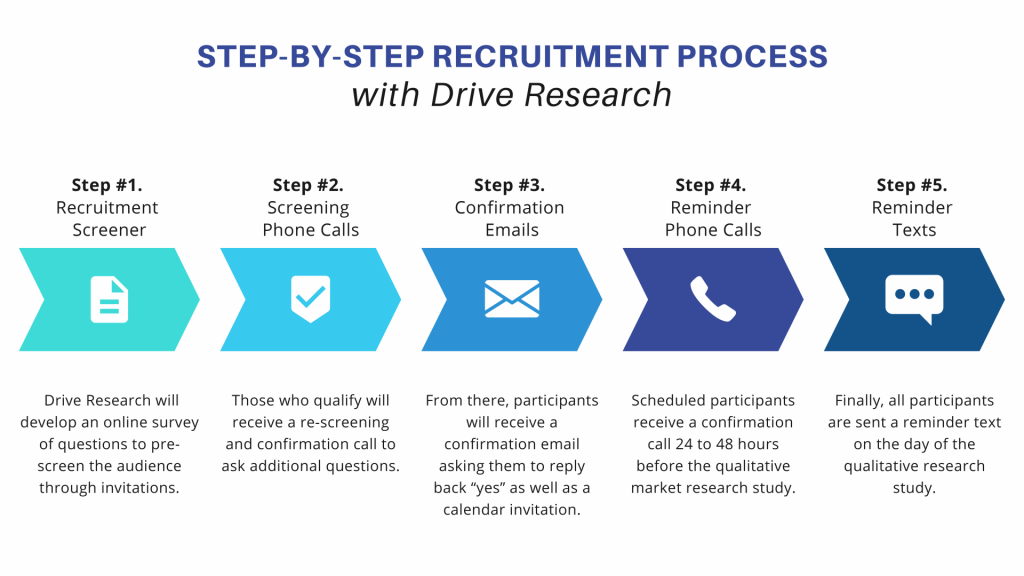
To avoid this, we add a re-screening and confirmation phone call for those who qualify online to verify answers and ask any extra questions needed for your category.
4. Schedule and confirm participation
Once someone is qualified, we confirm them with clear logistics and multiple touchpoints:
📧 Confirmation email (including a “yes” reply request)
📅 Calendar invite
☎️ Confirmation call 24–48 hours before
📱 Reminder text the day of.
This approach is part of why we typically average about a 95% show rate for recruiting projects.
Bottom line: Recruiting is not a checkbox step. It is risk management.
When the right consumers show up, the conversation gets specific fast, and you leave with insights your team can actually use.
Get more expert strategies for finding, recruiting, and scheduling focus group participants.
You will hear contradictions. You will hear strong preferences that are actually niche. You will hear one participant dominate and another quietly drop the best insight of the whole night.
The goal is not to collect quotes. The goal is to identify patterns and translate them into decisions your team can act on.
Which benefits and claims land as credible, and which trigger skepticism
What “premium” means for your audience in this category (and what feels overpriced)
Where shoppers get confused in the product story (and what they need to believe)
How your product fits into routines, not just shelves
What would cause trial, repurchase, or switching
Example 2: Shade range feedback that goes beyond “more inclusive”
We partnered with a tinted sunscreen brand that wanted feedback on an expanded shade range. The research revealed participants don’t just react to shades, they talk about shade selection confidence.
They explained how they shop, what lighting they trust, what they fear (pilling, undertone mismatch), and how shade names affect whether they even pick up a product.
That insight changed more than their product. It impacted their PDP layout, shade finder tool, influencer briefs, and retail planograms.
Drive Research designs and moderates beauty focus groups, recruits the right participants, and turns qualitative feedback into next steps your product and marketing teams can use immediately.
If you share your category, target buyer, timeline, and ideal budget, we can scope the right approach and get you moving.
We analyze more than data—we also track how our site is used to improve your experience. Cookies help us understand what’s working so we can deliver the most relevant insights. Click “Accept” to enable full functionality.
Functional
Always active
The technical storage or access is strictly necessary for the legitimate purpose of enabling the use of a specific service explicitly requested by the subscriber or user, or for the sole purpose of carrying out the transmission of a communication over an electronic communications network.
Preferences
The technical storage or access is necessary for the legitimate purpose of storing preferences that are not requested by the subscriber or user.
Statistics
The technical storage or access that is used exclusively for statistical purposes.The technical storage or access that is used exclusively for anonymous statistical purposes. Without a subpoena, voluntary compliance on the part of your Internet Service Provider, or additional records from a third party, information stored or retrieved for this purpose alone cannot usually be used to identify you.
Marketing
The technical storage or access is required to create user profiles to send advertising, or to track the user on a website or across several websites for similar marketing purposes.