In today’s rapidly evolving business landscape, staying ahead of the competition requires more than just a great product or service. It demands a deep understanding of the market, consumer behavior, and emerging trends. This is where the market research process becomes invaluable. In this blog post, we will delve more into market research and explore...
There is never a wrong time to do market research. However, most research projects are birthed because a company or organization is at a crossroads. Whether you’re a startup or Fortune 500 company, you’ll have critical decisions to make. This blog will detail common market research examples and how our clients have used them to...
Net Promoter Score is one of those deceptively simple metrics. One question, one number, and a ton of organizational emotion attached to the result.
When we’re working with brands that want long-term improvement, the highest-impact shift is usually this. Treat NPS as a decision tool that guides experience investments, not just a number to report.
A quick definition of NPS
Net Promoter Score measures customer loyalty by asking how likely someone is to recommend your company, product, or service on a 0–10 scale. Scores of 9–10 are promoters, 7–8 are passives, and 0–6 are detractors. Your NPS is calculated by subtracting the percentage of detractors from the percentage of promoters. This article walks through what shapes your NPS, why it still matters, and practical ways to improve it over time without falling into the common trap of chasing the number instead of the drivers.
Get an NPS survey design built by our market research company.
At its core, NPS reflects the strength of your customer relationship at the moment you ask.
But the score is shaped by several layers of reality…
Your product or service performance. Reliability, ease of use, outcomes, and perceived value are the obvious foundations.
Your customer experience and support. Customers can tolerate a lot when they feel heard, helped, and respected. They are also quick to punish inconsistent service.
Expectations and positioning. If marketing promises a premium experience and delivery feels average, NPS suffers even if the product works. This gap between promise and reality is one of the most common hidden drivers we see when we’re working with B2B and B2C brands.
Timing and context. A customer who just experienced a shipping delay, a platform outage, or a billing issue will answer differently than that same customer two weeks later after a great support interaction.
Your customer mix. NPS can vary across segments like tenure, plan tier, region, use case, and even the decision-maker vs. day-to-day user dynamic.
A healthy NPS program accounts for these forces instead of assuming the score is a clean, single truth.
Why You Want a Strong NPS Score
A strong NPS can be a leading indicator of customer loyalty and momentum. When used correctly, it can be an early warning signal before churn shows up in retention data.
It also provides a simple language for cross-functional alignment. For example:
For customer success teams, it helps identify where relationships are strengthening or weakening before churn signals are obvious.
For leadership, it provides an accessible story about customer health that can unify priorities across product, support, marketing, and operations.
And it helps you prioritize. NPS feedback, especially the open-end rationale, can surface the few issues that create outsized frustration, or the strengths that drive repeat purchasing and referrals.
The key is using NPS as a starting point for investigation, not the final answer.
How to Improve Your NPS
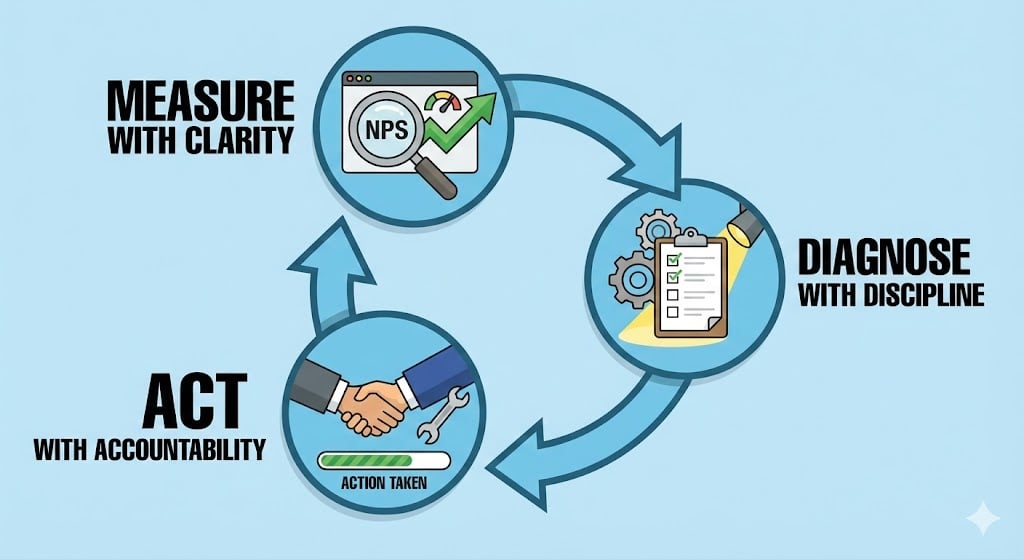
A simple way to think about sustainable improvement is a three-step loop.
Measure with clarity.
Diagnose with discipline.
Act with accountability.
The rest of the tips outlined below fit inside that loop.
1. Create a Targeted NPS Survey
Most NPS programs ask the core question, “On a scale of 0-10, how likely are you to recommend our brand to a friend or family member?” and stop there. That is where the missed opportunity begins.
A targeted NPS survey includes a few short, strategic follow-ups that help you understand why someone is a promoter, passive, or detractor. The goal is not a long questionnaire. The goal is clarity.
When we’re working with brands, we often recommend including:
A concise open-end prompt for the primary reason behind the score.
One or two driver questions tailored to your business, like ease of onboarding, responsiveness of support, reliability, or value for money.
A segmentation question that lets you cut results by plan, product line, usage intensity, or customer tenure.
This creates immediate actionability. You can see patterns by segment, identify the biggest experience gaps, and avoid guessing what the score means.
Benchmarking can be helpful, as long as it is used responsibly. Here are a few things to keep in mind.
External benchmarks are often hard to compare cleanly. Different industries such as retail, healthcare, banking, survey at different touchpoints and with different audience mixes. But they can provide a rough sanity check.
Internal benchmarking is usually more valuable. Compare NPS by customer segment, account size, geography, or lifecycle stage. This tells you where loyalty is strong and where your experience is fragile.
3. Track Scores Over Time
A single NPS snapshot is easy to overreact to. The real power comes from trends.
Our Net Promoter Score company recommends tracking customer satisfaction metrics monthly or quarterly, depending on your volume and business model, and pair the score with the themes emerging in verbatim feedback.
In practice, we see stronger programs create a simple monthly rhythm:
Review NPS trend and segment shifts
Identify top 2–3 drivers of negative movement
Assign owners for fixes
Share progress back to customers when appropriate
This rhythm ties your measurement to change. That is where improvement happens.
Request a quote for Drive Research to run your NPS study.
Email-only NPS programs may bias results toward your most engaged users.
A thoughtful omnichannel approach can improve both data quality and representation. Consider:
In-app prompts for active users
SMS for transactional touchpoints
Email for broader relationship check-ins
Phone follow-ups for high-value accounts
The best mix depends on your customers and their behaviors. When looking to improve customer experience, remember to meet customers where they already are.
5. Reduce Customer Effort in Your Highest-Friction Moments
When we’re working with brands, we often encourage them to include questions that measure customer effort.
That’s because NPS improves when customers feel that doing business with you is easy. That ease is often shaped by a few recurring friction points rather than a long list of minor inconveniences.
Look for patterns in where customers have to repeat themselves, wait too long, or navigate unclear processes.
These are the moments that quietly drain loyalty even if the final outcome is acceptable. Over time, reducing effort creates a smoother experience that customers remember when you ask the recommendation question.
6. Strengthen Cross-Functional Handoffs
Many NPS dips have nothing to do with a single team’s performance. They are caused by handoff breakdowns between sales, onboarding, customer success, and support.
If key context gets lost during transitions, the experience feels fragmented and trust erodes. That erosion shows up in NPS as passives who say things like “great product, but…” or “good people, inconsistent experience.”
Improving handoffs does not always require big structural change.
Shared notes, clearer internal ownership, and a standard “next-step” message for customers can eliminate confusion and make your brand feel more cohesive. Over time, this consistency helps convert neutral customers into advocates.
7. Build Team Culture Around NPS
Try and reframe your mindset that NPS improvement is just a survey project, but instead an organizational practice.
Teams that improve NPS sustainably tend to do a few things consistently:
They share customer feedback widely, not just in leadership meetings.
They celebrate improvements linked to real customer outcomes, not just higher scores.
They help frontline teams understand how their daily decisions influence loyalty.
In our experience, a simple internal shift often changes the trajectory: moving from “How do we raise NPS?” to “What are we doing right now that makes loyalty harder?”
8. Action Items From Feedback
The fastest way to kill trust in your NPS program is to collect feedback and do nothing visible with it.
Even small changes matter when you can connect them back to what customers said.
For example, if a theme emerges around confusing billing, long wait times, or missing integrations, turn that into a clear action plan with owners and timelines.
Then communicate progress internally and externally. Customers do not expect perfection. But they do expect evidence that their voices mean something.
9. Identify Underlying Issues
NPS verbatims often point you in the right direction. They do not always give you the full root cause.
If customers mention “support,” that might mean speed, clarity, tone, expertise, or handoff confusion.
If they mention “value,” that might reflect pricing, adoption, or unclear measurement of outcomes.
This is one of the places where a structured CX or VoC research partner can add real value by separating symptoms from root causes.
10. Leverage Feedback From Passives
Many companies focus most of their energy on detractors, which makes sense emotionally because negative feedback tends to feel more urgent. But from a score-improvement standpoint, it is usually much easier to move customers from passives to promoters than to move detractors to passives.
This is where small, targeted changes can create meaningful momentum. When you look closely at passive feedback, you will often see patterns that point to fixable friction.
Addressing these themes helps customers who are already close to advocacy take that final step. Over time, that shift can lift your score faster and more sustainably than placing all your bets on “rescuing” detractors.
In practice, we often recommend treating passives as your highest-opportunity group. Identify the common narratives you are hearing, prioritize the small improvements that remove uncertainty or inconvenience, and watch how quickly loyalty can move in the right direction.
Partner with Drive Research to identify passives and convert them faster.
One of the most dependable ways to lift NPS is to help customers reach value faster.
Passives often feel close to enthusiasm but not fully confident yet. The product may be good, support may be fine, and outcomes may be emerging. The missing piece is momentum.
This is especially common in B2B. If onboarding is slow or unclear, customers form a cautious narrative. That narrative can persist even after the product performs well.
A practical approach is to identify the first moment customers say they are seeing real ROI, then remove the blockers that delay that experience. Clear milestones, simplified setup, proactive check-ins, and better enablement materials can all help move customers closer to advocacy.
It is familiar enough to be understood across departments.
And it is flexible enough to be paired with qualitative feedback and deeper quantitative drivers.
The strongest CX programs treat NPS as a headline indicator supported by other measures like CSAT, CES, churn risk models, and journey-specific feedback.
Used this way, NPS becomes less controversial and more useful.
A Quick Example of NPS Improvement in Action
In one of our NPS studies, a local integrated design-build firm partnered with Drive Research for the second consecutive year to better understand client satisfaction and what factors matter most when choosing a firm like theirs.
The study was designed to support KPIs and guide future business decisions, with an annual cadence so the team could compare year-over-year movement instead of relying on a one-time snapshot.
By pairing the NPS question with customized follow-ups, the firm gained clearer insight into …
What was driving loyalty
What clients associated with the brand
Where expectations were not fully aligned with delivery.
That kind of clarity makes improvement more straightforward. It helps leadership prioritize the specific experience changes most likely to shift passives toward promoters, then validate the impact in the next wave.
It depends on volume and customer cadence, but many organizations track monthly or quarterly to build a reliable trend. The priority is consistency and pairing scores with action.
What is a good NPS score?
NPS varies by industry and business model. Your most meaningful benchmark is usually your own historical trend and how scores differ across key segments.
Both matter for different reasons. Passives often represent the fastest near-term opportunity for lifting your score, while detractors help you identify bigger risks and structural experience breakdowns.
Can NPS replace other CX metrics?
It works best as part of a broader measurement approach. Pairing NPS with journey-level feedback and operational metrics gives you clearer insight into what to fix first. I recommend reading, Alternatives to NPS: How Else To Track Customer Satisfaction for more insight here.
If you want an NPS program that creates clear priorities and measurable lift, we can help. Our market research company, Drive Research supports organizations with targeted NPS survey design, benchmarking, segmentation, trend tracking, and advanced driver analysis that links loyalty to the operational changes most likely to move your score over time.
We analyze more than data—we also track how our site is used to improve your experience. Cookies help us understand what’s working so we can deliver the most relevant insights. Click “Accept” to enable full functionality.
Functional
Always active
The technical storage or access is strictly necessary for the legitimate purpose of enabling the use of a specific service explicitly requested by the subscriber or user, or for the sole purpose of carrying out the transmission of a communication over an electronic communications network.
Preferences
The technical storage or access is necessary for the legitimate purpose of storing preferences that are not requested by the subscriber or user.
Statistics
The technical storage or access that is used exclusively for statistical purposes.The technical storage or access that is used exclusively for anonymous statistical purposes. Without a subpoena, voluntary compliance on the part of your Internet Service Provider, or additional records from a third party, information stored or retrieved for this purpose alone cannot usually be used to identify you.
Marketing
The technical storage or access is required to create user profiles to send advertising, or to track the user on a website or across several websites for similar marketing purposes.