In today’s rapidly evolving business landscape, staying ahead of the competition requires more than just a great product or service. It demands a deep understanding of the market, consumer behavior, and emerging trends. This is where the market research process becomes invaluable. In this blog post, we will delve more into market research and explore...
There is never a wrong time to do market research. However, most research projects are birthed because a company or organization is at a crossroads. Whether you’re a startup or Fortune 500 company, you’ll have critical decisions to make. This blog will detail common market research examples and how our clients have used them to...
Pharmaceutical Research in Short: Pharmaceutical market research provides the insights organizations need to understand healthcare audiences, evaluate opportunities, and make informed business decisions that can impact everyone from physicians and payers, to patients and other healthcare stakeholders. This type of research ultimately reduces uncertainty with launching healthcare products and aims to improve the healthcare market overall.
Pharmaceutical market research plays a critical role in helping life sciences organizations make confident, data-backed decisions in a highly regulated and competitive environment.
From early-stage product development to post-launch brand tracking, research provides clarity around physician needs, patient experiences, competitive landscapes and market dynamics that are often difficult to uncover without a reliable third-party source.
As treatment options expand and expectations evolve, pharma companies can no longer rely on assumptions or legacy data.
Market research helps bridge the gap between scientific innovation and real-world adoption by capturing feedback from healthcare professionals, patients, payers, and other decision-makers.
These insights help organizations reduce risk, strengthen commercialization strategies, and make more informed business decisions throughout the product lifecycle.
In this guide, we break down the purpose of pharmaceutical market research, the key components of a successful study, common research methods, and the types of projects pharma brands use to support strategy, commercialization, and growth.
Turn pharmaceutical insights into actionable strategies with expert market research.
What is the Main Purpose For Pharmaceutical Market Research?
The primary purpose of pharmaceutical market research is to reduce uncertainty across complex business decisions.
Whether a company is testing a new therapy concept, evaluating messaging for a launch campaign, or understanding barriers to adoption, research provides objective insight from the people who matter most.
Pharma market research also helps organizations align internal teams around shared, data-backed evidence. Insights from physicians, patients, payers, and other stakeholders can validate assumptions, challenge internal bias, and ensure decisions are grounded in market reality rather than internal opinion.
Ultimately, pharmaceutical market research supports smarter investments, clearer positioning, and stronger engagement across the product lifecycle.
It enables companies to anticipate market needs, adapt to regulatory and competitive pressures, and improve patient outcomes through better-informed strategies that lead to more long-term commercial success.
The Key Parts of a Pharmaceutical Market Research Study
Project Design
Project design translates business questions into a structured research plan that can deliver clear answers. This includes selecting the right methodology, defining sample requirements, and building discussion guides or questionnaires that reflect real-world clinical and decision-making scenarios.
Research Tip: In pharma research, careful wording and structure are essential. Questions must be unbiased, compliant, and easy for medical audiences to interpret while still capturing nuanced feedback.
Recruiting
Recruitment is one of the most critical components of pharmaceutical research. Studies often require highly specific audiences such as physicians by specialty, advanced practice providers, pharmacists, patients with diagnosed conditions, or healthcare administrators.
Finding the right participants is essential to ensuring research findings accurately reflect the intended audience and business objectives.
Effective recruiting ensures participants meet strict eligibility criteria while complying with industry regulations and privacy requirements. A strong recruitment approach balances speed, quality, and representativeness to avoid bias and ensure reliable findings.
Data Cleaning
Data cleaning begins before responses are ever collected through thoughtful survey programming, validation rules, and quality controls.
Once fieldwork is finished, it must be reviewed and cleaned before analysis can start. This step involves removing low-quality responses, validating logic checks, and ensuring consistency across datasets.
Data cleaning is especially important in pharmaceutical research where sample sizes can be smaller and each response carries more weight. Clean data ensures insights are accurate and defensible
Useful resource: Here are 9 data cleaning tips our market research firm follows to ensure our clients receive high quality insights.
Reporting
Reporting turns raw data into insight. Strong pharma market research reporting goes beyond charts and percentages by connecting findings back to business objectives and clinical realities.
Clear summaries, audience segmentation, and practical recommendations help teams understand what the results mean and how to act on them. The goal is to transform complex findings into clear, actional recommendations that stakeholders can confidently use to guide future decisions.
Stage
Primary Focus
Why It Matters
Recruiting
Identifying qualified healthcare participants
Ensures reliable, representative insights
Project Design
Developing the research methodology
Produces unbiased, actionable data
Data Cleaning
Validating and refining collected responses
Improves data quality and accuracy
Reporting
Turning findings into business recommendations
Support informed decision-making
Research Tip: Every stage of the research process builds on the last. Even the strongest study design can be undermined if poor recruitment, low-quality data, or flawed reporting isn’t up to part with business objectives. High standards should be set from the start, and follow through to end (and a market research firm can ensure this happens!)
Main Research Methods For Pharma Market Research
Primary & Secondary
Primary research involves collecting new data directly from target audiences such as healthcare providers or patients. This approach is ideal for answering specific questions that existing data cannot address.
Because the research is customized to specific objectives, this can be especially useful for insights that directly support developmental and commercialization decisions.
Secondary research uses existing sources such as published studies, industry reports, and market data. While useful for context and benchmarking, it is often combined with primary research to gain deeper, more current insights.
Together, these approaches help pharmaceutical companies a more complete understanding of their markets while reducing gaps within their research.
Qualitative & Quantitative
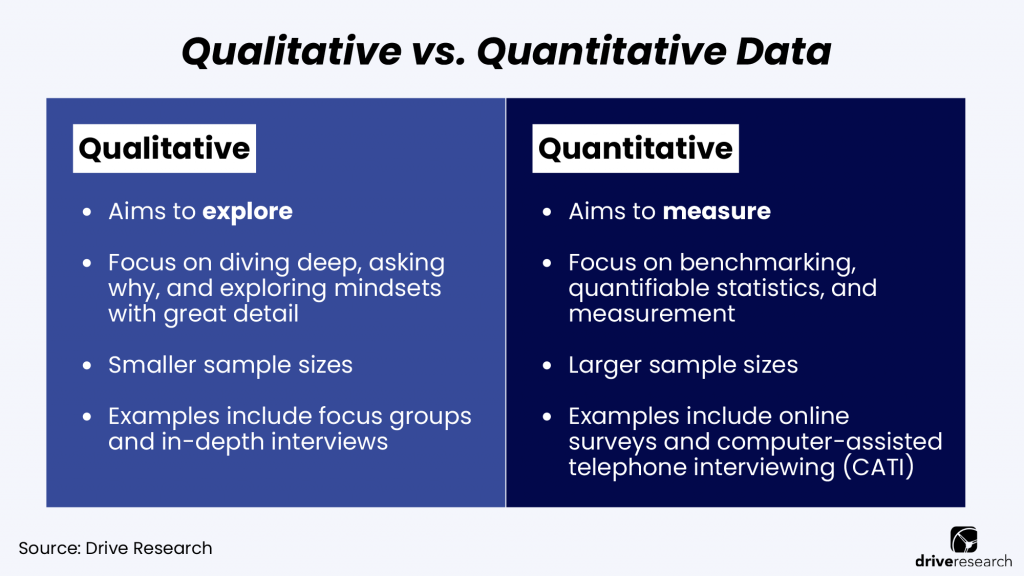
Qualitative researchfocuses on understanding motivations, perceptions, and decision-making processes through open-ended discussions. It is commonly used for message testing, concept development, and exploratory research, making it especially valuable during the early stages of product or campaign development.
Quantitative researchmeasures attitudes and behaviors at scale, allowing pharma brands to size opportunities, track performance, and compare results across segments. Many studies combine both approaches to gain depth and statistical confidence.
Types of Pharma Market Research We Help With
Focus Groups
Focus groups are used in pharmaceutical research to uncover perceptions, reactions, and language in a guided group setting from each participant.
They are especially useful for testing messaging, educational materials, and early-stage concepts. They also help researchers identify common themes, misconceptions, and emotional responses that may influence healthcare-decision making.
In pharma, focus groups may include physicians by specialty, patients with shared conditions, or caregivers. These discussions reveal how ideas resonate in real conversations and uncover insights that structured surveys may miss.
An added benefit of focus groups is the ability to observe group dynamics and peer influence, which are especially relevant in healthcare decision-making.
Physicians often react differently when hearing how peers approach treatment decisions, while patients may surface concerns or questions they would not raise in isolation. This interaction helps pharma teams refine messaging, educational tools, and support materials before wider rollout.
Online Surveys
Online surveys allow pharmaceutical companies to collect feedback from larger samples efficiently. They are commonly used for tracking awareness, measuring satisfaction, and quantifying preferences or behaviors, and evaluating market trends over time.
Well-designed surveys balance scientific rigor with respondent experience, ensuring medical professionals and patients can provide thoughtful, accurate input without fatigue.
In pharmaceutical research, online surveys are particularly valuable for benchmarking and tracking changes over time.
They can be deployed across regions, specialties, or patient populations to identify trends, compare segments, and support data-driven decisions. When paired with strong survey design and quality controls, online surveys offer scalable insights that are both reliable and actionable.
In-Depth Interviews
In-depth interviews provide one-on-one conversations that allow for deep exploration of complex topics. They are ideal for understanding prescribing behavior, treatment decision-making, and barriers to adoption.
Because conversations are conducted one-on-one, these interviews offer flexibility and confidentiality, making them well-suited for sensitive topics or high-value respondents such as specialists and healthcare executives.
Researchers can use these interviews to probe, clarify, and adapt questions in real time to uncover nuanced insights that may not surface in group settings.
In pharmaceutical research, this method helps teams understand not just what decisions are made, but why they are made, providing critical context for strategy, education, and commercialization planning.
Here’s a real world use case of IDIs for a pharmaceutical company
Drive Research conducted 32 in-depth phone interviews to help a pharmaceutical organization better understand how potential partners viewed its brand. Completed in May 2025, the interviews explored awareness, likelihood to partner, and the reasons behind those perceptions.
The findings could help the organization identify barriers to consideration, refine its messaging, and emphasize the qualities decision-makers value most. They could also guide future outreach and strengthen the company’s positioning with prospective partners.
If You Need To…
Best Research Method
Test messaging or concepts
Focus Groups
Measure satisfaction or awareness
Online Surveys
Understand complex decision-making
In-Depth Surveys
Explore treatment perceptions
Focus Groups or Interviews
Benchmark performance over time
Online Surveys
Key Takeaway: Research methods aren’t one-size-fits-all, and choosing the “right” one ultimately depends on your business objectives. It’s important to remember that while surveys quantify trends, focus groups and interviews provide deeper context needed to understand why certain trends exist.
If your pharmaceutical organization needs reliable insights to support development, commercialization, or brand strategy, working with an experienced market research partner can make all the difference.
Drive Research specializes in designing and executing pharmaceutical market research studies that deliver clear, actionable results while meeting industry standards and timelines. Reach out to discuss your objectives and learn how custom research can support your next decision.
B2B Qualitative Research: How to Collect Insights Into Your Audience
Blog Posts
Healthcare Qualitative Research [Types, Examples, & Challenges]
When You Give Us A Cookie
We analyze more than data—we also track how our site is used to improve your experience. Cookies help us understand what’s working so we can deliver the most relevant insights. Click “Accept” to enable full functionality.
Functional
Always active
The technical storage or access is strictly necessary for the legitimate purpose of enabling the use of a specific service explicitly requested by the subscriber or user, or for the sole purpose of carrying out the transmission of a communication over an electronic communications network.
Preferences
The technical storage or access is necessary for the legitimate purpose of storing preferences that are not requested by the subscriber or user.
Statistics
The technical storage or access that is used exclusively for statistical purposes.The technical storage or access that is used exclusively for anonymous statistical purposes. Without a subpoena, voluntary compliance on the part of your Internet Service Provider, or additional records from a third party, information stored or retrieved for this purpose alone cannot usually be used to identify you.
Marketing
The technical storage or access is required to create user profiles to send advertising, or to track the user on a website or across several websites for similar marketing purposes.