In today’s rapidly evolving business landscape, staying ahead of the competition requires more than just a great product or service. It demands a deep understanding of the market, consumer behavior, and emerging trends. This is where the market research process becomes invaluable. In this blog post, we will delve more into market research and explore...
There is never a wrong time to do market research. However, most research projects are birthed because a company or organization is at a crossroads. Whether you’re a startup or Fortune 500 company, you’ll have critical decisions to make. This blog will detail common market research examples and how our clients have used them to...
Mixed Methods Research: Examples, Designs, & When to Use It
George Kuhn
Mixed methods market research is an approach that uses more than one methodology to collect data within the same study. In most cases, that means combining qualitative and quantitative research, such as surveys, interviews, focus groups, or online communities, to answer a business question more completely.
In market research, this approach is often the right fit when one method alone cannot give you the full picture.
A survey may show that satisfaction is dropping, but not explain why.
A focus group may uncover strong reactions to a concept, but not tell you how widespread those opinions are across your target audience.
Our market research firm often recommends a mixed mode approach for high-stakes decisions like product development, customer experience programs, and brand strategy. That’s because it helps brands understand both the measurable trends and the human context behind them.
In this guide, I’ll walk through what mixed methods research is, when to use it, how it works, common design types, and a few examples of what it looks like in practice.
See how Drive Research designs custom mixed methods research studies.
Mixed methods research is the use of both qualitative and quantitative research methods to answer a business question.
You may also hear this referred to as mixed-mode research, hybrid market research, or multimethod research.
In practical terms, it means you are using more than one methodology to collect and analyze data for the same decision.
For example, a brand might work with a focus group company to explore what customers care about most, how they make decisions, and what product attributes influence their choices.
That early feedback can then be used to create an online survey with more precise wording and answer choices that are better aligned with how people actually think about the purchase.
Why Mixed-Mode Research is So Useful
Mixed methods research is valuable because it gives businesses a more complete view of the decision in front of them.
Instead of relying on one source of information, teams can look at an issue from multiple angles and come away with a clearer understanding of what matters most, what is driving behavior, and what to do next.
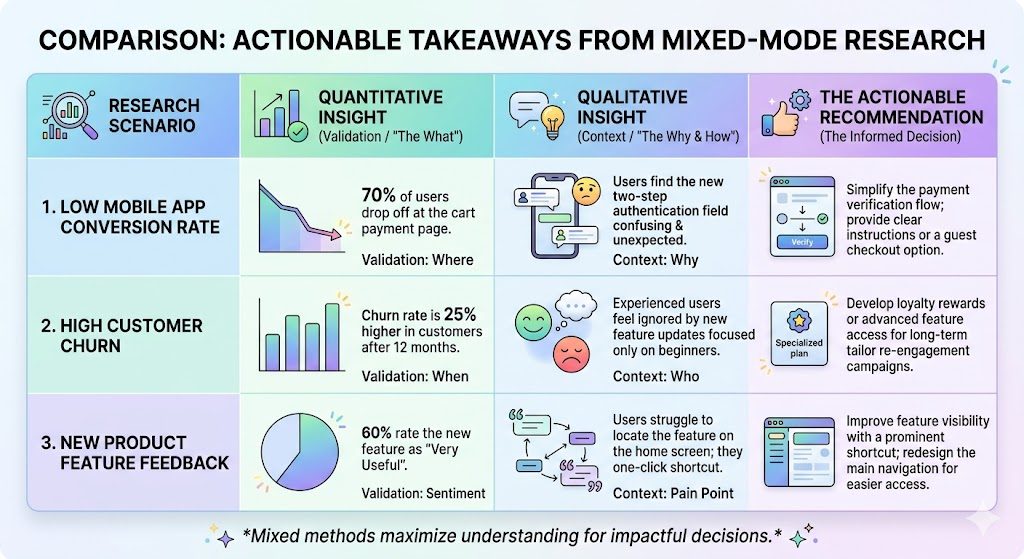
It combines scale with context. Quantitative research helps measure patterns across a larger audience. Qualitative research adds the explanation behind those patterns. Used together, they offer a stronger foundation for decision-making.
It improves the quality of the research itself. One phase can make the next phase better. Early in-depth interviews or focus groups can uncover the language people use, the tradeoffs they make, and the factors shaping their choices. That often leads to a survey with clearer wording, stronger response options, and more relevant questions.
It makes findings easier to prioritize. Mixed methods research makes prioritization easier by pairing measurable results with the context behind them. That helps businesses separate minor issues from the ones that are truly affecting choice, satisfaction, or loyalty.
It creates a stronger story for stakeholders. We know research is often shared across teams, not just with one decision-maker. Leadership may want clear numbers, while marketing, product, or operations teams may connect more with direct customer feedback. A hybrid research approach helps bridge that gap by combining evidence that feels both credible and human.
It reduces the risk of overlooking something important. Every type of market research method has pros and cons. A survey may miss nuance, while interviews alone may not show how widespread a theme really is. Combining both can lead to a more balanced and informed interpretation.
It leads to more actionable recommendations At the end of the day, research delivers the strongest ROI when it does more than identify what is happening and helps shape better decisions. Mixed methods research is often more actionable because it gives teams both the scale to validate an issue and the context to know how to respond.
When to Use Mixed Methods Research
Mixed methods research is not necessary for every project. Sometimes a well-designed survey is enough. Sometimes a round of in-depth customer interviews is all you need.
But there are certain situations where combining methods makes a lot of sense. Here are the instances where we often recommend a multimethod research approach.
When quantitative results are inconclusive
This is one of the most common reasons to add a qualitative research component.
Let’s say you hire an online survey company to field a survey among recent retail banking customers. The results show that satisfaction is lower among customers who opened a new checking account in the past 90 days.
While open-ended responses suggest onboarding may be part of the issue, interviews or focus groups can explore that experience in more depth and pinpoint exactly where customers are running into friction.
When the survey needs early direction
In some studies, the biggest risk is asking the wrong survey questions.
When we are working on a newer topic, a complex buying journey, or an audience with very specific language, we often recommend starting with qualitative work first. A few interviews can reveal the themes, terminology, and decision factors that should shape the survey.
That usually leads to stronger answer choices, more relevant metrics, and better data overall.
When you’re measuring an experience across multiple touchpoints
Mixed methods research is a strong fit for studies where the goal is not just to measure performance, but to understand what is shaping it. This is a common goal when organizations are evaluating employee experience, customer journey research, and brand tracking.
A quantitative phase can measure outcomes like awareness, satisfaction, engagement, participation, or perceived value across a broader audience. That helps identify where performance is strong, where it is lagging, and which groups may be having a different experience.
A qualitative phase adds the context behind those results. It can uncover why certain steps feel confusing, why a message is not landing, or why a program that looks effective at a high level is producing mixed reactions in practice. That added depth makes it much easier to move from reporting results to improving the experience.
When the decision is high stakes
The more expensive or visible the decision, the more useful it becomes to have both breadth and depth.
That might include:
Launching a new product
Repositioning a brand
Redesigning the customer experience
Refining pricing
Evaluating a major campaign
Prioritizing features on a roadmap
In these situations, the cost of making the wrong decision is often much higher than the added effort of running a mixed methods study.
Partner with Drive Research on your next mixed methods project.
When to Use Qualitative First vs. Quantitative First
This is a common question our market research company is asked – and it’s a good one. One of the most important decisions in a mixed methods project is sequencing.
Should you begin with interviews or focus groups and then move into a survey? 🤔
Or should you start with a survey and follow up qualitatively? 🤔
The answer depends on what you know already and what decision the research needs to support.
Start with qualitative research when you are still exploring
In most instances, we recommend qualitative research should come first, but especially when the topic is still fuzzy or at an early stage.
For example, if you are testing a concept, qualitative research can be a smart first step. At that stage, the goal is usually not to validate final numbers right away. It is to understand how people react to the idea.
A focus group can reveal which parts feel most compelling and which parts need refinement before you put the idea in front of a larger audience.
That makes the next phase of research much stronger, because the survey can focus on the messages, features, or concerns that actually surfaced in conversation.
Start with quantitative research when you need to measure or prioritize
Quantitative research should usually come first when you already have a strong sense of the issues, but need to measure them at scale.
For example, a company may already suspect that pricing, service responsiveness, and onboarding are the main drivers of churn. A survey can help quantify which one matters most, how different customer groups compare, and where the biggest opportunity sits.
Once you have that ranked or segmented data, qualitative follow-up can explain the patterns and bring the numbers to life.
Common Mixed Methods Research Designs (With Examples)
Convergent parallel design: In a convergent parallel design, qualitative and quantitative research happen at roughly the same time.
For example, a company might field a customer survey while also conducting a set of interviews with current customers. Each method explores the same broad topic, and the insights are brought together at the end.
This design is useful when you need both depth and scale quickly, and when the goal is to compare or validate findings across methods.
Explanatory sequential design: This design starts with quantitative research and follows with qualitative research.
A common example would be a survey that identifies surprising results, followed by interviews to understand why those results happened.
This is one of the most practical mixed methods designs in market research because it starts with measurable patterns and then adds explanation.
If a segment scores lower than expected, or one concept performs much better than another, qualitative follow-up can uncover what is behind that pattern.
Exploratory sequential design: This design starts with qualitative research and follows with quantitative research.
For example, a company may conduct interviews with buyers to understand how they evaluate vendors, what concerns slow down the purchase process, and what words they use to describe value. Those learnings are then used to build a survey that can measure those themes across a larger audience.
This is a strong design when the topic is newer, the language is unclear, or you want the survey to reflect the audience’s world rather than internal assumptions.
Embedded design: An embedded design places one method inside a larger study led by another method.
For example, a brand tracker may be mostly quantitative, but include a handful of follow-up interviews each wave to help interpret the movement in scores.
Or a series of focus groups may include a short pre-task survey to collect baseline reactions before the discussion starts.
This design is useful when one method clearly plays a supporting role.
Other design types you may hear about
Depending on the type of work, you may also hear terms like multistage, intervention, case study, or participatory mixed methods. These are more common in academic, healthcare, nonprofit, and evaluation settings, but the core principle is the same: use multiple types of evidence to answer a more complex question.
Our Step By Step Approach to Multimethod Research
A successful mixed methods study takes more than simply pairing two methodologies together.
There are a lot of decisions involved, from choosing which phase should come first to defining the audience, shaping the discussion guide or survey, and making sure each part of the research builds toward the same objective.
While the exact process depends on a company’s goals, timeline, and budget, here is a general approach we often follow when designing these studies for clients.
Step 1: Start with a kickoff meeting focused on the end goal
Before building the research plan, it is important to align on what the study needs to accomplish. That is why we typically begin with a kickoff meeting focused less on the methodology and more on the business goal behind the project.
At this stage, we ask questions like:
Why is this research happening now?
What are the desired objectives or outcomes?
What decisions should the study inform, whether that is pricing, promotions, product assortment, store experience, or brand positioning?
Who will be using the findings internally?
Those answers should carry through the entire process. They help shape the survey design, the moderator’s guide, the reporting, and the recommended actions that come from the data.
When that alignment happens early, the research is much more likely to lead to useful decisions.
Step 2: Separate what needs scale from what needs depth
Some questions are best answered with measurable data. Others need conversation and context.
For example:
“Which pain points are most common?” is usually a quantitative question.
“Why does that pain point matter so much?” is usually a qualitative question.
This step helps determine whether qual should come first, quant should come first, or both should happen together.
Step 3: Choose the right design
Once you know what needs to be measured and what needs to be explored, choose the right structure.
That could be exploratory sequential, explanatory sequential, convergent parallel, or an embedded design. I will explain each of those below.
Step 4: Build each phase so they connect
This is where many studies go wrong.
The interview guide, focus group discussion guide, and survey should not feel like separate projects. They should build on one another.
If qualitative comes first, use what you learn to sharpen survey language and answer options. If quantitative comes first, use the results to decide where qualitative probing should go deeper.
Step 5: Field the research
Run the first phase, or both phases if the design is parallel.
As data comes in, keep an eye on emerging themes and whether anything needs to be refined before moving forward. Good project management matters a lot here, especially if there are multiple audiences, vendors, or fieldwork streams involved.
Step 6: Turn findings into action
The final deliverable should answer the business question clearly.
What should the company prioritize?
What should it stop doing?
What should it test next?
What message should lead?
What features should move up the roadmap?
Mixed methods research is most valuable when it leads to decisions, not just documentation.
Contact Drive Research for surveys, interviews, and focus groups.
There are many ways to combine methods, but a few pairings show up again and again in business research.
Surveys + in-depth interviews
This is one of the most versatile combinations. A survey helps identify patterns, segment differences, and ranked priorities. Interviews then explain the logic, emotion, and language behind those results.
We often recommend this pairing for customer experience research, B2B studies, pricing work, and messaging development.
Surveys + focus groups
This combination works well when you need broad data and group discussion around a shared topic.
For example, a company might use a survey to evaluate awareness and consideration, then use focus groups to test reactions to creative, positioning, or product concepts in more detail.
Online community + survey
An online market research community can be incredibly useful when you want to learn over time instead of in one moment.
For example, you might use a community to collect journaling exercises, concept reactions, and follow-up discussions over several days or weeks, then field a survey to quantify the biggest themes with a broader audience.
Observational research + survey
Sometimes what people do and what they say are not exactly the same.
In categories like retail, healthcare, financial services, or consumer goods, observational work can help uncover real-world behavior. A survey can then measure how common those behaviors or barriers are across a wider audience.
Mixed Methods Research Examples (Real Client Stories)
Example 1: Interviews + Employee Survey + Online Survey
In one mixed methods research study, Drive Research partnered with an architecture, engineering, and construction firm to assess brand equity, understand differentiators, and explore company culture before moving forward with branding and messaging decisions.
The study was designed to gather feedback from multiple stakeholder groups, including principals, employees, current clients, and former clients.
To do that, the project combined three methods:
One-on-one interviews with principals
Employee survey
Online survey with current and former clients
In a case like this, mixed methods research is especially useful because a rebrand should not rely on one audience alone. It needs to reflect how the organization sees itself and how the market experiences it.
In another study, an international healthcare insurance company wanted to improve retention, learn more about non-members, and evaluate growth opportunities across the U.S., Mexico, and Chile.
We started with telephone in-depth interviews to explore buying decisions, needs, and pain points in more detail.
Those learnings then informed a broader online survey.
The result was a mixed methods design that helped the client move from exploration to validation, giving them stronger direction for both customer experience improvements and expansion strategy.
For a nonprofit education client, the challenge was understanding program awareness, barriers, and perceived impact across students, parents, and educators in Upstate and Western New York.
Drive Research began with an online survey to collect measurable feedback across audiences and markets. That same survey also helped recruit participants for nine follow-up focus groups.
The survey identified the patterns, and the focus groups added the context behind them, giving the client a clearer picture of how the program was being experienced in each community.
Drive Research is a full-service market research company that designs custom qualitative and quantitative studies based on your goals, audience, and timeline.
Whether you need a survey, focus groups, interviews, an online community, or a blended approach, our team can help you choose the right path and turn the findings into action.
When should I use qualitative vs. quantitative research?
Use qualitative research when you need depth, explanation, language, or early exploration. Use quantitative research when you need measurement, comparison, prioritization, or confidence at scale. Use both when the decision requires both a clear pattern and the reason behind it.
Is mixed methods research more expensive?
Usually, yes. It often involves more design work, more fieldwork, and more analysis. But it can also reduce risk and lead to better decisions, especially for larger or more complex business questions.
How long does a mixed methods project take?
That depends on the design. A parallel study may move faster on the calendar because both phases happen at once. A sequential design usually takes longer, but can produce better integration because one phase informs the next.
What is the best mixed methods design for market research?
There is no single best design for every study. Explanatory sequential works well when you want to explain survey results. Exploratory sequential is strong when you need to develop the right survey measures. Convergent parallel is useful when you need speed and want both types of insight at the same time.
How do you combine qualitative and quantitative findings in one report?
The best reports do not treat them as separate chapters. Instead, they organize findings around key business questions, then use quantitative data and qualitative insight together to answer each one. For example, a report might show that onboarding is the biggest driver of dissatisfaction, then include quotes or themes explaining exactly where that onboarding experience breaks down.
We analyze more than data—we also track how our site is used to improve your experience. Cookies help us understand what’s working so we can deliver the most relevant insights. Click “Accept” to enable full functionality.
Functional
Always active
The technical storage or access is strictly necessary for the legitimate purpose of enabling the use of a specific service explicitly requested by the subscriber or user, or for the sole purpose of carrying out the transmission of a communication over an electronic communications network.
Preferences
The technical storage or access is necessary for the legitimate purpose of storing preferences that are not requested by the subscriber or user.
Statistics
The technical storage or access that is used exclusively for statistical purposes.The technical storage or access that is used exclusively for anonymous statistical purposes. Without a subpoena, voluntary compliance on the part of your Internet Service Provider, or additional records from a third party, information stored or retrieved for this purpose alone cannot usually be used to identify you.
Marketing
The technical storage or access is required to create user profiles to send advertising, or to track the user on a website or across several websites for similar marketing purposes.