In today’s rapidly evolving business landscape, staying ahead of the competition requires more than just a great product or service. It demands a deep understanding of the market, consumer behavior, and emerging trends. This is where the market research process becomes invaluable. In this blog post, we will delve more into market research and explore...
There is never a wrong time to do market research. However, most research projects are birthed because a company or organization is at a crossroads. Whether you’re a startup or Fortune 500 company, you’ll have critical decisions to make. This blog will detail common market research examples and how our clients have used them to...
Transactional vs. Relational NPS: Which Should You Use & Why
Emily Taylor
Transactional vs. Relational NPS in Short: Both transactional and relational NPS measure customer loyalty, but they capture feedback at different points in the customer journey. Transactional NPS helps evaluate interactions as they’re happening while relational NPS measures sentiment over time. Understanding when to use each approach can help organizations collect more meaningful feedback and make more informed business decisions.
Ready to learn about the differences to consider when thinking about transactional versus relational net promoter score (NPS)? While both surveys measure customer loyalty using the same core question, they serve very different purposes depending on when feedback is collected.
One gathers NPS at a specific moment (like after a trigger event) within the customer journey, while the other is asked on a recurring basis (such as a quarterly or yearly cadence) to measure customer sentiment over time. Each provides valuable context, but the insights you’ll get can look different depending on the timing of the survey.
For example, a software company may send a transactional NPS survey immediately after a customer support ticket is resolved to evaluate that individual interaction and get quick reactions.
The same company might also send a relational NPS survey once a year to get a better understanding of how their customers feel about the brand as a whole. Together, these surveys provide a more complete picture of customer loyalty.
Below, we’ll explore the key differences between transactional and relational NPS, when each approach makes sense, and how organizations can use both to build a more robust feedback loop.
Build customer loyalty with data-driven NPS insights.
In both instances, Net Promoter Score (NPS) measures how likely a customer is to recommend a brand to others. Because the surveys are heavily focused on when they’re asked and not just the questions themselves, the timing becomes a valuable tool for different business objectives.
NPS is typically asked in a specific format using specific phrasing, which allows the results to be benchmarked to other organizations, industries, geographies of interest, and even their own historical performance over time.
Definition of Relational NPS
Simply put, relational NPS is asked in a more general manner, gathering insight into the likelihood to recommend a brand based on a customer’s experience overall/within a certain time frame (i.e., the last 12 months).
The ideal survey cadence depends on the type of organization and how frequently customers interact with it. For example, for a grocery store where customers visit weekly, it likely makes sense to ask customers on a more regular basis than a type of service/store with infrequent repeat visitors, like roofing companies.
Definition of Transactional NPS
Transactional NPS, however, gathers the likelihood to recommend a brand or organization after a specific customer touchpoint (i.e., point of sale).
Common transactional NPS touchpoints include:
Point of sale
After onboarding/kickoff
Post customer service ticket
Post major update
Post delivery date
Completion of a project or engagement
Subscription renewal or account review
Why both types matter and how they complement each other
Organizations don’t always have to choose between relational and transactional NPS. In many cases, the strongest customer feedback programs utilize both survey types to understand customer sentiment from multiple perspectives.
Think of relational NPS as a way to monitor the long-term health of the customer relationship, while transactional NPS helps pinpoint the specific areas or experiences that are exceeding expectations or falling short. When reviewed together, the results can reveal whether isolated issues are influencing overall customer loyalty or if broader trends need attention.
This more complete view helps organizations prioritize improvements, monitor changes over time, and make better business decisions.
What is the main difference between relational NPS and transactional NPS?
Feature
Relational NPS
Transactional NPS
Purpose
Measure overall customer loyalty
Measure loyalty after a specific interaction
Timing
Monthly, quarterly, or annually
Immediately after a touchpoint
Best for
Brand health and benchmarking
Journey optimization
Example
Annual customer survey
Post-support survey
Primary insight
Overall relationship
Individual experience
Research Tip: Avoid comparing one NPS type over the other. Because they measure loyalty and satisfaction at different touch points in the customer journey, the scores serve different purposes and should be evaluated within their own context.
When and How to Use Relational or Transactional NPS
Understanding the differences between relational and transactional NPS is only half the equation. Knowing when to use each survey type is just as important.
While some organizations rely exclusively on one approach, many find greater value in using both at different stages of the customer journey. The examples below highlight when each methodology is most effective.
Relational NPS
Think annual brand tracking for this one or recurring customer satisfaction and loyalty surveys for this approach. Relational NPS is what we’d recommend using when comparing the metric to other organizations as a more apples-to-apples comparison.
Because it captures an overall perception of your organization, relational NPS is often the preferred option when benchmarking against competitors or comparing results to industry averages. It also helps businesses monitor long-term trends and identify whether sentiment is improving or declining over time.
Transactional NPS
Consider transactional NPS for focusing on specific moments a customer might experience, like after purchasing, after reaching out to customer support, after a support ticket is resolved, after onboarding, after the final product/deliverables are sent, etc.
These specific moments transactional NPS pinpoints illustrate how strong or weak the customer experience is, making it easier to prioritize operational improvements where they will have the greatest impact.
Implementation
Deciding on the opportune timing/cadence really depends on the type of NPS survey and survey length.
For example, are you solely asking NPS and perhaps a few other questions, or is it part of a longer, annual CSAT survey? Transaction NPS is likely short and limited to just a handful of questions (or simply NPS and its rationale). These will typically occur at the desired moment, on a regular cadence (i.e., after every support ticket is resolved).
Relational NPS is likely part of a larger customer satisfaction or loyalty survey. These may occur on a monthly, quarterly, or annual basis. The cadence likely depends on general customer engagement levels, meaning you can likely survey more engaged customers more frequently.
Which type of NPS should I start with: relational or transactional?
The best place to start depends on the business questions you’re trying to answer.
Remember you don’t necessarily have to choose one over the other. Many organizations successfully use both!
If you’re looking to compare your results to other organizations or industry benchmarks, I would recommend starting with relational NPS. However, if you want to gauge loyalty after specific moments and compare/contrast those scores within the customer journey, transactional NPS would be more useful.
Designing Each Type of NPS Surveys
Ultimately, designing an NPS survey comes down to the type (i.e., relational versus transactional) and the goals of the research. While both surveys start with the same core NPS questions, the follow-up questions and survey timing should reflect the insights you want to uncover.
Sample Questions for Relational vs Transactional Surveys
First things first, you likely want to ask NPS to start.
How likely is it that you would recommend [insert company] to a friend or colleague? Select one.
Not at all likely 0
1
2
3
4
5
6
7
8
9
Extremely likely 10
◯
◯
◯
◯
◯
◯
◯
◯
◯
◯
◯
Please explain why you rated [insert company] as [insert response] out of 10. Enter your response below.
[Text box]
For transactional NPS, you might dive into a few specifics about the moment NPS is being gathered. For example, if it’s a point of sale, you might ask about satisfaction with value, packaging, ease of finding/sourcing, etc.
For relational NPS, you might want to dive into factors in choice, satisfaction with those factors, how satisfaction has changed in the past year, sources of awareness, etc.
How to Calculate and Interpret Relational vs Transactional NPS Results
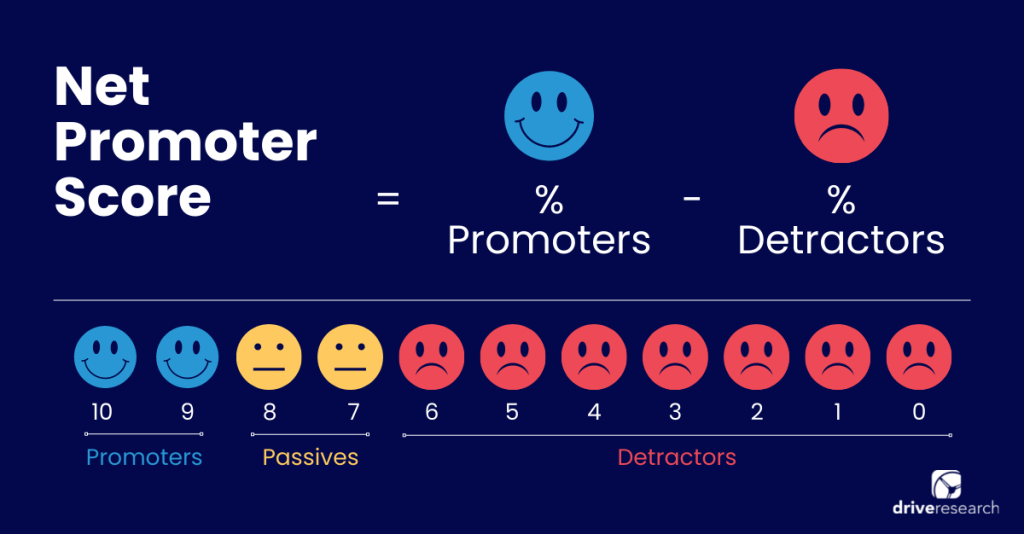
NPS categorizes respondents into three groups:
Promoters (rating of 9 or 10): Loyal customers who are likely to recommend your brand.
Passives (rating of 7 or 8): Generally satisfied customers who may be open to competitors.
Detractors (rating of 0 to 6): Customers who are less satisfied and may discourage others from choosing your business.
To calculate NPS, you subtract the percentage of detractors from the percentage of promoters, providing a score on a scale of -100 (all detractors) to +100 (all promoters). The goal of this metric is to help organizations understand how many raving fans their brand has.
Linking NPS results to business outcomes
NPS can be a helpful tool to understand and predict levels of churn, revenue, overall customer satisfaction, and more. While several metrics all play a role here, NPS can help provide insight into the relationship an organization has with its customers with trends related to:
Retention
Churn
Brand loyalty
Satisfaction
Repeat purchases or renewals
Referral and word-of-mouth potential
How often should I send a relational NPS survey?
The ideal cadence depends on your industry, customer engagement levels, and survey objectives. In general:
Monthly: Best for highly engaged customer bases using rotating samples.
Quarterly: Helpful for monitoring ongoing customer sentiment without excessive surveying.
Annually: Ideal for comprehensive relationship or brand health assessments.
As a best practice, longer surveys should generally be sent less frequently to prevent survey fatigue. Short surveys can be sent out more regularly, especially when organizations rotate participants rather than surveying the same customers every time.
Start measuring how your customers really feel with expert NPS research.
Integrating Relational & Transactional NPS Into a Customer Feedback Program
Metrics are meant to be used! Integrating NPS into a regular feedback program is a great way to keep the pulse on customer sentiment. Rather than treating NPS as a one-time measurement, organizations should use it alongside other customer experience metrics, establish clear follow-up processes, and turn customer feedback into meaningful improvements.
Combining NPS with other metrics
While NPS is one of the most widely used customer satisfaction metrics, it provides even more value when paired with other experience metrics like:
Customer Effort Score (CES):Measures how easy it is for customers to complete a task or interact with your business.
Likelihood to Switch (LTS): Helps eliminate risk of customer churn.
Together, these metrics provide a deeper look and understanding of customer loyalty, satisfaction, and future business opportunities.
Using NPS insights
As we know, results from NPS can help users understand where the organization falls in terms of its number of loyal customers. But also, organizations should also compare their findings against industry benchmarks to gain more helpful context for results-driven improvements. Once they get these insights, organizations can use them to:
Monitor changes in customer sentiment over a set time
Understand how competitors are meeting their customers’ needs
Identify trends across customer segments
Prioritize which operational changes to make first
Track the impact of customer experience initiatives
Acting on Transactional NPS Feedback
It’s safe to say that when responding to transactional feedback, faster is better, especially if the score is negative. This may mean taking action within 24 to 48 hours, depending on the industry. Common next steps include:
Escalating recurring issues to leadership
Identifying process improvements
Contacting dissatisfied customers
Monitoring recurring feedback trends
Recognizing employees for exceptional customer service
Establishing a closed-loop feedback process
One benefit of working with a custom research company is the ability to create automations upon receiving a response. This is particularly helpful because it allows the team to act quickly and respond to any concerns with the goal of reacting before fallout occurs. Some valuable aspects that can be automated are:
Alerting teams when low NPS scores are submitted
Routine feedback to appropriate departments
Triggering customer follow-up workflows
Tracking resolution status over time
Should You Combine Relational and Transactional NPS?
While you could combine these metrics into one overall score, there is value to understanding each separately.
Relational NPS is likely better for comparing results to other organizations or industry benchmarks, while transactional will provide a more nuanced/particular measurement at a specific moment. Combining them may mask meaningful trends and make it more difficult to identify where improvements are needed.
Instead, review each score independently while using both to build a more complete picture of customer satisfaction.
Best Practices at a Glance
Best Practice
Why It Matters
Pair NPS with CES and CSAT
Adds context beyond loyalty alone
Respond to low transactional scores quickly
Helps resolve issues before they escalate
Automate customer alters
Speeds up follow-up and improves consistency
Benchmark results over time
Measures long-term improvement
Keep relational and transactional scores separate
Preserves meaningful insights from each survey type
Ultimately, understanding the strengths of each NPS approach allows organizations to collect better insights and make even stronger decisions for their customer base. While relational NPS provides a broader view of customer loyalty over time, transactional NPS captures feedback at key moments throughout the customer journey.
And together, they paint a complete picture of where a business stands with their customer experience.
At Drive Research, we understand that the most successful customer feedback programs don’t just measure customer loyalty, but also use those insights to drive real action. Whether you need help deciding on your NPS approach or building out a comprehensive feedback program, our NPS market research experts are here to help.
11 Best Ways To Improve Customer Experience & Why It Matters
Blog Posts
Alternatives to NPS: How Else To Track Customer Satisfaction
When You Give Us A Cookie
We analyze more than data—we also track how our site is used to improve your experience. Cookies help us understand what’s working so we can deliver the most relevant insights. Click “Accept” to enable full functionality.
Functional
Always active
The technical storage or access is strictly necessary for the legitimate purpose of enabling the use of a specific service explicitly requested by the subscriber or user, or for the sole purpose of carrying out the transmission of a communication over an electronic communications network.
Preferences
The technical storage or access is necessary for the legitimate purpose of storing preferences that are not requested by the subscriber or user.
Statistics
The technical storage or access that is used exclusively for statistical purposes.The technical storage or access that is used exclusively for anonymous statistical purposes. Without a subpoena, voluntary compliance on the part of your Internet Service Provider, or additional records from a third party, information stored or retrieved for this purpose alone cannot usually be used to identify you.
Marketing
The technical storage or access is required to create user profiles to send advertising, or to track the user on a website or across several websites for similar marketing purposes.