In today’s rapidly evolving business landscape, staying ahead of the competition requires more than just a great product or service. It demands a deep understanding of the market, consumer behavior, and emerging trends. This is where the market research process becomes invaluable. In this blog post, we will delve more into market research and explore...
There is never a wrong time to do market research. However, most research projects are birthed because a company or organization is at a crossroads. Whether you’re a startup or Fortune 500 company, you’ll have critical decisions to make. This blog will detail common market research examples and how our clients have used them to...
Consumer Product Evaluation: What It Is and How It Works
Austin Parker
Consumer Product Evaluation in Short: Consumer product evaluation is the process of putting a product in front of its target consumers and measuring how they perceive, use, and respond to it. Studies typically measure appeal, perceived quality, purchase intent, and specific attribute performance using methods like in-home usage tests (IHUTs), central location tests (CLTs), online surveys, focus groups, and sensory evaluation panels.
Every product on a shelf started as an idea that someone believed consumers would buy again and again. Consumer product evaluation is how that idea gets tested against real people, gathering the insights needed before your brand bets the launch budget on it.
It’s easy to think of evaluation as a single test you run once. However, In real research, the strongest brands treat this as an ongoing investment, running smaller studies at each decision point and larger ones before major product launches.
The teams that get this right make better product decisions, catch problems earlier, and go to market with greater confidence because their decisions are backed by reliable consumer feedback, not assumptions.
In this guide, we walk through what consumer product evaluation measures, the methods that produce those measurements, and the step-by-step process our team uses to run a study that actually informs a business decision.
Turn consumer feedback into confident decisions with a consumer product evaluation today.
The stakes are high for new products that haven’t hit the market yet. According to NielsenIQ BASES, products flagged as “not ready” in pre-market testing carry an 80% failure rate when brands push them to launch anyway. Most of those failures can be identified long before a product reaches shelves. Consumer product evaluation helps uncover those risks early.
A product solves a problem consumers don’t actually have.
It solves a real problem in a way consumers reject.
The packaging or price can’t clear the shelf.
Consumer product evaluation also protects the investments you’ve already made, and prevents your new product ideas from falling victim to these three challenges. Marketing budgets, retail slotting fees, production runs, and distribution deals are often committed before launch, making it important to validate assumptions about how consumers will respond before investing further.
Key Takeaway: Consumer product evaluations encourage a habit of making decisions based on evidence rather than assumptions. While it can feel tempting to jump the gun and move a promising idea forward, evaluation provides the data needed to refine it, validate key decisions, and better meet consumer expectations before it hits the market.
What Consumer Product Evaluation Measures
No single metric tells the complete story of how a product will perform in the market. Instead, a well-designed evaluation study measures several factors that help brands understand how their product is perceived by consumers and where improvements are needed.
Below are the five most common metrics included in consumer product evaluation
1. Product Appeal
Product appeal measures how much consumers like the product overall, usually on a 5-point or 7-point scale. It’s often the first metric brands look at, but shouldn’t be viewed in isolation.
Strong appeal means the product resonates with its target audience. However, weak appeal doesn’t automatically mean the product is bad. It just means that positioning may be off, the target consumer isn’t the right fit, or the product doesn’t feel different enough compared to what’s already in stores. Appeal is the starting question, not the ending one, and it always needs to be paired with other metrics to tell you what to do next.
2. Perceived Quality and Value
Perceived quality captures whether consumers feel the product is well-made. Perceived value captures whether they feel it’s worth what you’re planning to charge. The two are related but distinct, and both matter.
A product can score high on quality and still fail on value. That usually means the price is too high for what consumers believe they are getting. On the flip side, a product that scores low on quality but high on value is usually competing on price, which can limit its long-term competitive advantage.
In our experience, this metric is where surprises show up. Teams close to a product often overestimate how much premium consumers will pay for materials or features they’ve spent months perfecting. Consumers evaluate the final product from a different perspective, and what they share usually reveals more about the reality of a product’s value than businesses expect.
3. Purchase Intent
Purchase intent is one of the metrics most closely tied to real-world sales performance.
It typically uses a 5-point scale:
Definitely would buy
Probably would buy
Might or might not buy
Probably would not buy
Definitely would not buy
The top-two-box score combining “Definity would buy” and “Probably would buy” is typically the metric brands focus on most because it is a telling indicator of overall purchase interest.
However, intent can’t always predict purchase volume, so it shouldn’t be seen as a definitive sales forecast. A top-two-box score of 60% isn’t a guarantee that 60% of the market will buy the product. It’s a signal that the concept has enough value for consumers to consider purchasing it. Translating intent into projected sales require additional analysis that considers category trends, distribution assumptions, and marketing plans.
4. Attribute Performance
Attribute-level ratings are where evaluation becomes more diagnostic. Instead of asking “Do you like this product?” consumers rate the individual features that make up their overall experiences.
The specifics vary by category, but common ones include:
Scent (fragrance, cleaning products, personal care)
Texture and mouthfeel (food, beverage, skincare)
Packaging design and ease of use (nearly every category)
Setup time and effort required (electronics, appliances, kits)
Cleanup and maintenance (durable goods, kitchen and home)
The goal is the same across all of them: isolate which parts of the product are working and identify which ones are bringing the overall score down. This is where you’d find, for example, that a diaper’s fit scores strongly but the packaging opens awkwardly.
Or that a beverage’s flavor lands but the bottle is hard to grip. These smaller insights help prioritize product improvements that businesses don’t realize could stop their buyers from becoming loyalists.
5. Unmet Needs and Improvement Areas
The final piece of a strong evaluation study surfaces is understanding what consumers feel a product is missing. These insights are usually captured through open-ended survey questions or in-depth follow-ups after a usage period, and they’re the most valuable findings in the entire study.
Unmet needs, though challenging, should be embraced as they are what helps you build an elevated version of your original product roadmap. They enable you to look deeper for improvements, new features, packaging enhancements, or even future product line extensions. In our experience, teams that take this qualitative feedback as seriously as their quantitative results are the ones who make more informed decisions and develop stronger products over time.
Consumer Product Evaluation Methods
There isn’t a single “best” consumer product evaluation method. The right approach depends on your research objectives, product category, and the type of insights you need. Strong evaluation programs blend two or three methods across a single study, and the difference between qualitative and quantitative approaches shapes what each one can and can’t tell you.
Here are the five most common methods at a glance:
Method
Best for
Typical sample
Setting
IHUT
Real-world usage over days or weeks
30 to 100
Participant’s home
CLT
Controlled side-by-side product testing
30 to 100
Research facility or mall intercept
Online survey
Statistically projectable metrics at scale
300+ per cell
Remote, self-administered
Focus group
Deep qualitative exploration of reactions
6 to 10 per session
Facility or online video
Sensory panel
Precise measurement of sensory attributes
Varies by test type
Sensory booth, controlled
In-Home Usage Tests (IHUTs)
In-home usage tests are one of our favorite methods for consumer product evaluation. This research method allows consumers to use a product in their everyday environment over a set period, and capture how it fits into their daily routine. Because of this natural evaluation, IHUTs often uncover packaging frustrations, usability issues, and performance challenges that may not come up in a research facility.
For example, we recently ran an IHUT for a home fragrance manufacturer developing a new nebulizer, ultrasonic diffuser, and wax warmers.
The client shipped us prototypes and we recruited 40 participants against their target consumer profile and had 30 to 35 complete a four-week test with daily usage logs. Consumer feedback revealed leaking around the siphon, unexpected noise levels, cycle time issues, and a setup process consumers found frustrating.
The fragrance brand used those findings to make functional changes before moving to branded packaging in phase two.
Central Location Testing (CLTs)
Central location tests bring consumers into a controlled setting, such as a research facility or mall intercept location, to evaluate products under consistent testing conditions. Where IHUTs win on realism, CLTs win on control. Every respondent gets the same sample, in the same rotation, at the same temperature, in the same environment.
This research method is also well suited for early-stage prototypes without commercial packaging, formulations that require refrigeration or specific handling, or products with confidentiality concerns that rule out sending them home.
Online Product Surveys
Online surveys are one of the most flexible and scalable evaluation methods. They allow brands to measure key metrics like attribute performance and competitive positioning across large audiences.
Modern online surveys are more than multiple-choice questionnaires. They now incorporate visual stimuli, heat maps, side-by-side comparisons, and open-ended follow-ups that all fit inside a single survey, giving researchers both quantitative and qualitative context all at once.
For instance, we ran an online survey for a cold-pressed juice brand testing two package label designs before a retail rollout.
We recruited 800 respondents against the target consumer profile and paired appeal ratings with heat map testing and word associations. Ultimately, the findings gave the client clear direction on what would resonate most with their audience.
The heat map showed which specific label elements consumers focused on while the word associations revealed how those elements shaped the brand’s perceived positioning, helping for more informed business strategies.
Focus Groups
Focus groups are best suited to use in consumer product evaluations when the goal is depth of understanding rather than breadth of numbers. A moderated discussion with a smaller group of 6 to 10 target consumers can surface emotions, perceptions, motivations, and language that quantitative data alone can’t capture.
So, focus groups are especially valuable when used alongside a quantitative study. After identifying trends through a survey, conducting a follow-up focus group study can help further explain the reasons behind the results.
Sensory Evaluation Panels
Sensory evaluation panels are a specialized method used when the product’s success depends on how it registers to the human senses. This includes any product where taste, smell, texture, sound, or visual appeal shape purchase behavior, and has become technically rigorous enough where organizations like ASTM International have published protocols for brands running defensible sensory tests.
Sensory panels fall into two main categories:
Affective panels: Regular consumers what they personally like or don’t like about a product.
Descriptive panels: Trained panelists identify specific attributes like intensity, mouthfeel, or aftertaste. The precise language used in this panel explains why one product is preferred, and gives R&D teams what they need to take action.
Many consumer product evaluation studies benefit from both approaches. Affective panels validate overall appeal while descriptive panels identify specific attributes motivating preferences. Together, they build a more complete picture of what makes a product so likable by a target audience.
Monadic vs. Comparative Consumer Evaluation
Beyond picking a research method, you also need to pick a research design. Two designs dominate consumer product evaluation, along with two hybrid variants worth knowing about. Choosing the right design influences the quality of your findings, meaning it’s just as important as choosing the right methodology.
Monadic testing shows each respondent one product in isolation. Comparative testing shows every respondent every product. That single difference has real consequences for what you can conclude from the results and which design best supports your research objectives.
Design
How it works
Best for
Trade-off
Monadic
Each respondent evaluates one product independently
Predicting real-world purchase modeling and making go/no-go decisions
Requires a larger sample size but more closely reflects real purchasing power.
Comparative
Every respondent evaluates more than one product, side by side
Comparing concepts, packaging, or product variations early in development.
Rankings may exaggerate differences because participants must choose between options.
Monadic testing closely reflects how consumers make purchasing decisions in the real world. Instead of comparing several products side by side, most shoppers evaluate one product at a time, and decide if it’s worth buying. So, monadic research provides a more realistic measure of interest.
Comparative testing is particularly useful if your goal is to compare multiple concepts, formulations, or packaging designs. Because participants evaluate products alongside one another, strengths and weaknesses are easier to identify. However, interpretations from comparative studies should be taken with a grain of salt as participants will typically rank products, even if none fully meet their expectations, leading to uneven results.
Pro Tip: Choose monadic testing when you need the most realistic picture of market performance. Choose comparative testing if you need to narrow down multiple concepts before moving forward.
How to Conduct a Consumer Product Evaluation
The evaluation itself is only part of the work. Getting a study to actually inform a business decision means moving carefully through each step of the process, ensuring that you aren’t skipping or rushing through any of them to keep findings reliable, actionable, and business-aligned.
Here’s how Drive Research approaches a typical consumer product evaluation study.
Step 1: Identify What You’re Evaluating and Why
Every good evaluation starts with a specific business question. Instead of asking broad questions like, “How is our product performing?” focus on the decision you’re trying to make, like if you should launch one product variant over another, or if your pricing is aligned with consumer expectations. Clearly defining your objectives helps shape every decision that follows.
This is also the stage where you decide what success looks like in numeric terms. Creating performance benchmarks (purchase intent, appeal scores, etc.) before fieldwork is done helps ensure results stay objective and can be tied to your original goals.
Step 2: Design the Study and Select a Method
Once the business question is locked, the next step is choosing the best methodology. Different research methods work best for different objectives.
For example:
Testing early prototypes with no packaging? A CLT lets consumers handle the product without the constraints of home shipment.
Evaluating a fully-formed product across a full usage cycle? An IHUT is where you’ll get the richest data.
Comparing multiple design options quickly and cheaply? An online survey with visual stimuli is usually the answer.
Trying to understand why consumers react a certain way? A focus group will surface language and emotion the numbers can’t.
Study design is where the details matter. Sample size, question wording, order effects, scale choices, and stimulus quality all shape the reliability and value of your findings.
Step 3: Recruit Qualified Participants
The quality of your research depends on the quality of your participants. A concept test with the wrong audience produces purchase intent numbers that don’t predict anything, because the respondents wouldn’t buy the category at any price. Rigorous qualitative recruiting starts with a well-written screener and gets tightened with follow-up verification before anyone actually joins the study.
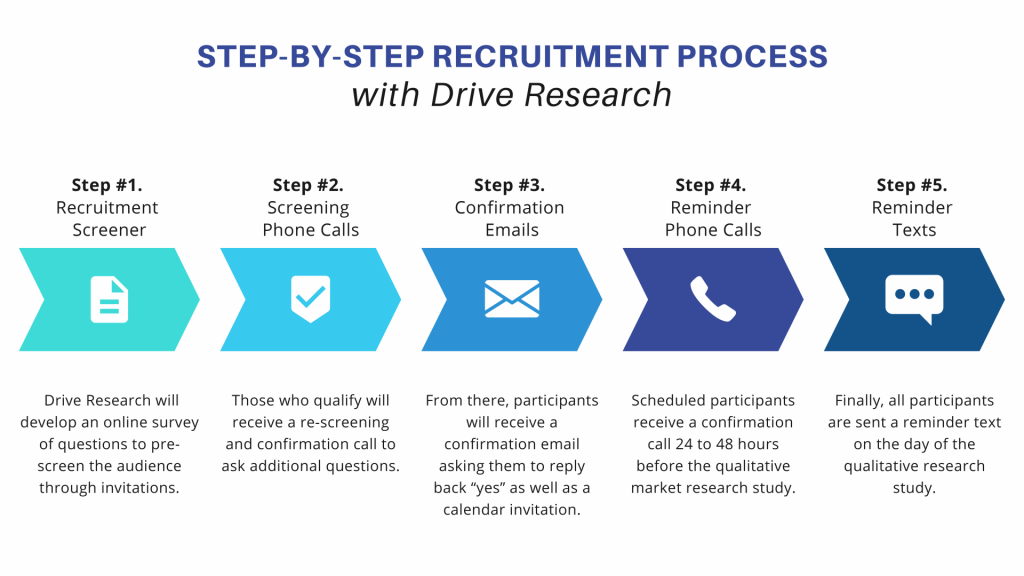
At Drive Research, our participant recruitment includes a detailed screener, a re-screening phone call, a confirmation email, and reminder communications before they ever start the study. While this process requires more time than fully automated recruitment, it ensures the right people can properly evaluate your product.
Step 4: Collect and Analyze Feedback
Collecting feedback is only one part of the research process. The real value comes from analyzing the data and discovering meaningful patterns that drive smarter decisions.
Our analysis typically includes:
Comparing results against your predefined success metrics.
Reviewing attribute-level performance to see strengths and weaknesses.
Analyzing open-ended responses for recurring themes and opportunities.
Segmenting results to uncover differences across key groups.
Step 5: Translate Findings Into Action
Having a stack of charts and cross-tabs with endless data is never the end goal. The final step is translating findings into clear, prioritized recommendations that directly answer your original business question.
In our experience, this is where evaluation studies deliver the greatest value. 60-slide decks full of raw data and broad suggestions aren’t helpful to anyone. That’s why our reports always end with actional recommendations that move from data collection to launch.
Key Takeaway: Consumer product evaluations don’t end with data. They end with direction. Data should always serve as a roadmap and give your team clear, evidence-based next steps that reduce uncertainty and strengthen choices.
Frequently Asked Questions About Consumer Product Evaluation
What is consumer product evaluation?
Consumer product evaluation is the research process of putting a product in front of its target consumers and measuring how they perceive, use, and respond to it. It measures key metrics like appeal, purchase intent, perceived quality, and attribute performance using methods including IHUTs, CLTs, online surveys, focus groups, and sensory panels. The insights gathered helps brands make evidence-based decisions about launching, refining, or improving a product.
What is the difference between monadic and comparative product testing?
Monadic testing shows each respondent one product in isolation, which mirrors how consumers actually encounter products in the real world. Comparative testing shows every respondent every product and asks them to rate or rank them side by side. Monadic testing is more accurate for predicting real-world performance. Comparative testing is faster and more cost-efficient for screening a longer list of options. Most rigorous evaluation programs use monadic testing for final go/no-go decisions.
What does consumer product evaluation measure?
A typical evaluation study measures five things: overall appeal, perceived quality and value, purchase intent, attribute-level performance (scent, texture, packaging, ease of use, and more), and unmet needs or areas for improvement. However, the right mix depends on the goals of the study and the business decision it’s meant to inform. Not every study needs all five metrics.
How do you recruit consumers for a product evaluation study?
Recruiting starts with a well-written screener that filters for qualified participants within your target audience. The screener is followed by a re-screening call, a confirmation, and reminder communications before the study begins. Skipping any of these steps compromises participant quality and ultimately, the reliability of your findings.
When should a brand conduct a consumer product evaluation?
Brands should conduct consumer product evaluations as early and as often as their development process allows. Some evaluations happen at the concept stage before development. Others happen during prototype validation, pre-launch, launch, and post-launch to guide future product improvements. The most common mistake we see is running the first evaluation study after development is nearly complete, when there’s no room left to act on what the research reveals.
Consumer product evaluations are an invaluable tool to use to have a better understanding of how your product’s perceived value and to reduce decision uncertainty before launch. Partnering with an experienced research firm ensures you’re collecting reliable, actionable insights from the right consumers using the right methodology.
Drive Research is a full-service product testing research company that designs and executes consumer product evaluation studies for CPG brands, healthcare organizations, financial services firms, and B2B companies across the country. Whether your team is working on a new product or refining an existing one, we’d like to help.
We analyze more than data—we also track how our site is used to improve your experience. Cookies help us understand what’s working so we can deliver the most relevant insights. Click “Accept” to enable full functionality.
Functional
Always active
The technical storage or access is strictly necessary for the legitimate purpose of enabling the use of a specific service explicitly requested by the subscriber or user, or for the sole purpose of carrying out the transmission of a communication over an electronic communications network.
Preferences
The technical storage or access is necessary for the legitimate purpose of storing preferences that are not requested by the subscriber or user.
Statistics
The technical storage or access that is used exclusively for statistical purposes.The technical storage or access that is used exclusively for anonymous statistical purposes. Without a subpoena, voluntary compliance on the part of your Internet Service Provider, or additional records from a third party, information stored or retrieved for this purpose alone cannot usually be used to identify you.
Marketing
The technical storage or access is required to create user profiles to send advertising, or to track the user on a website or across several websites for similar marketing purposes.