In today’s rapidly evolving business landscape, staying ahead of the competition requires more than just a great product or service. It demands a deep understanding of the market, consumer behavior, and emerging trends. This is where the market research process becomes invaluable. In this blog post, we will delve more into market research and explore...
There is never a wrong time to do market research. However, most research projects are birthed because a company or organization is at a crossroads. Whether you’re a startup or Fortune 500 company, you’ll have critical decisions to make. This blog will detail common market research examples and how our clients have used them to...
If you have ever considered market research that asks respondents to make trade-off decisions, there is a good chance you have heard of MaxDiff or conjoint research.
These are two powerful and advanced research techniques that go a step beyond direct question-and-answer analysis.
Both of these research methods have one thing in common: they each allow businesses to understand which features directly impact their target audience.
However, these techniques aren’t interchangeable, and choosing the wrong one wastes budget and respondent time in your online surveys.
Below, we’ll break down what MaxDiff and conjoint are, when to use each, real examples, benefits, sample sizes, and how the two can work together.
The short answer: MaxDiff ranks individual items by importance. Conjoint analysis measures how people trade off attribute levels inside full product configurations. Use MaxDiff to prioritize a long list of features, messages, or claims. Use conjoint when pricing, packaging, or product design decisions are at stake.
Choose the right technique—explore the differences between MaxDiff and Conjoint Analysis for optimal insights.
MaxDiff, short for Maximum Difference Scaling, is an advanced survey method we use to prioritize a list of attributes, features, statements, or other items.
It is a repetitive exercise in which respondents are presented with a handful of items to review, which are placed into two groups:
The one they deem the “best”
The one they deem the “worst”
There’s flexibility in the terms used for the two selections as long as they’re opposites, most important / least important, most appealing / least appealing, and so on.
Respondents may repeat this exercise 1 to 30 times, depending on the total number of items in the list. Ideally, you want each item to appear at least three times across the exercises.
The resulting data consists of how often each item was selected as “best”, selected as “worst”, or not selected when displayed. An analysis creates a hierarchy of the items, factoring in all the data.
The items at the top can be interpreted as the best overall. Conversely, the items that fall to the bottom would be the worst overall.
In our experience, the biggest benefit of MaxDiff is how it forces respondents to consider each set carefully. The trade-offs sharpen differentiation in the results, far better than the flat “everything is important” pattern you get from select-all-that-apply or Likert questions.
💡 The Key Takeaway: MaxDiff produces a clean, defensible ranking of items by forcing trade-offs respondents can’t dodge.
Example of MaxDiff Analysis
Let’s take a look at an example of how MaxDiff works. Say a company wants to determine which features of a new smartphone are most valued by potential customers.
They design a survey where respondents select the most and least important features from selections like:
Price
Battery life
Camera quality
Screen size
Overall style
After collecting responses, they analyze the data to produce a utility score for each feature.
Results might show that price is the most important feature (22%) and the operating system is the least important (2%), helping the company prioritize features in their product development.
MaxDiff Benefits
MaxDiff offers a range of advantages, both for what it reveals and how it’s run. A few we lean on most often:
Forces differentiation. By making respondents pick within each set, MaxDiff mirrors real-world decisions and sidesteps the survey trap of everything being rated equally important.
Versatility in applications. MaxDiff isn’t just for feature prioritization. It also works for honing in on the most effective messaging or talking points and uncovering the key drivers of customer satisfaction.
Flexible analysis options. Basic output is a ranking of items from most to least preferred, often using simple best-minus-worst scoring. More advanced approaches generate individual-level utility scores, market simulations, and segmentation inputs.
User-friendly for respondents. The task is to pick the best and the worst, which makes it less mentally taxing than conjoint and reduces survey fatigue.
Cost-effective. MaxDiff requires less investment in design, programming, and analysis than conjoint, which makes it a strong fit when budgets are tight.
💡 The Key Takeaway: MaxDiff is the workhorse method when you need clean priorities fast and you don’t need to model real-world product configurations.
What Is Conjoint Analysis?
Conjoint analysis is an advanced survey research method that focuses on product or service optimization.
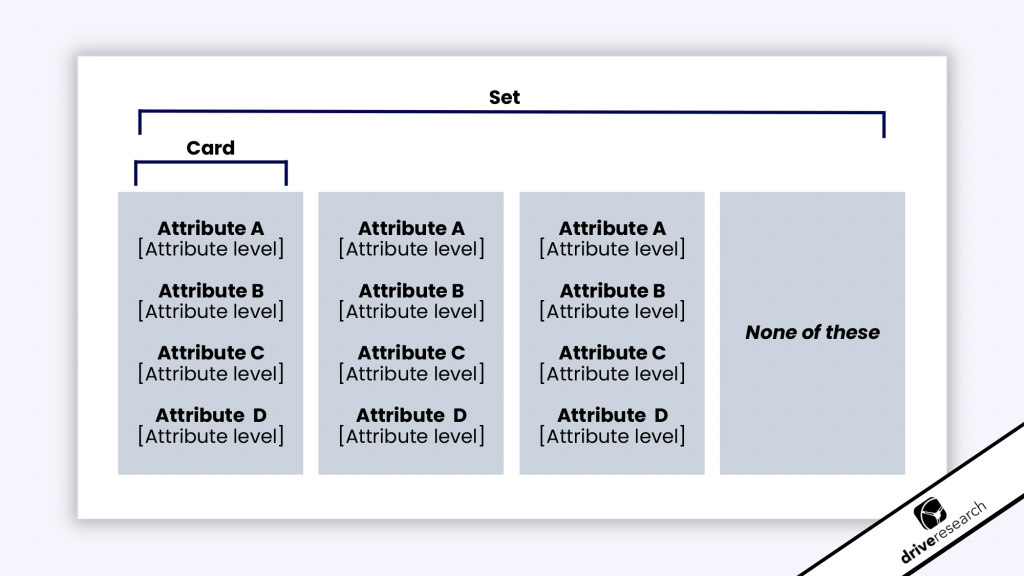
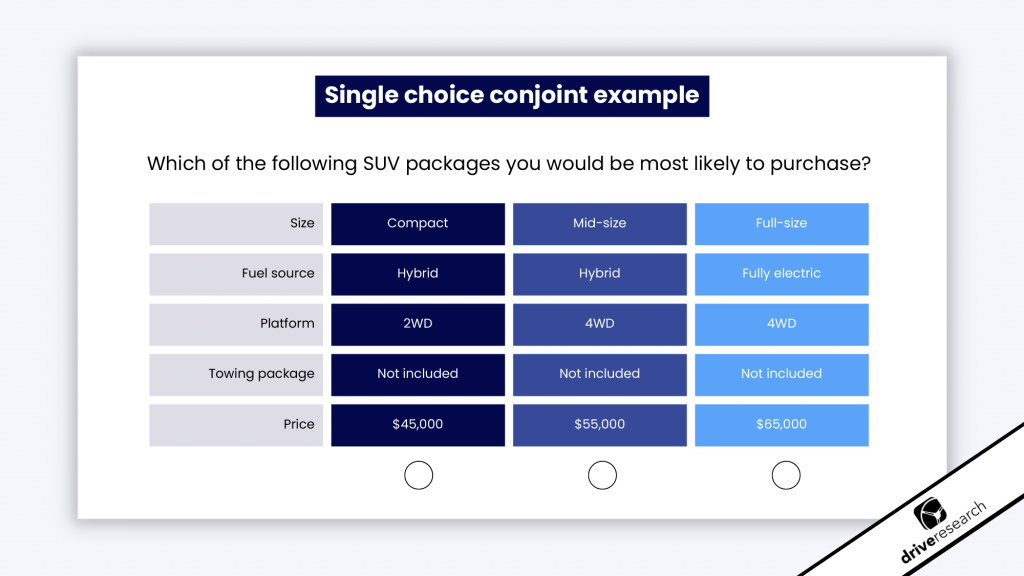
This technique presents survey respondents with hypothetical products or services and asks them to choose which one they prefer. Each product or service is defined by multiple predetermined attributes with various levels under each attribute.
These questions replicate real-world decision-making, collecting valuable data with every respondent selection. The data is used to calculate utility values (desirability measurements) for each attribute level featured in the design. The relative importance of each attribute overall can also be calculated.
The results of a conjoint analysis can be inserted into a market simulator to see the impact of a customized portfolio of products and services.
Using a market simulator allows a business to estimate the market share of its current offerings, potential new offerings, and competitive offerings in any combination.
Example of Conjoint Analysis
Here is an example of how conjoint analysis can be helpful. Let’s say a car manufacturer wants to understand consumer preferences for a new model.
They conduct a conjoint analysis by presenting potential buyers with different car configurations, varying attributes such as engine type (hybrid, gasoline), price ($35,000, $45,000, $65,000), and additional features (size, platform, towing package).
Then, respondents rank or choose their preferred options among these combinations in a survey. The analysis reveals that consumers value advanced safety features the most, followed by engine type and then price.
With this insight, the company can focus on incorporating advanced safety features into their new model and highlight these features in marketing campaigns to better meet consumer demands and maximize market share.
Check out some additional examples of conjoint analysis here.
Conjoint Analysis Benefits
Conjoint analysis brings unique advantages by simulating more realistic decision-making scenarios. The ones that matter most: Realistic insights. By including both attributes and their levels, conjoint analysis mirrors the complexity of real-world choices. Respondents make trade-offs, and we get to see how attributes influence one another rather than studying them in isolation.
Versatility in applications. Conjoint identifies the optimal combination of attributes for a target audience, pinpoints price points, and measures willingness to pay for specific features. It’s especially useful in industries like healthcare and finance, where buyers weigh intricate product or service options.
Attribute and level analysis. Unlike MaxDiff, conjoint measures both the importance of each attribute and the desirability of different levels within each attribute, for example, open parking vs. covered parking vs. indoor parking.
Advanced analysis. Conjoint enables market share simulations, optimal product configurations, and segmentation analysis, outputs that can directly shape product, pricing, and go-to-market strategy.
⚠️ Caveat: Conjoint asks more from respondents than MaxDiff. If your attribute list is too long or your levels are too granular, respondent fatigue starts driving the results instead of true preference. Keep the design tight, typically 4 to 6 attributes with 2 to 5 levels each.
MaxDiff vs. Conjoint Analysis – What’s The Difference?
Even though we have covered the basics of MaxDiff and conjoint analysis, you may still be wondering what makes each technique unique. While they both utilize trade-offs in respondent decision-making, these two methods are not interchangeable.
Their primary objectives and outputs are what set them apart.
While you can determine the importance of product attributes using either one, conjoint analysis allows you to test different levels of each attribute at one time.
Here’s how the two methods stack up side by side:
Factor
MaxDiff
Conjoint Analysis
What it measures
Prioritization of individual items in a list
Trade-offs between attribute levels in a full product profile
Question format
Pick the best and worst from a small set of items
Pick the preferred product from competing bundles of attributes
Respondent burden
Lower, short, easy choices
Higher, more cognitive load per question
Cost
More budget-friendly to design, field, and analyze
Higher investment in design and analysis
Output
Utility scores and a ranked hierarchy of items
Attribute importance, level of desirability, and market share simulations
New product development, pricing, portfolio optimization, competitive assessment
When to Use MaxDiff vs. Conjoint Analysis
Below are some of the most common applications for MaxDiff and conjoint analysis. These use cases help illustrate how these two techniques differ and where they each might fit within your business objectives.
When to Use MaxDiff
Feature Prioritization: If you have a list of product or service features but don’t know what customers most value, consider using MaxDiff. The results will provide a clear order of importance for all the features.
Message Testing: MaxDiff may also be leveraged to test advertising copy, taglines, or positioning statements. You will be able to narrow down which messaging performs the best among your target audience.
Segmentation: If your ultimate goal is to segment your customers or market, MaxDiff offers an excellent first step. By having respondents select the psychographics they most and least identify with, you have a reliable method for collecting the input data for a segmentation cluster analysis.
When to Use Conjoint Analysis
New Product Development: Conjoint can be a great tool for businesses that are looking to launch a new product or service. You may learn the best combination of attribute levels to maximize market share and avoid cannibalization.
Portfolio Consolidation: Conjoint also works well if your goal is to optimize your current portfolio of products and services. See the direct impact of consolidating or removing offerings to be as efficient as possible.
Competitive Assessment: If your competition plays an important role in the market, consider using a conjoint analysis to gauge how their latest move affects your business. Simulating market share for your products against competitive brands will allow you to make strategic decisions based on reliable data
Which Should You Use? A Quick Decision Framework
Still on the fence? The choice between MaxDiff and conjoint usually comes down to three questions:
What’s your budget? MaxDiff is the more budget-friendly option, with less investment required in design, setup, and analysis. Conjoint asks for a higher upfront spend.
How much time do respondents have? MaxDiff is faster and easier on respondents. Conjoint takes longer and demands more focus per question.
How deep do your insights need to go? If you need a clear ranked list of items, MaxDiff is enough. If you need to model trade-offs across price, features, and packages, and simulate market share, conjoint is the only method that gets you there.
In our experience, most clients land on MaxDiff when they’re trying to narrow a long list down to what matters, and on conjoint when there’s a real product or pricing decision on the table with measurable downstream impact.
💡 The Key Takeaway: Don’t pick the method based on what’s familiar. Pick it based on the decision you’re trying to make. We’ve seen teams default to conjoint when MaxDiff would’ve answered the question for half the budget, and vice versa. The decision drives the method, not the other way around.
Sample Size Guidance for MaxDiff and Conjoint
MaxDiff Sample Size
For MaxDiff, we typically recommend 200 to 400 respondents per segment you want to analyze separately. If you only need overall rankings for your entire audience, you can settle for the lower end of that range. If you need to compare results across multiple subgroups, say, by age, region, or buyer type, the sample size needs to scale up.
The number of items being tested also matters. The more items in your list, the more times each respondent needs to see each item, and the more respondents you need to keep statistical reliability intact.
Conjoint Sample Size
For conjoint, we typically recommend 300 to 500 respondents per segment, and often more depending on complexity. Studies with more attributes and more levels per attribute require larger sample sizes to produce stable utility estimates.
If you’re planning to run market simulations, especially with multiple competitive brands or product configurations, err toward the higher end of the range.
⚠️ Caveat:
These ranges are starting points, not absolutes. The final sample size should be set in the study design based on your specific attribute count, level count, segments of interest, and required confidence levels. Our team scopes this on every project.
Can MaxDiff and Conjoint Be Used Together?
Yes, and in some of the strongest research designs we run, they are.
MaxDiff and conjoint complement each other well, especially when you’re working with a long initial list of features or attributes. The hybrid approach goes like this:
Step 1: Run MaxDiff first. Use it to narrow a long list of potential features, attributes, or value props down to the handful that matter most to your target audience.
Step 2: Run conjoint on the winners. Take the top-ranked attributes from MaxDiff and use them in a conjoint design to test trade-offs across different levels.
The payoff is a tighter, more defensible study. You’re not asking respondents to wade through 20 attributes in a conjoint exercise. You’re asking them to evaluate the 5 or 6 that actually drive decisions. Respondent burden drops, data quality improves, and the conjoint output is sharper because the inputs have already been validated.
In our experience, this is the methodologically rigorous approach for new product development, repositioning, and major portfolio decisions, and it’s often more cost-effective than running an oversized conjoint to begin with.
💡 The Key Takeaway: MaxDiff for what to test, conjoint for how it performs. The two together can outperform either one alone.
Frequently Asked Questions About Maxdiff vs. Conjoint
What is the main difference between MaxDiff and conjoint analysis?
MaxDiff ranks individual items by importance. It tells you which features, messages, or attributes matter most. Conjoint analysis goes further by measuring how respondents trade off attribute levels across full product configurations, making it useful for pricing, product design, and market share simulation.
When should I use MaxDiff instead of conjoint analysis?
Use MaxDiff when your goal is to prioritize a list, features, messages, value props, satisfaction drivers, and you don’t need to model trade-offs at the product level. Use MaxDiff if you also have a tighter budget or need shorter survey times to protect completion rates.
Is conjoint analysis more expensive than MaxDiff?
Generally, yes. Conjoint requires a more complex study design, longer surveys, larger sample sizes, and more sophisticated analysis, all of which increase costs. MaxDiff is the more budget-friendly of the two when you don’t need the full depth that conjoint provides.
Can MaxDiff and conjoint analysis be used together in the same study?
Yes. A common hybrid approach is to run MaxDiff first to narrow a long list of attributes down to the most important ones, then run a conjoint on those top-ranked attributes to test trade-offs at different levels. This often yields sharper insights at a lower total cost than an oversized conjoint study.
How many respondents do I need for MaxDiff vs. conjoint?
As a starting point, we typically recommend 200 to 400 respondents per segment for MaxDiff and 300 to 500 or more per segment for conjoint. The actual sample size should be set during study design based on your number of items or attributes, the number of levels, and the subgroups you need to analyze.
Which method is easier for respondents to complete?
MaxDiff. The task, pick the best and worst from a short set of items, is intuitive and quick. Conjoint asks respondents to evaluate full product profiles with multiple attributes and levels, which takes more cognitive effort per question.
Contact Our Market Research Analysis Company
Both MaxDiff and conjoint analysis are incredibly useful in understanding what features matter most to consumers. Using this data, brands can continuously improve their offerings and drive business.
Our team is well-versed in both MaxDiff and conjoint analysis and can help guide brands to choose which method is best based on their unique needs.
We analyze more than data—we also track how our site is used to improve your experience. Cookies help us understand what’s working so we can deliver the most relevant insights. Click “Accept” to enable full functionality.
Functional
Always active
The technical storage or access is strictly necessary for the legitimate purpose of enabling the use of a specific service explicitly requested by the subscriber or user, or for the sole purpose of carrying out the transmission of a communication over an electronic communications network.
Preferences
The technical storage or access is necessary for the legitimate purpose of storing preferences that are not requested by the subscriber or user.
Statistics
The technical storage or access that is used exclusively for statistical purposes.The technical storage or access that is used exclusively for anonymous statistical purposes. Without a subpoena, voluntary compliance on the part of your Internet Service Provider, or additional records from a third party, information stored or retrieved for this purpose alone cannot usually be used to identify you.
Marketing
The technical storage or access is required to create user profiles to send advertising, or to track the user on a website or across several websites for similar marketing purposes.