In today’s rapidly evolving business landscape, staying ahead of the competition requires more than just a great product or service. It demands a deep understanding of the market, consumer behavior, and emerging trends. This is where the market research process becomes invaluable. In this blog post, we will delve more into market research and explore...
There is never a wrong time to do market research. However, most research projects are birthed because a company or organization is at a crossroads. Whether you’re a startup or Fortune 500 company, you’ll have critical decisions to make. This blog will detail common market research examples and how our clients have used them to...
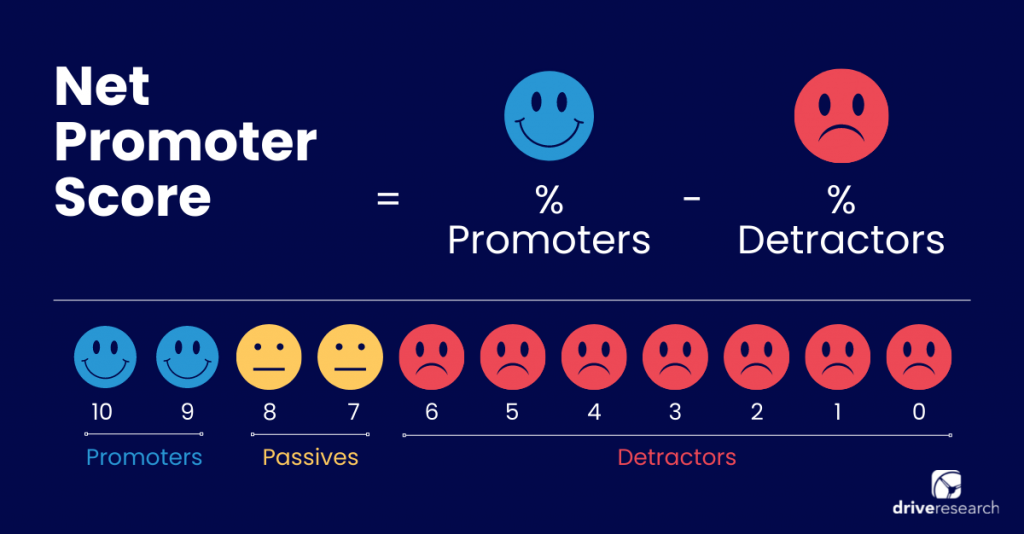
Net Promoter Score (NPS) is a critical metric used by businesses to gauge important metrics such as customer satisfaction and retention. At its core, NPS measures one fundamental question: “How likely are you to recommend our product/service to a friend or colleague?” Customers respond on a scale of 0 to 10, and based on their answers, they’re categorized into three groups: Promoters (9-10), Passives (7-8), and Detractors (0-6).
It’s a simple yet powerful figure that provides insights into customer sentiment and helps drive improvements in products, services, and overall customer experience. The calculation looks like this: subtract the percentage of Detractors from the percentage of Promoters to get your NPS score, which ranges from -100 to +100. For example, if you survey 100 customers and 70 are Promoters while 10 are Detractors, your calculation would be: 70% – 10% = 60. This means your NPS is 60. Any positive score shows more promoters than detractors, scores above 50 are considered excellent, and world-class companies often achieve scores of 70 or higher.
In this blog post, we’ll delve into the process of calculating net promoter score, understand its significance, analyze its implications, and explore methods to collect NPS data effectively.
Let us measure and track your Net Promoter Score—gain actionable insights for improved customer loyalty
NPS serves as a barometer of customer loyalty and satisfaction, offering businesses a clear picture of their standing in the market.
By calculating NPS, companies can identify promoters, passives, and detractors within their customer base.
Promoters are loyal enthusiasts who advocate for the brand, while detractors are unhappy customers who can potentially damage the brand’s reputation. Passives fall in between, neither promoting nor detracting significantly.
Understanding the percentage of promoters, passives, and detractors enables businesses to prioritize efforts aimed at converting detractors into promoters and enhancing customer satisfaction overall.
NPS calculation provides a quantifiable measure of customer sentiment, facilitating data-driven decision-making and strategic planning.
How to Calculate Net Promoter Score
A net promoter score is calculated based on responses to a single question: “How likely are you to recommend our product/service to a friend or colleague?”
Respondents typically rate their likelihood on a scale of 0 to 10, with 0 being highly unlikely and 10 being highly likely.
To calculate NPS, respondents are segmented into three categories:
Promoters: Respondents who rate the likelihood of recommendation as 9 or 10.
Passives: Respondents who rate the likelihood as 7 or 8.
Detractors: Respondents who rate the likelihood as 0 to 6.
Understanding the Three NPS Categories
To calculate NPS, respondents are segmented into three distinct categories based on their scores:
Promoters (9-10): These are your loyal brand advocates, enthusiastic customers who actively recommend your business to others. Promoters are the customers who drive growth through positive word-of-mouth, repeat purchases, and forgiveness of occasional mistakes. They typically have higher lifetime values and lower acquisition costs since they become an extension of your marketing team.
Passives (7-8): These customers are satisfied but not enthusiastic. They’re unlikely to spread negative word-of-mouth, but they won’t actively promote your brand either. Passives are vulnerable to competitive offerings and represent a significant opportunity. With the right improvements to their experience, they can be converted into Promoters. Passives are a super important area of opportunity to convert them to promoters.
Detractors (0-6): These are unhappy customers who are unlikely to recommend your business and may actively discourage others from buying from you. Notice that the Detractor range is wider (spanning scores 0-6) than the Promoter range (just 9-10). While detractors are important to note and address, it’s
The NPS formula subtracts the percentage of detractors from the percentage of promoters to yield a score ranging from -100 to 100.
A good net promoter score indicates a healthier customer sentiment and greater potential for business growth, while a negative score suggests significant room for improvement.
Analyze Your Current NPS Score
Analyzing your current NPS provides valuable insights into customer satisfaction metrics, trends, and areas for improvement.
This is why our market research company recommends regular monitoring of the metric. Doing so enables businesses to track performance over time, identify patterns, and measure the effectiveness of initiatives aimed at enhancing customer experience.
Additionally, comparing NPS ratings across different segments, such as demographics, geographic regions, or product lines, can reveal disparities in customer satisfaction and highlight areas requiring targeted interventions.
Plus, by drilling down into the underlying reasons for variations in NPS scores, businesses can effectively tailor strategies to address specific customer needs and preferences.
Collecting NPS data efficiently is essential for obtaining accurate insights and driving actionable outcomes. The best way to do that is with customer satisfaction surveys.
Online surveys represent a convenient and cost-effective method for gathering NPS feedback from customers across diverse demographics and geographic locations.
NPS Survey Types
Depending on your industry, audience type, and key objectives there are different types of NPS surveys to choose from.
From our experience, most clients choose between a transaction survey or a relationship survey.
Transactional Surveys: Sent immediately after a specific interaction or transaction, transactional surveys capture real-time feedback regarding the customer experience.
Relationship Surveys: Conducted periodically, relationship surveys assess overall satisfaction and loyalty towards the brand over an extended period.
By leveraging a net promoter score company, like Drive Research, you can lean on expert opinions to determine what type of NPS survey is best for your unique needs and goals.
How We Can Help
At Drive Research, we understand the importance of NPS in driving customer-centric strategies and fostering long-term relationships with clients.
Our comprehensive suite of market research services and resources empowers businesses to lean on our team to measure, analyze, and optimize their NPS scores effectively.
We also act as net promoter score consultants, providing meaningful and actionable recommendations in addition to survey insights. After fielding the survey data, you’ll receive more than an export of data and numbers.
Many of our reports include a question-by-question analysis, key takeaways, executive summary sections, data visualizations, and industry benchmarking data.
You will walk away with actionable recommendations from the data we collect to accelerate business strategy.
Drive Research is a full-service market research company specializing in net promoter score surveys.
Our team of senior market research professionals manages each aspect of your NPS survey to ensure 100% quality respondents and data. This includes survey design, programming, fielding, and analyzing feedback.
Interested in conducting an NPS survey with our team? Contact us today.
We analyze more than data—we also track how our site is used to improve your experience. Cookies help us understand what’s working so we can deliver the most relevant insights. Click “Accept” to enable full functionality.
Functional
Always active
The technical storage or access is strictly necessary for the legitimate purpose of enabling the use of a specific service explicitly requested by the subscriber or user, or for the sole purpose of carrying out the transmission of a communication over an electronic communications network.
Preferences
The technical storage or access is necessary for the legitimate purpose of storing preferences that are not requested by the subscriber or user.
Statistics
The technical storage or access that is used exclusively for statistical purposes.The technical storage or access that is used exclusively for anonymous statistical purposes. Without a subpoena, voluntary compliance on the part of your Internet Service Provider, or additional records from a third party, information stored or retrieved for this purpose alone cannot usually be used to identify you.
Marketing
The technical storage or access is required to create user profiles to send advertising, or to track the user on a website or across several websites for similar marketing purposes.