In today’s rapidly evolving business landscape, staying ahead of the competition requires more than just a great product or service. It demands a deep understanding of the market, consumer behavior, and emerging trends. This is where the market research process becomes invaluable. In this blog post, we will delve more into market research and explore...
There is never a wrong time to do market research. However, most research projects are birthed because a company or organization is at a crossroads. Whether you’re a startup or Fortune 500 company, you’ll have critical decisions to make. This blog will detail common market research examples and how our clients have used them to...
In summary: Financial services market segmentation is the process of dividing your customer base into distinct groups based on shared behaviors, needs, and attitudes so you can market to them more precisely, build better products, and deliver experiences that actually feel relevant.
Done well, it replaces internal assumptions with data your entire team can act on. This guide covers the types of segmentation we use in financial services research, how we collect and analyze the data, and how clients put the findings to work.
One of the most consistent things we hear from financial services clients before a segmentation project is some version of the same problem: “We know we have different types of customers, but we treat them all the same.”
First-time homebuyers, high-net-worth investors, Gen Z digital natives, and retirees managing fixed incomes all use financial products, but they need fundamentally different things from them.
Financial services brands that market to all of them with a single message and a single experience end up serving none of them especially well.
Market segmentation research closes that gap. It replaces broad assumptions with a data-backed model of your audience that marketing, product, and customer experience teams can actually build strategy around.
What Is Market Segmentation in Financial Services?
Financial services market segmentation is the process of dividing your customer or prospect base into distinct groups whose members share similar needs, behaviors, or attitudes.
Rather than treating your entire customer base as one large, undifferentiated pool, segmentation research lets you understand the specific motivations of different audiences and build strategies around them.
From a research standpoint, this is not a simple demographic exercise.
Age and income are a starting point, but the most actionable segmentation models go much deeper, incorporating behavioral data, attitudinal patterns, and underlying financial needs that a transaction history alone will never reveal.
The output of a well-designed segmentation study is a set of clearly defined customer profiles that your teams can actually use.
Think of it less as a one-time deliverable and more as a strategic foundation for most of the decisions that follow.
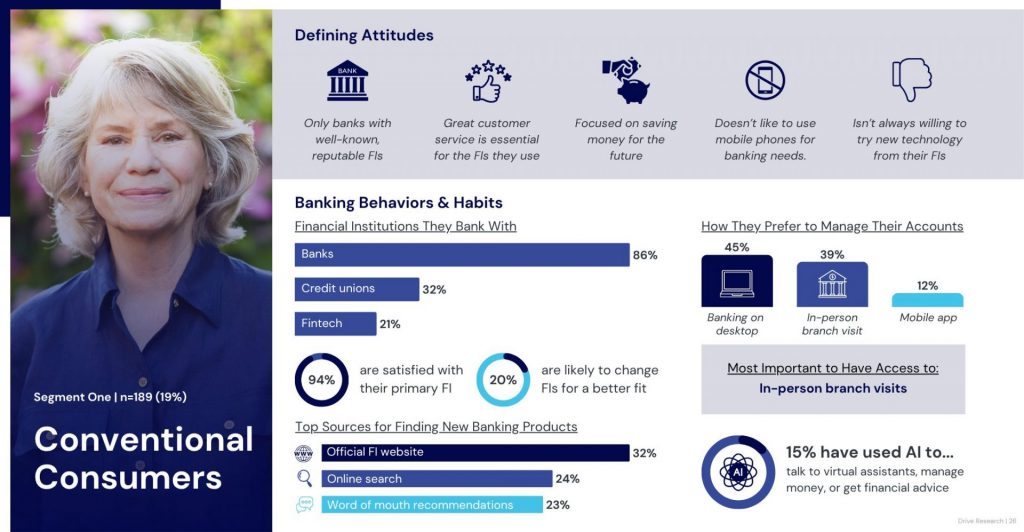
For further clarity, here is an example consumer segment we created in our State of Banking Report.
Why Segmentation Matters More Now
Financial institutions have always had diverse customer bases. What has changed is the competitive environment.
Fintechs and digital-first challenger banks have raised the bar on personalization, offering product experiences that feel tailored from the first interaction.
Traditional banks and credit unions that market with broad strokes are increasingly losing ground to providers that feel like they actually understand their customers.
According to our survey of 1,000 banking customers, over 1 in 3 say they would switch to a new financial institution that better fits their needs.
Over 1 in 3 say they would switch to a new financial institution that better fits their needs (37%).
By understanding the different priorities, pain points, and decision drivers across customer groups, banks and credit unions can better tailor their products, messaging, and experiences before customers start looking elsewhere.
Types of Segmentation Research Best for Financial Services Brands
There is no single segmentation framework that works for every institution. The right approach depends on your goals, your existing data, and what decisions you are trying to make.
This divides customers by factors like age, income, household size, or life stage. It is the most familiar approach and a useful baseline, but demographics alone rarely tell you enough. Two 45-year-olds with similar incomes can have completely different attitudes toward risk, digital banking, and financial planning.
This looks at how customers actually use financial products. Mobile banking adoption rates, credit utilization patterns, savings habits, and product ownership are all signals that can reveal distinct behavioral clusters within a customer base.
Psychographic Segmentation
This goes deeper, capturing values, attitudes, and motivations that influence financial decision-making. It is where you learn things like why one segment chooses in-person service even when digital options are available, or why another segment prioritizes rates above all other factors.
Needs-Based Segmentation
This focuses on unmet financial needs in your customer base, such as retirement planning support, debt consolidation guidance, or education for first-time homebuyers. It is particularly valuable for product development and content strategy.
Pro tip: In most of the segmentation studies we design for financial services clients, we combine multiple approaches. The result is a hybrid segmentation model that captures the full picture rather than just one dimension of your audience.
Ready to segment your financial services audience? Our senior research team can help.
The data collection methodology depends on what you are trying to learn.
Most projects use a combination of quantitative and qualitative methods, from surveys that measure customer attitudes and behaviors at scale to interviews or focus groups that explore the “why” behind each segment.
This balanced approach is often central to conducting customer segmentation because it helps financial services brands move beyond basic demographics and uncover the real needs, motivations, and decision drivers behind different customer groups.
Online Surveys
Surveys are the primary vehicle for most segmentation work.
A well-designed survey can capture demographic, behavioral, psychographic, and attitudinal data at scale, giving us the statistical foundation needed to identify meaningful segments. Sampling is especially important here.
For financial services clients, we put significant effort into ensuring the survey reaches the right mix of customers and prospects. If your online survey draws from the wrong sample, you may end up with segments that do not reflect your actual audience at all.
Focus Groups and In-Depth Interviews
Qualitative methods are not always part of a segmentation study, but they add real value when you want to understand the reasoning behind the patterns you find in the data.
In our experience, the qualitative component often surfaces language and framing insights that make the quantitative findings far more actionable.
We have worked with financial services clients who had segmentation data but lacked the ability to activate it because they did not understand why the segments behaved differently.
A few focus groups helped answer those questions and gave their marketing team the context they needed.
Internal Data Analytics
Transaction data, account usage patterns, and product ownership information from your existing customer base can validate or sharpen segments identified through survey research.
The combination of first-party behavioral data and survey-collected attitudinal data tends to produce the most precise segmentation models, especially for institutions that have been collecting customer data for years and want to finally turn it into something actionable.
How to Use Your Financial Services Segmentation Findings
This is the question that matters most, and it is one we spend meaningful time on in every debrief. Research that sits in a presentation deck does not generate ROI.
Smarter Marketing
Once you know that one segment is motivated primarily by digital convenience while another prioritizes a personal relationship with their banker, you stop writing one message that tries to speak to both.
You build separate campaigns, separate content, and separate creative that speaks to each segment’s actual motivations.
Over time, this kind of targeted approach improves acquisition rates, reduces marketing spend per customer, and builds stronger brand relevance with the audiences that matter most.
If research shows that a specific segment consistently reports frustration with digital onboarding, that is a direct prioritization signal for your product and UX teams.
If another segment values proactive financial guidance, your frontline staff can be trained and equipped to deliver it.
Segmentation does not just tell you who your customers are. It tells you how to design experiences that keep them.
Product Development
Financial services customers’ needs vary widely, and segmentation research highlights the gaps where new offerings can have the biggest impact.
It also helps institutions validate banking product concepts before launch, ensuring that features in development align with actual market demand rather than internal assumptions.
Validating innovation with customer insight reduces risk, strengthens differentiation, and produces solutions that resonate.
What to Expect From a Financial Services Segmentation Study
If you have never commissioned a segmentation study before, knowing what the process looks like helps you plan and advocate for it internally.
Most segmentation projects run six to twelve weeks from kickoff to final deliverable.
The variation depends on methodology, sample complexity, and how many audience segments are in scope.
Most financial services segmentation studies include these phases:
The process starts with a kickoff meeting to align on your research objectives, discuss the decision you are trying to make, and determine the right methodology.
From there, we design the research instrument, manage fieldwork, conduct the analysis, and deliver a presentation-ready report with the segmentation model and recommended applications.
Deliverables typically include an interactive data dashboard, a detailed presentation with segment profiles and personas, and strategic recommendations for activating the findings across marketing, CX, and product teams.
Frequently Asked Questions
How many segments should we expect from a financial services study?
Most studies produce between three and six segments. Fewer than three usually means the data is not revealing meaningful differences. More than six makes the model difficult to operationalize. The right number depends on your data and goals, and our team will make a recommendation once analysis is complete.
Can we use existing customer data in the segmentation study?
In many cases, yes. Internal transaction data and account records can supplement survey data and help validate segments. We work with clients early in the process to understand what first-party data is available so we can integrate it effectively.
How much does a financial services segmentation study cost?
Most projects start between $20,000 and $40,000, depending on methodology, sample size, and scope. Studies that include qualitative components, multiple audience segments, or advanced analytics typically run higher. We are happy to scope a project based on your specific objectives and budget.
How often should we refresh our segmentation model?
We recommend revisiting segmentation models every two to three years, or sooner if your customer base has changed significantly, a major competitor has entered your market, or a significant economic shift has changed customer behavior. The financial services landscape moves quickly enough that a four-year-old segmentation model can be actively misleading.
For more, watch this video of Drive Research President, George Kuhn, sharing his thoughts on how often brands should run a segmentation study.
Drive Research is a full-service financial services market research company with experience designing and executing segmentation studies for banks, credit unions, insurance companies, and fintechs across the country. If you are ready to build a smarter picture of your customer base, our team would be glad to discuss your objectives and put together a proposal.
Bank & Credit Union Market Research Options for 2026
Blog Posts
How to Conduct Customer Segmentation in 6 Easy Steps
Blog Posts
How To Do Market Research For Financial Services
When You Give Us A Cookie
We analyze more than data—we also track how our site is used to improve your experience. Cookies help us understand what’s working so we can deliver the most relevant insights. Click “Accept” to enable full functionality.
Functional
Always active
The technical storage or access is strictly necessary for the legitimate purpose of enabling the use of a specific service explicitly requested by the subscriber or user, or for the sole purpose of carrying out the transmission of a communication over an electronic communications network.
Preferences
The technical storage or access is necessary for the legitimate purpose of storing preferences that are not requested by the subscriber or user.
Statistics
The technical storage or access that is used exclusively for statistical purposes.The technical storage or access that is used exclusively for anonymous statistical purposes. Without a subpoena, voluntary compliance on the part of your Internet Service Provider, or additional records from a third party, information stored or retrieved for this purpose alone cannot usually be used to identify you.
Marketing
The technical storage or access is required to create user profiles to send advertising, or to track the user on a website or across several websites for similar marketing purposes.