In today’s rapidly evolving business landscape, staying ahead of the competition requires more than just a great product or service. It demands a deep understanding of the market, consumer behavior, and emerging trends. This is where the market research process becomes invaluable. In this blog post, we will delve more into market research and explore...
There is never a wrong time to do market research. However, most research projects are birthed because a company or organization is at a crossroads. Whether you’re a startup or Fortune 500 company, you’ll have critical decisions to make. This blog will detail common market research examples and how our clients have used them to...
How To Conduct Pricing Research [Methods + Benefits]
Austin Parker
Pricing research is a crucial step for any business to take before launching a product, adjusting an existing offering, or entering a new market. It’s ideal for brands to find the sweet spot for a product or service that customers are willing to pay (even if it’s a price range). Without data from pricing research, your brand might be guessing wrong on pricing, which can lead to lost revenue, damaged brand perception, or customers walking straight to a competitor.
It’s why many businesses conduct pricing market research to collect insights that allow them to thrive in any ever-evolving market.
In this blog post, our pricing research company offers insights and practical tips to navigate the complexities and make informed pricing decisions that can elevate your business.
Optimize your pricing strategy—let us conduct pricing research to maximize profit and customer demand!
The main goal of a pricing research project is to uncover exactly what dollar amount customers are willing to pay for your company’s product or service. This research can help target the best price point in order to maximize revenue, profit, and more.
There is a sweet spot to aim for that includes the customers being willing to pay and still feeling like they are getting the better deal but you as a company are able to sustain profits.
The best pricing research not only tells you where the sweet spot is for your pricing – but also pricing levels to avoid (coming off cheap, eating into profits, etc.).
Pricing research done over time can also benefit how organizations change their prices based on customer sentiment.
Different pricing models can be adapted to maximize profits but other benefits are readily available such as:
Measuring the value of your company’s brand
Capture the highest returns on your investments
Understand the market’s feedback towards your products/services
How often should businesses conduct pricing research?
Pricing research isn’t a one-time study (or at least, it shouldn’t be). Markets change, competitors adjust their pricing, and customer expectations/demands shift. Running pricing studies periodically (usually biannually or annually) helps ensure your pricing strategy stays updated with the market to avoid under or over-pricing.
What is the difference between pricing research and price testing?
Pricing research typically happens before a price is set (it can happen after setting prices), using surveys and statistical models to predict customer behavior. Price testing, on the other hand, usually involves real-world experimentation with live customers to observe how actual purchasing behavior changes at different price points.
Why Should You Run a Pricing Research Project?
The biggest reason to run a pricing research project is to collect valuable data that can help make tough business decisions much easier.
It’s not always great to rely on gut decisions when taking the business into account – using numbers in our experience is much better.
Beyond just a profit help, it can be a great health check for any new venture, product, market, or even competition.
By using price optimization research it’s possible to increase your chances of success regardless of what it is that you’re looking into. While there are limits to a pricing research project, different models will help you uncover more of what you’re looking for depending on the project you’re wanting to run.
Methods We Use To Run Pricing Research Projects
There are a few different main pricing research methodologies used for projects. It’s best to start with a goal in mind since each objective is slightly different.
Here are a few examples of popular pricing research methods:
Van westendorp
Developed in the 1970s, the Van Westendorp method addresses the proper value or price of a product or service through a series of 4 survey questions.
It asks the following 4 questions:
At what price do you think the product is priced so low that it makes you question its quality?
At what price do you think the product is a bargain?
At what price do you think the product begins to seem expensive?
At what price do you think the product is too expensive?
If your company offers services instead of products, you can easily swap out the language.
Van Westendorp’s method identifies psychological price points by surveying consumers and analyzing their answers for how much they are willing to spend. It’s also possible to see where customer sentiment falls off for different price points.
The reason for this points to one of our early points in this post. When asked open-ended questions, respondents may write or type in unrealistic price points which then become outliers or unusable data.
Conjoint analysis
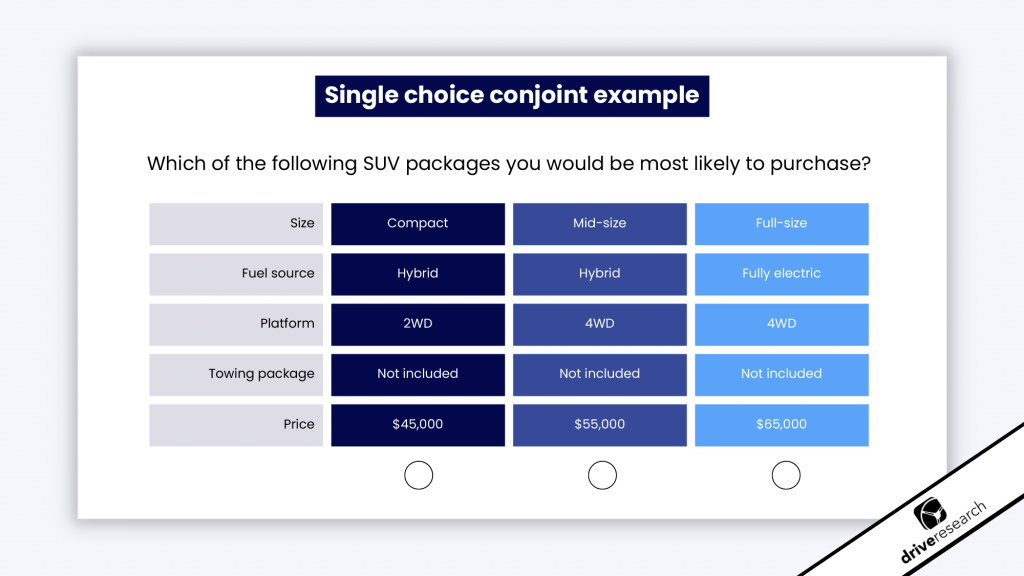
While there are different types of conjoint analysis, choice-based conjoint analysis is the main version that is used more often than not.
Choice-based conjoint analysis is an advanced survey technique in which respondents make choices based on combinations of various product attributes.
What sets a conjoint survey apart from other survey approaches to product optimization is how respondents must factor all the features into their decision-making.
It is critical to ensure no respondent is provided a set with the same combination of attribute levels more than once.
While not a commonly used approach in formal pricing research, cost-plus pricing is worth understanding as a foundational concept. This method works by calculating the total cost of producing a product (including manufacturing, labor, and overhead), then adding a percentage markup to arrive at the final price.
This can be a simple method for pricing products, but it lacks a bit of market information on the customer side compared to other, more complex methods. It does deserve a spot on the list because it helps establish a price floor (what you don’t want to go below). Knowing the absolute minimum price can help your brand avoid going below it and incurring extra costs that can’t be offset.
In B2B specifically, cost-plus can leave customers wanting line-item or transparency. Its weakness is that it operates without market-based price information. It doesn’t consider competitor pricing, shifts in demand, or unexpected cost increases. So this can be a good starting point/reference, but it’s not recommended to rely on it alone.
Brand Pricing
Brand-price trade-off (BPTO) is a lesser-known statistical pricing research technique that examines how your brand affects pricing (ideally, for the better). It can also help compare your brand to competitors in the market.
The core idea behind BPTO is straightforward: customers don’t just buy products; they buy from brands they trust. The reputation, trust, and perceived quality associated with your brand all influence what customers are willing to pay. BPTO quantifies that influence, giving you a clearer picture of how much pricing power your brand equity actually gives in numbers.
Gabor-granger
Gabor-Granger is a pricing research method typically used for determining a revenue versus demand curve for a product/service.
It involves asking potential customers how likely they are to purchase a product or service at different price points.
The Gabor-Granger pricing technique helps answer these two main questions:
Can you change your prices without affecting sales?
At what price points is it obvious that the consumer’s willingness and ability to pay changes?
Monadic testing
Monadic testing is usually a set of questions that ask respondents about a concept and attributes/features they like or dislike.
The target audience is divided into groups with one of the concepts and asked questions about it to determine how respondents feel about the different price points.
How do I know which pricing research method is right for my business?
The right method depends on your goals and objectives. If you need to understand psychological price thresholds, Van Westendorp is a strong starting point. If you’re weighing product features against price, conjoint analysis is more appropriate. A pricing research company (like us!) can help you identify the best approach for your specific goals.
Contact Our Pricing Research Company
Explore the power of market research in shaping your pricing strategy! Our comprehensive market research services offer support at every stage, employing surveys, focus groups, and interviews to deliver profound insights that enable you to establish optimal price points. Contact Drive Research today for more information!
We analyze more than data—we also track how our site is used to improve your experience. Cookies help us understand what’s working so we can deliver the most relevant insights. Click “Accept” to enable full functionality.
Functional
Always active
The technical storage or access is strictly necessary for the legitimate purpose of enabling the use of a specific service explicitly requested by the subscriber or user, or for the sole purpose of carrying out the transmission of a communication over an electronic communications network.
Preferences
The technical storage or access is necessary for the legitimate purpose of storing preferences that are not requested by the subscriber or user.
Statistics
The technical storage or access that is used exclusively for statistical purposes.The technical storage or access that is used exclusively for anonymous statistical purposes. Without a subpoena, voluntary compliance on the part of your Internet Service Provider, or additional records from a third party, information stored or retrieved for this purpose alone cannot usually be used to identify you.
Marketing
The technical storage or access is required to create user profiles to send advertising, or to track the user on a website or across several websites for similar marketing purposes.