In today’s rapidly evolving business landscape, staying ahead of the competition requires more than just a great product or service. It demands a deep understanding of the market, consumer behavior, and emerging trends. This is where the market research process becomes invaluable. In this blog post, we will delve more into market research and explore...
There is never a wrong time to do market research. However, most research projects are birthed because a company or organization is at a crossroads. Whether you’re a startup or Fortune 500 company, you’ll have critical decisions to make. This blog will detail common market research examples and how our clients have used them to...
Dry January has become a popular way to reset after the holidays and rethink what a healthier, more intentional relationship with alcohol could look like.
To understand how people are approaching the challenge and what it might signal for the rest of the year, Drive Research surveyed 1,000 U.S. adults.
Here are the key Dry January and Damp January stats, plus what they suggest about where drinking habits may be headed next.
Key Dry January Statistics
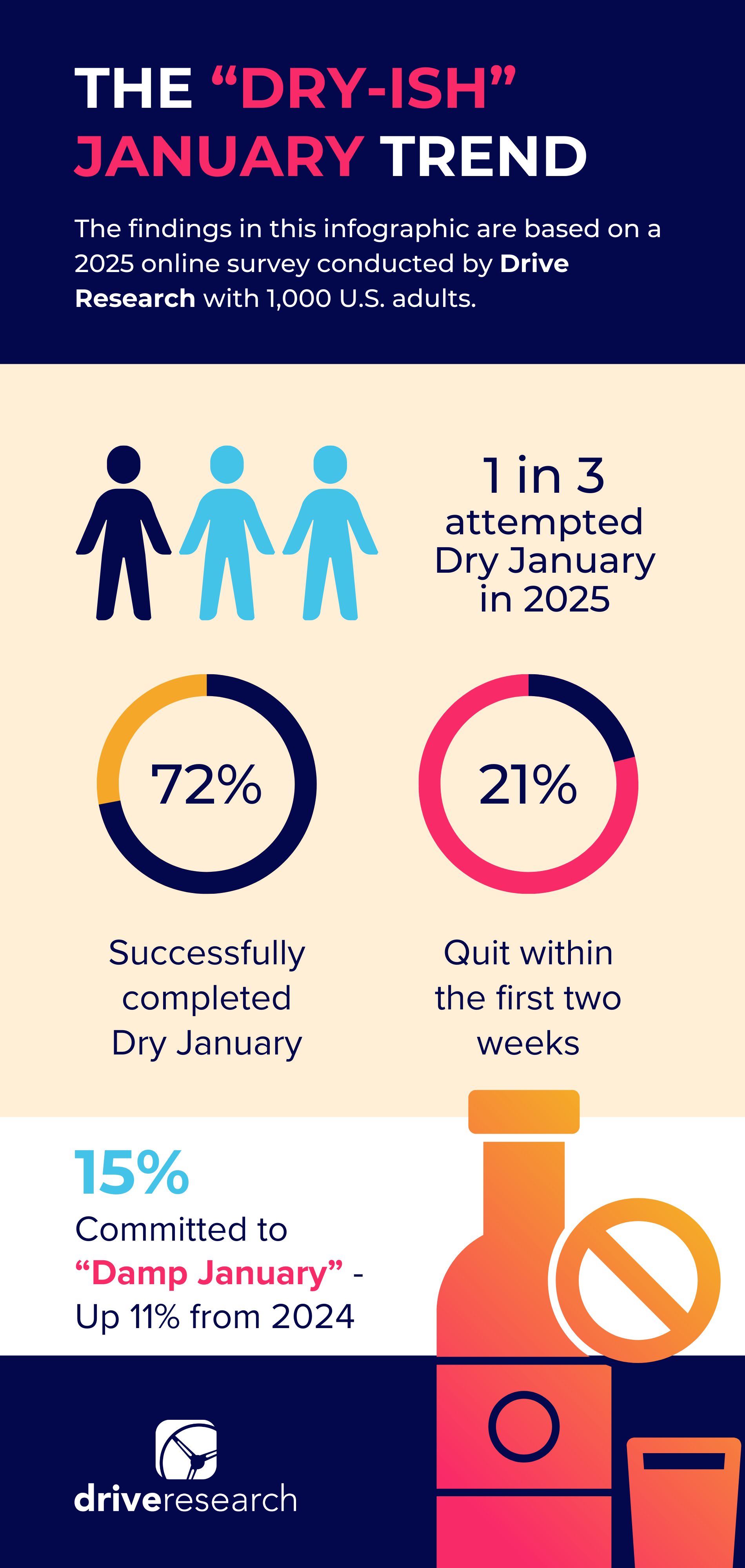
– 1 in 3 people participated in Dry January (33%) in 2025
– Most who participated in Dry January completed successfully (72%)
– Of those who failed Dry January, 1 in 5 quit the first (11%) or second week (10%)
– Damp January participation increased to 15% in 2025, up from 11% in 2024
– 48% say they plan to consume less alcohol, while only 5% expect to drink more
What is Dry January?
Dry January is a personal challenge where people choose to avoid alcohol for the month of January. Many do it to reset habits after the holidays, see how they feel without drinking, and start the year with a clearer sense of their health and routines.
It can also be a simple way to test your relationship with alcohol without making a long-term commitment.
How Many People Participate in Dry January?
In 2025, 1 in 3 people participated in Dry January (33%), with most completing it successfully (72%).
An additional 15% participated in “Damp January” in 2025 which is a modified version of Dry January where people reduce alcohol consumption instead of cutting it out completely.
How many people fail Dry January?
Of those that started Dry January in 2025, nearly 3 in 10 failed to complete it (28%). A fifth of people gave up in the first (11%) or second week (10%) of January, while others gave up the third (7%) or fourth week (1%).
Benefits of Dry January
Dry January can help people reset habits and feel the day-to-day upsides of drinking less, even if they do not plan to cut alcohol long-term.
In our survey on why people reach for NA beer, spirits, or mocktails, nearly half cited health and wellness (48%) and many said they do it because they do not like being hungover (46%), which aligns closely with the motivations behind a month off alcohol.
Others pointed to practical and quality-of-life benefits like getting home safely (36%), improving sleep (32%),and saving money (31%).
Taken together, these reasons suggest Dry January is often less about a strict rule and more about feeling better, sleeping better, and starting the year with more control and intention.
The Long-Term Shift Beyond Dry January
For a lot of people, Dry January is the moment they pause and take a quick, honest look at their habits. The bigger takeaway is not just whether someone made it through the month, but whether the experiment changes how they want to drink moving forward.
It is a low-pressure way to ask, “What do I actually want my relationship with alcohol to look like this year?”
Nearly half plan to consume less alcohol in 2025
When asked about the next 12 months, 48% say they plan to consume less alcohol, while only 5% expect to drink more. It appears that Dry January can be the start of a broader, more personalized reset, one that lasts well beyond the calendar flip to February.
The perception of alcohol may be changing too
Looking further ahead, 47% agree alcohol consumption will be viewed more negatively over the next 20 years, similar to the perception shift of cigarettes.
Only 23% disagree, while 30% are neutral. This suggests people expect more caution and more thoughtful norms around drinking, even if alcohol remains part of social life.
Methodology
The findings in this article are based on an online survey conducted by Drive Research with 1,000 U.S. adults. Using a probabilistic framework as a reference, a sample of this size carries a margin of error of approximately +/- 3% at the 95% confidence level.
About Drive Research
Drive Research is a global market research company specializing in custom-built, quantitative and qualitative methodologies. Our market research firm takes pride in making organizations more successful by extracting insights from the data we collect to accelerate business strategy.
We analyze more than data—we also track how our site is used to improve your experience. Cookies help us understand what’s working so we can deliver the most relevant insights. Click “Accept” to enable full functionality.
Functional
Always active
The technical storage or access is strictly necessary for the legitimate purpose of enabling the use of a specific service explicitly requested by the subscriber or user, or for the sole purpose of carrying out the transmission of a communication over an electronic communications network.
Preferences
The technical storage or access is necessary for the legitimate purpose of storing preferences that are not requested by the subscriber or user.
Statistics
The technical storage or access that is used exclusively for statistical purposes.The technical storage or access that is used exclusively for anonymous statistical purposes. Without a subpoena, voluntary compliance on the part of your Internet Service Provider, or additional records from a third party, information stored or retrieved for this purpose alone cannot usually be used to identify you.
Marketing
The technical storage or access is required to create user profiles to send advertising, or to track the user on a website or across several websites for similar marketing purposes.