In today’s rapidly evolving business landscape, staying ahead of the competition requires more than just a great product or service. It demands a deep understanding of the market, consumer behavior, and emerging trends. This is where the market research process becomes invaluable. In this blog post, we will delve more into market research and explore...
There is never a wrong time to do market research. However, most research projects are birthed because a company or organization is at a crossroads. Whether you’re a startup or Fortune 500 company, you’ll have critical decisions to make. This blog will detail common market research examples and how our clients have used them to...
B2B Market Segmentation: Types, Examples & How It Works
Emily Rodgers
B2B market segmentation in short: B2B market segmentation divides a business audience into smaller groups based on meaningful differences in what they need, how they buy, and what influences their decisions. This guide explains the most common segmentation methods, when primary research is necessary, and how to build segments your teams can actually use.
If every company in your target market receives the same message, sales pitch, or product story, there is a good chance important differences between buyers are being missed.
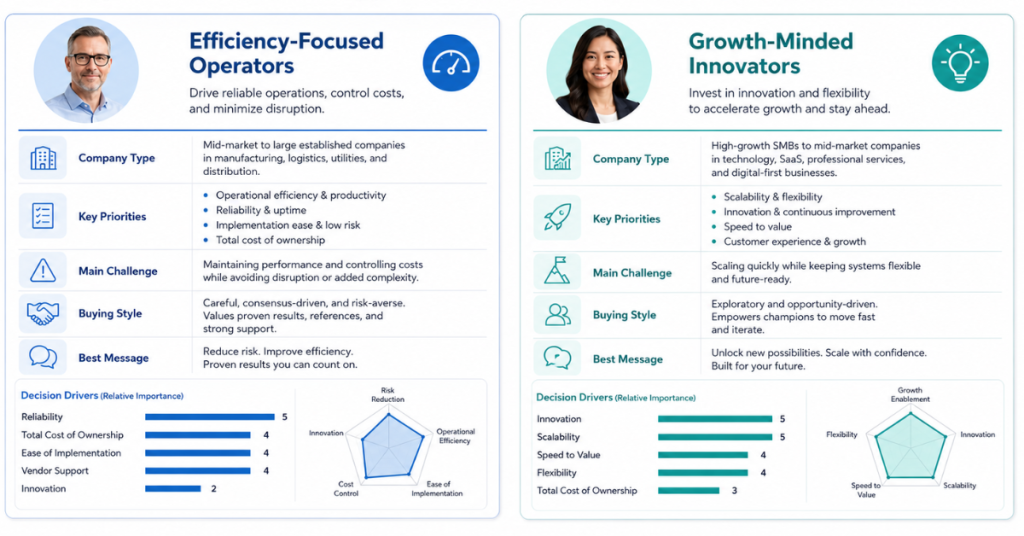
You might already know your ideal customers work in a certain industry or fall within a particular revenue range. What is harder to see is why one company prioritizes minimizing risk while another cares far more about flexibility. Those differences often have a much greater influence on how someone buys.
That is what a strong B2B market segmentation study is built to uncover.
At our B2B market research company, we use segmentation research to find meaningful groups within a market, then help clients understand what separates them and how those differences should influence business strategy.
Build your B2B segmentation study with Drive Research.
B2B market segmentation is the process of dividing a business market into groups with shared characteristics, needs, behaviors, or attitudes.
At its simplest, a company might segment businesses based on industry or annual revenue. Research-based segmentation goes further by identifying differences that may not exist in your CRM, such as how buyers evaluate options, which benefits matter most, or how they think about risk.
For example, imagine an industrial equipment manufacturer selling to food processing companies.
Two prospects may have similar revenue and production capacity, yet one prioritizes reliability because downtime is extremely costly while another is more focused on reducing labor requirements.
On paper, they look similar but their reasons for buying are likely not.
B2B Market Segmentation vs. B2B Customer Segmentation
B2B market segmentation and B2B customer segmentation use many of the same techniques. The main difference is who is included in the analysis.
B2B market segmentation
B2B customer segmentation
Who is included?
The broader addressable market, potentially including customers, prospects, former customers, and noncustomers
Existing customers
Common data sources
Primary market research plus available market or CRM data
CRM records, purchase history, and customer research
Primary purpose
Understand meaningful differences across the market
Understand differences within the current customer base
Example
Determine which audiences have different needs for a new product
Develop different account strategies for existing customers
Which one you need depends on the decision(s) you’d like to make from the research.
If you are planning a new product launch, studying only current customers could miss an attractive audience that does not currently buy from you.
If retention is the bigger concern, segmenting the existing customer base may be enough.
Why Is B2B Market Segmentation Important?
B2B segmentation helps answer a question that broad target-market definitions cannot: What should we do differently for one type of buyer versus another?
That can influence several areas of the business.
Focus resources on stronger opportunities
Not every account with the right company size and industry represents the same opportunity.
A segmentation study might reveal that one group has a strong need for your solution and relatively few barriers to adoption.
Another technically fits your ideal customer profile but requires much more education before it would consider purchasing.
Knowing that difference gives the business another way to decide where resources should go.
Create messaging around what buyers actually care about
Good segmentation gives you something meaningful to personalize around.
Instead of changing ad copy because someone works in healthcare rather than financial services, you might change the message because one segment prioritizes minimizing disruption while another is actively looking for innovation.
Inform product decisions with market-level context
Say customers repeatedly ask a commercial equipment manufacturer for a new reporting feature.
Segmentation research may reveal that the feature is extremely important to one small market segment but largely irrelevant to the company’s highest-opportunity group.
That does not automatically mean the feature should be ignored, but product leadership now has more context before prioritizing development.
Help sales understand different members of the buying process
B2B purchases are rarely influenced by one person, but an entire team of decision-makers. In fact, Gartner research found that buying groups can range from five to 16 people across as many as four functions.
Consider a cybersecurity company selling an enterprise platform. The security team may focus on risk reduction, while procurement approaches the same purchase from an entirely different perspective.
Role-based insights can help the seller understand which concerns are likely to matter to the person in the conversation rather than delivering the same pitch to everyone involved.
Types of B2B Market Segmentation
The most common types of B2B market segmentation include firmographic, technographic, behavioral, needs-based, attitudinal or psychographic, intent, and role-based segmentation.
Some are easier to build from existing CRM or third-party data. Others require primary research to uncover clear, concrete differences in buyer decision-making.
Here are some of the most common approaches.
Segmentation type
What it uses
Example
Our perspective
Firmographic
Company characteristics
Existing customers
Useful and accessible, but often better for profiling than explaining why buyers differ
Technographic
Technology currently used
CRM, ERP, competing platforms
Especially valuable when compatibility or switching behavior matters
Behavioral
What customers or prospects do
Purchase frequency, product usage
Strong when reliable behavioral data already exists
Needs-based
Problems buyers are trying to solve
Efficiency versus customization
Often more actionable for messaging and product strategy
Attitudinal / psychographic
Values, beliefs, priorities, motivations
Risk-averse versus innovation-oriented
One of our preferred foundations for primary segmentation research
Intent
Signals of active purchase interest
Research activity or engagement
Useful for targeting in-market accounts
Role-based
Position within the buying process
Economic buyer versus user
Helpful when buying committee members have substantially different priorities
Why we often look beyond firmographics
Firmographics are useful. They help describe the market and are often relatively easy to append to survey data.
The limitation is that they primarily tell you general basics of what a company is.
Knowing an organization has 1,000 employees does not necessarily tell you why it prefers one solution over another. The same is true of industry.
For primary segmentation studies, we often prefer to use psychographics, attitudes, values, and beliefs as key inputs into the segmentation model. That’s because those variables can reveal differences in how buyers think that are difficult to observe otherwise.
Once those segments are identified, firmographics and behavioral data can be layered on to make them easier to understand and target.
Research Tip: Firmographics are often better at describing a segment than creating one. Two companies that look nearly identical in a database can still have very different motivations and purchase priorities.
When Do You Need Research-Based B2B Segmentation?
Not every organization needs cluster analysis and a large segmentation survey.
Sometimes grouping accounts in your CRM is perfectly sufficient if the information is accurate and up to date. Primary research becomes more valuable when the differences you need to understand are not sitting in an existing database.
We have seen this firsthand with healthcare segmentation work at Drive Research.
One client already understood which types of healthcare professionals used its product. What it did not understand was how those professionals differed in their preferences, purchase considerations, and attitudes.
The segmentation study helped uncover those less-visible differences so the company could develop a more informed marketing strategy.
Use research to build B2B segments your team can act on.
The quality of a B2B segmentation model depends heavily on the research that feeds it. That is why we generally recommend a qual before quant.
As we explain in our guide to conducting customer segmentation, qualitative research helps uncover the needs, attitudes, and decision factors that should be measured before those inputs are tested across a larger quantitative sample.
From there, the study should move through a clear sequence, from exploratory research to survey design, fieldwork, analysis, and activation.
Here is how we typically approach each stage.
1. Start with how the segments will be used
First and foremost, determine what someone should be able to do differently once they know a buyer’s segment.
Maybe the marketing team needs stronger positioning. Perhaps leadership is deciding which audiences deserve more investment.
Those business decisions should influence the research inputs from the start.
This is also the time to involve the stakeholders who will ultimately use the findings. Getting alignment after thousands of survey responses have already been collected is much more difficult than agreeing on the inputs beforehand.
2. Explore the market qualitatively
In-depth interviews are useful for uncovering buyer language, decision criteria, pain points, and attitudes that an internal team may not think to include in a survey.
If exploratory interviews are being used to develop preliminary segments or personas, 20 to 30 interviews per anticipated segment can be a useful planning guideline for reaching saturation.
These interviews are not a replacement for statistical segmentation.
Their role is to help us understand the market well enough to design a stronger quantitative phase.
3. Design the quantitative segmentation survey
This is where the variables used to create the segmentation need particular attention. Respondents cannot be separated into meaningful groups if the questionnaire does not capture meaningful differences.
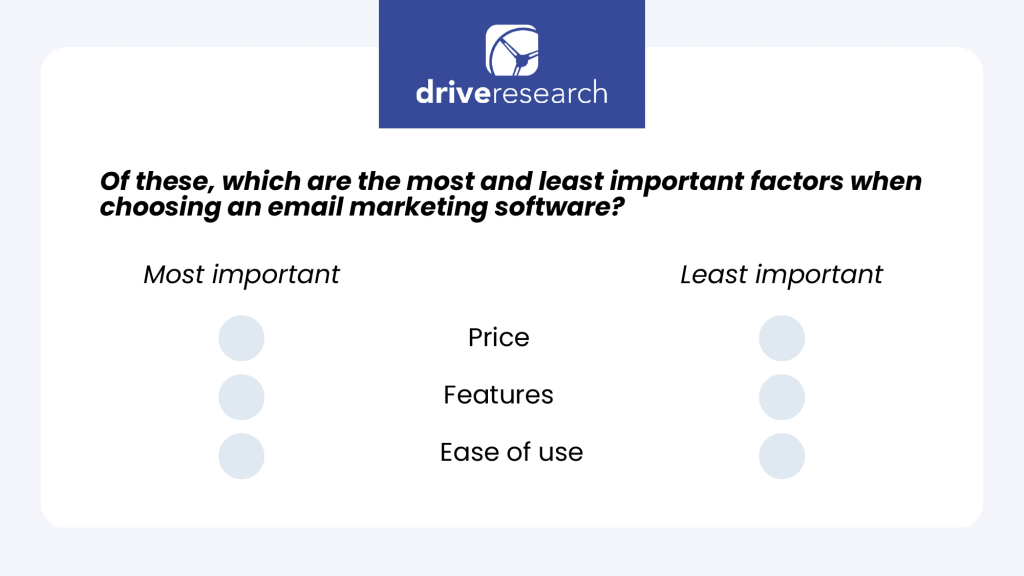
One technique we commonly consider is MaxDiff scaling.
MaxDiff asks respondents to make trade-offs by choosing the most and least important options from sets of attributes. It can produce stronger differentiation than asking respondents to rate each attribute independently.
Think about a buyer evaluating a new vendor. If we ask whether reliability, price, customer service, implementation support, and customization are important, there is a good chance they will rate most of them highly.
MaxDiff forces prioritization.
That makes the resulting data especially useful when we are trying to determine what truly separates one group from another.
4. Recruit a large enough sample of B2B respondents
For quantitative B2B market segmentation, we typically recommend 400 to 1,000+ respondents.
Larger samples provide more freedom during cluster analysis. If several potential segment solutions are being evaluated, we want enough respondents in the resulting groups to understand what distinguishes them.
Research Tip: B2B sample can be difficult and expensive to obtain, particularly when eligibility is limited to senior decision-makers or niche industries. That makes sample planning an important conversation early in the project.
5. Analyze, test, and validate different solutions
In practice, a useful B2B segmentation often lands around 3 to 5 segments, although we are open to fewer or more when the data supports it. We do not go into it assuming there must be exactly four groups.
Complex projects also need enough time for iteration. We often recommend allowing two to four weeks for the segmentation analysis itself so the research team can test different inputs and solutions rather than accepting the first model that runs.
What we evaluate
What it means in practice
Distinct
The segments are meaningfully different from one another
Substantial
Each group is large enough to matter
Understandable
Teams can grasp what makes each segment unique
Actionable
Knowing the segment changes a business decision
The last point is especially important.
If eight statistically different groups emerge but the company could never realistically create eight separate strategies, that solution may not be the most useful one.
Validation matters too. One technique is to divide the sample into training and testing datasets. For instance, 60% of the sample may be used to develop the segments and the remaining 40% used to see whether similar patterns emerge.
The goal is to reduce the risk that the model reflects random quirks within one sample rather than meaningful patterns in the market.
6. Profile the segments so teams can recognize them
Once the underlying groups are established, we can layer additional information onto them.
This is where company size, industry, purchase behavior, role, and other descriptive information become valuable.
One segment might over-index among enterprise organizations. Another may be more likely to learn about products through industry associations.
That supporting information turns a statistical cluster into something marketing or sales teams can actually picture and find.
We saw a version of this in a Drive Research study with curriculum leaders responsible for EdTech decisions.
The audience was already highly specific, including senior curriculum and academic leaders. Simply separating respondents by title would not have answered the client’s questions.
Instead, the study explored what mattered when evaluating EdTech systems, challenges during procurement, and how curriculum leaders learned about new technologies.
A total of 300 surveys were completed, and segmentation analysis was used to understand meaningful differences within that already narrowly defined B2B audience.
The client knew who the buyers were. The research helped explain how they differed.
7. Plan how the segmentation will live beyond the report
One of the easiest ways for a segmentation investment to lose value is for the final segment profiles to live inside a PowerPoint that few people open six months later.
Activation should be planned before the project ends.
A marketing team might use the findings to adjust messaging by segment. Sales may incorporate segment information into account planning.
For longer-term use, we often recommend developing a segmentation typing tool.
A typing tool uses a smaller set of highly predictive questions to assign future respondents, prospects, or customers to one of the established segments. That means the organization does not need to administer the original segmentation questionnaire every time it wants to classify someone.
Useful resource: Our segmentation typing tool blog post explains how shorter algorithms can identify which established segment a future respondent belongs to.
Turning Segmentation Findings Into Strategy
Creating segment profiles is not the finish line. The question should always be: What can the business do now that it could not do before?
Here are a few examples.
Possible segmentation finding
How it could influence strategy
One group prioritizes a simple implementation because its internal resources are limited
Emphasize onboarding support and reduce perceived implementation burden
A second segment values customization even when it requires a longer rollout
Lead with flexibility and relevant configuration options
Buyers in one segment want innovation but worry about taking on unnecessary risk
Provide stronger proof, implementation evidence, and relevant case studies
Another group prefers conducting substantial research before engaging with sales
Invest in educational content that supports independent evaluation
A high-opportunity segment places unusually strong importance on ongoing service
Align the customer experience and sales story with that expectation
Notice that none of these strategies are based solely on naming the segment or creating a persona. The value comes from identifying a meaningful difference and changing something because of it.
FAQs About B2B Market Segmentation
How many B2B market segments should you have?
A useful B2B segmentation typically results in 3 to 5 segments.
That is a practical guideline, not a statistical rule. Researchers should compare different solutions and select the one that creates meaningful separation without becoming too complicated for the organization to use.
What sample size is needed for B2B market segmentation?
For quantitative segmentation, we typically recommend 400 to 1,000+ respondents.
Larger samples allow more flexibility when testing solutions and analyzing the final groups.
Exploratory qualitative research serves a different purpose. When interviews are being used to develop preliminary personas or potential segment hypotheses, 20 to 30 interviews per anticipated segment can be a useful planning guideline.
Can you conduct B2B segmentation using CRM data?
Yes.
If your goal is grouping accounts using information such as industry, company size, account value, or purchase history, your CRM may provide everything you need.
Primary market research is more appropriate when you need to understand differences in motivations, attitudes, needs, or decision-making that existing records cannot show.
What statistical analysis is used for B2B market segmentation?
Cluster analysis is commonly used to identify groups of respondents with similar patterns across selected survey variables.
The exact analytical approach depends on the study design. Techniques such as MaxDiff may also be used to create stronger inputs for the segmentation.
How often should B2B market segments be refreshed?
We generally recommend revisiting a B2B market segmentation every 2 to 3 years.
That timeline may be shorter if the market changes significantly, a major new product is introduced, or buying behavior shifts enough that the existing groups no longer reflect reality.
Documenting the original methodology and model inputs makes future refreshes much easier.
What is the difference between a B2B segment and a buyer persona?
A market segment is a group identified based on shared characteristics or statistically similar patterns. A buyer persona is typically a more descriptive representation used to bring a type of buyer to life.
Personas can be created from segmentation findings, but they are not the same thing as the underlying segmentation model.
Drive Research conducts B2B market segmentation studies for organizations that need to understand differences their CRM cannot explain.
Our team can manage the exploratory qualitative research and online surveys, then conduct the advanced analysis needed to build and validate the final segmentation model. We can also develop typing tools and other deliverables that make the findings easier to use after the research is complete.
Build your B2B segmentation study with Drive Research.
B2B Market Research: Methods, Process, and Examples
Blog Posts
How to Use Segmentation to Improve Your Marketing Strategy
Blog Posts
How to Conduct Customer Segmentation in 6 Easy Steps
When You Give Us A Cookie
We analyze more than data—we also track how our site is used to improve your experience. Cookies help us understand what’s working so we can deliver the most relevant insights. Click “Accept” to enable full functionality.
Functional
Always active
The technical storage or access is strictly necessary for the legitimate purpose of enabling the use of a specific service explicitly requested by the subscriber or user, or for the sole purpose of carrying out the transmission of a communication over an electronic communications network.
Preferences
The technical storage or access is necessary for the legitimate purpose of storing preferences that are not requested by the subscriber or user.
Statistics
The technical storage or access that is used exclusively for statistical purposes.The technical storage or access that is used exclusively for anonymous statistical purposes. Without a subpoena, voluntary compliance on the part of your Internet Service Provider, or additional records from a third party, information stored or retrieved for this purpose alone cannot usually be used to identify you.
Marketing
The technical storage or access is required to create user profiles to send advertising, or to track the user on a website or across several websites for similar marketing purposes.