In today’s rapidly evolving business landscape, staying ahead of the competition requires more than just a great product or service. It demands a deep understanding of the market, consumer behavior, and emerging trends. This is where the market research process becomes invaluable. In this blog post, we will delve more into market research and explore...
There is never a wrong time to do market research. However, most research projects are birthed because a company or organization is at a crossroads. Whether you’re a startup or Fortune 500 company, you’ll have critical decisions to make. This blog will detail common market research examples and how our clients have used them to...
Creating positive interactions for B2B customers is essential to nailing down repeat purchases and a loyal base.
A fantastic way to learn more about these interactions is by conducting B2B customer journey mapping research.
This type of research analyzes each key touchpoint, from the customer’s initial discovery of a business through the final purchase. The insights gathered can aid brands in crafting a more tailored, engaging customer experience to drive business.
B2B customer journey mapping research helps create a blueprint of the customer experience by showing the customer’s perspective to understand how your business processes, people, and systems impact their perception at every interaction. Effective journey maps identify pain points where customers face difficulties or negative emotions, pinpoint where relationships are strengthened or damaged, and reveal gaps between internal perceptions and actual customer experiences.
In this post, we’ll go over the key points of B2B customer journey mapping, what it is, why it matters, and how market research plays a crucial role in all of this. Keep reading.
Create a data-driven B2B customer journey map with our market research company.
B2B customer journey mapping research gathers insights about a B2B customer’s key interactions with a business from initial discovery to their final purchase. In some cases, even post-purchase actions may be measured.
Conducting B2B market research on the customer journey reveals many important details about their experience.
This often includes:
Pain points
Preferences
Key decision-making factors
Shopping patterns/trends
By implementing this feedback, businesses catering to B2B customers will likely see increased sales and lowered churn rates.
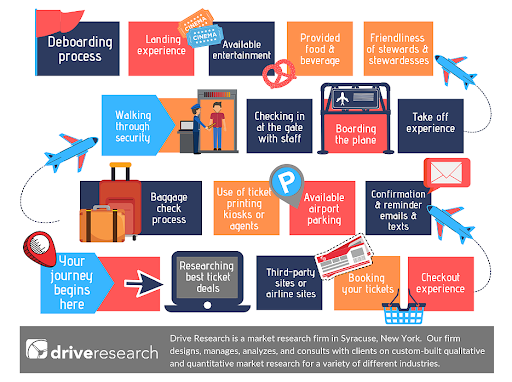
An example of a customer journey map:
Why B2B Customer Journey is Key To Conduct
Mapping the B2B customer journey provides specific details about customer interactions that can help improve business functions.
Not only does this provide specific customer details, but journey mapping tackles each point of the shopping process from beginning to end. In turn, this provides businesses with essential customer information on their experience, recurring themes, existing gaps in the purchasing process, and related details.
Once all this feedback has been obtained, businesses have a much clearer view of how their specific audience operates. Ultimately, this allows them to create a more tailored, enjoyable shopping experience.
Why B2B Customer Journeys Are Slightly Different
The B2B customer journey is somewhat different than B2C, for instance, as it deals directly with other businesses as customers.
As a result, B2B customer journey maps involve more players – we’re talking stakeholders and multiple departments, which can make the mapping process more complex.
Furthermore, these complexities often cause a longer buying process versus B2C.
Because businesses are dealing with more than a single customer in B2B interactions, this means taking the time to create stronger bonds with said stakeholders and other key players.
What the B2B Customer Journey Process Looks Like
When establishing the customer journey, our B2B market research company involves four key elements: awareness, shopping, purchase, and post-purchase. Below, we’ll give you a rundown of each stage and its importance.
Awareness Stage
In this initial stage, the B2B customer begins to experience a specific need or pain point. For B2B customers, this may look like noticing certain challenges in business operations. As a result, they begin to search for answers to the issue. During this phase, customers actively research potential solutions across various touchpoints, including company websites, social media, trade publications, word-of-mouth recommendations, blogs, white papers, and industry events.
In B2B markets, multiple stakeholders may be involved from the start, making it important to provide educational content that addresses different roles within the decision-making unit. This stage sets the baseline for how customers perceive your brand relative to competitors.
Consideration Stage
After the customer becomes aware of an issue, B2B customers enter the consideration stage, where they actively evaluate and compare options. This involves assessing pricing, features, vendor capabilities, and fit with their specific business requirements.
During this stage, customers interact with touchpoints like sales representatives, product demonstrations, case studies, and technical documentation. In B2B spaces, this process may take longer, as multiple parties are typically involved.
Purchase Stage
After committing to a solution, the B2B customer enters the purchasing stage and finalizes the process. For B2B customers, this can involve contract negotiations, legal reviews, procurement processes, and cross-departmental approvals.
To maintain a positive relationship with the B2B customer, businesses should make this transaction as smooth as possible.
Post-Purchase Stage
The post-purchase stage is arguably one of the most important stages of the B2B customer journey. Research shows that customers with stronger emotional connections to suppliers are more profitable and loyal.
This stage revolves around a business maintaining a connection with the B2B customer through various methods, from customer surveys to rewards programs to check-ins, to ensure they’re pleased with their purchase.
How to Improve The B2B Customer Journey With Market Research
Market research plays a significant role in developing a detailed B2B customer journey.
First off, businesses can conduct market research to create B2B customer personas based on demographic information gathered. Customer personas are essential for a business to better understand the needs of its target audience.
Secondly, market research can also provide insights into the B2B customer experience by uncovering specific pain points. In doing this, businesses will have a much better handle on tackling unique customer needs.
Lastly, businesses can use market research to strengthen customer bonds in the post-purchase stage via surveys. The small online surveys can provide key information about ease of purchase, what worked, what could be done better, and so on.
FAQs About Customer Journey Mapping & Research
How is the B2B customer journey different from the B2C one?
The B2B customer journey is more complex than B2C because it typically involves multiple stakeholders and departments rather than a single decision-maker. B2B journeys typically have longer buying cycles, require building relationships with various members across organizations, and involve more touchpoints throughout the decision-making process. The complexity means businesses must understand and serve multiple roles within the customer’s organization.
What are pain points in the B2B customer journey?
Pain points are areas in the customer journey where customers experience difficulties, frustration, or negative emotions. Common B2B pain points include unclear pricing structures, difficulty accessing decision-makers during the consideration phase, complex paperwork during purchase, delayed responses, confusing onboarding processes, inadequate technical support, or poor communication across departments. Identifying these pain points helps businesses prioritize improvements.
What methods are used in B2B customer journey mapping research?
B2B customer journey mapping research uses a combination of qualitative and quantitative methods, including in-depth interviews with senior management and department leaders, customer surveys, and focus groups (with current, potential, and lost customers), surveys to measure satisfaction and importance at specific touchpoints, and data analysis to identify gaps between internal perceptions and customer experiences.
Why Partner With Drive Research For B2B Customer Journey Research
The above points are just a glimpse of how market research can improve the B2B customer journey. Our third-party research firm is experienced in taking on unique client challenges and can help create a detailed B2B customer journey map based on those exact needs.
A major benefit of working with a third-party firm like ours? We allow businesses to focus on their duties without having the added stress of taking on an internal research project. Our team has decades of experience in advanced research methodologies, and understands the nuances that come with each methodology used. To summarize: leave market research to the pros!
We analyze more than data—we also track how our site is used to improve your experience. Cookies help us understand what’s working so we can deliver the most relevant insights. Click “Accept” to enable full functionality.
Functional
Always active
The technical storage or access is strictly necessary for the legitimate purpose of enabling the use of a specific service explicitly requested by the subscriber or user, or for the sole purpose of carrying out the transmission of a communication over an electronic communications network.
Preferences
The technical storage or access is necessary for the legitimate purpose of storing preferences that are not requested by the subscriber or user.
Statistics
The technical storage or access that is used exclusively for statistical purposes.The technical storage or access that is used exclusively for anonymous statistical purposes. Without a subpoena, voluntary compliance on the part of your Internet Service Provider, or additional records from a third party, information stored or retrieved for this purpose alone cannot usually be used to identify you.
Marketing
The technical storage or access is required to create user profiles to send advertising, or to track the user on a website or across several websites for similar marketing purposes.