In today’s rapidly evolving business landscape, staying ahead of the competition requires more than just a great product or service. It demands a deep understanding of the market, consumer behavior, and emerging trends. This is where the market research process becomes invaluable. In this blog post, we will delve more into market research and explore...
There is never a wrong time to do market research. However, most research projects are birthed because a company or organization is at a crossroads. Whether you’re a startup or Fortune 500 company, you’ll have critical decisions to make. This blog will detail common market research examples and how our clients have used them to...
An original 2026 survey of 1,096 U.S. adults by Drive Research found that dads are looking for a Father’s Day that feels personal, low-pressure, and centered on time with family.
While many fathers still want traditional celebrations, such as going out to eat, receiving gifts, or having a meal at home, the data also shows a more practical side of Father’s Day. Dads want thoughtfulness, useful gifts, fewer responsibilities, and, in some cases, a little space to enjoy the day on their own.
Ahead of Father’s Day on Sunday, June 21, 2026, this article explores what fathers really want, how that compares with what they received last year, where gift givers may miss the mark, and what the data reveals about the emotional and physical load tied to the holiday.
Top Father’s Day Statistics
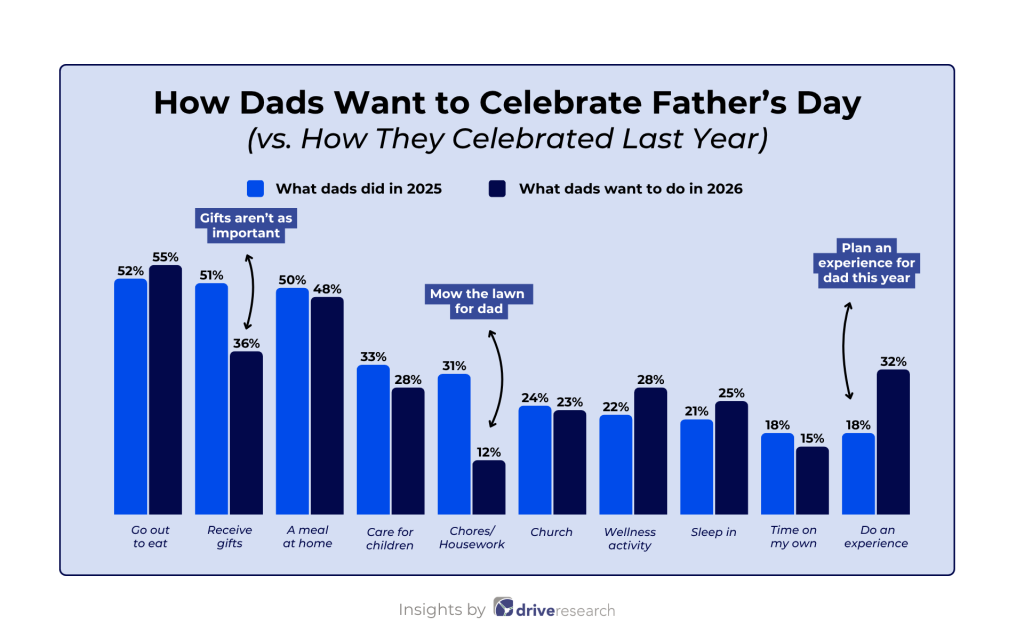
Dads are most likely to want to go out to eat for Father’s Day this year (56%) and/or have a meal at home (48%).
Over 1 in 3 dads want to receive gifts for Father’s Day, with gift cards (42%), handwritten cards (37%), money (30%), and food or beverages (29%) being the top requested presents.
Most dads want to spend Father’s Day with their children (88%) and spouse or partner (69%).
Nearly half of fathers say their spouse or partner is most responsible for coordinating Father’s Day plans (50%).
The household responsibility dads most want off their plate is home improvement or yard work (26%).
Most Father’s Day gift givers expect to spend between $25 and $149 this year (66%).
What do dads want to do for Father’s Day this year?
For Father’s Day 2026, dads are most likely to say they want to:
Go out to eat with family or friends (56%)
Have a meal at home (48%)
Receive gifts (36%)
Do an experience such as golfing, fishing, or camping (32%)
Participate in a wellness activity such as walking, hiking, or going to the gym (28%)
Last year’s celebrations were similar in some ways, but not identical. Fathers most commonly went out to eat (52%), received gifts (51%), had a meal at home (50%), took care of children or grandchildren (33%), and did chores or housework (31%).
The data suggests dads are not necessarily asking for an elaborate Father’s Day. Many want a familiar celebration, but with a little more intention built in. Experiences, wellness activities, sleeping in, and fewer chores all point to the same idea: dads want the day to feel different from a typical Sunday.
Some clear examples of this are:
Nearly 1 in 3 dads say they want to do an experience this year (32%), compared to 18% who did one last year.
Only 12% of dads want to do chores or housework on Father’s Day this year, although 31% did chores or housework last year.
Gifts may not be as important to dads as many assume. Although 51% received gifts last Father’s Day, only 36% say they want receiving gifts to be part of this year’s celebration.
Single fathers are more likely to spend time alone on Father’s Day
Single, separated, divorced, and widowed fathers were more likely than married fathers to spend time on their own last Father’s Day (26% vs. 14%) and to say they did nothing for Father’s Day (6% vs. 2%). Married fathers, on the other hand, were more likely to have a meal at home (55% vs. 38%) or do an experience (21% vs. 10%)
Who do dads want to spend Father’s Day with?
Most fathers want the day centered on close family. Among dads, 88% say they want to spend Father’s Day with their children, and 69% want to spend it with a spouse or partner.
Other groups are part of the day too, but at lower levels. About 22% want to spend Father’s Day with friends, 17% want to spend it with their own father or father figure, 16% want to spend it with grandchildren, and 15% want to spend it with siblings.
Only 3% say they want to spend Father’s Day alone.
This is one area where Mother’s Day and Father’s Day look very similar.
In our Mother’s Day survey, 89% of moms wanted to spend the day with their children, nearly identical to the 88% of dads who say the same about Father’s Day.
What dads want as Father’s Day gifts in 2026
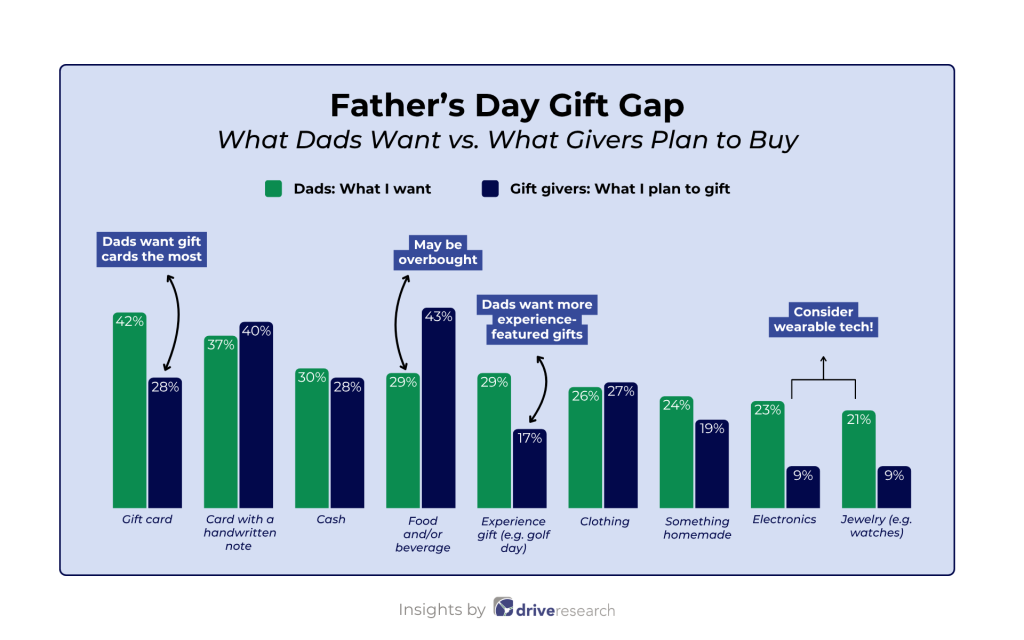
The most wanted Father’s Day gifts this year are gift cards (42%), handwritten cards (37%), cash or money (30%), food or beverages (29%), experience gifts (29%), and gifts related to hobbies or interests (28%).
Compared with what dads received last year, some gaps stand out.
Last year, fathers were most likely to receive handwritten cards (36%), food or beverages (31%), clothing or accessories (29%), and gift cards (27%). This year, gift cards move to the top of the wish list, and cash or money ranks higher among desired gifts than it did among gifts received last year.
In other words, dads still appreciate sentimental gifts, but they also appear to value flexibility. A handwritten card is still one of the strongest gift choices, but practical gifts like gift cards, cash, food, and hobby-related items all perform well.
What matters most when dads receive a gift
When receiving a Father’s Day gift, dads are most likely to say the present should feel personal or thoughtful (70%). Sentimental value also matters to many fathers (45%), followed by it being a surprise (41%), reflecting their interests (39%), and being useful or practical (39%).
By comparison, only 20% say high quality is important.
That finding makes Father’s Day gift giving less about price and more about fit. The data suggests dads are not simply looking for the most expensive item. They want evidence that the giver thought about who they are, what they enjoy, and what would actually make their day better.
This also mirrors a key theme from our Mother’s Day research.
Moms were even more likely than dads to say thoughtfulness mattered most, but in both studies, emotional meaning outranked product quality. For Mother’s Day, 81% of moms said a gift that feels personal or thoughtful is important. For Father’s Day, 70% of dads say the same.
Where gift givers may miss the mark this year
Among non-fathers who expect to celebrate Father’s Day this year, the most commonly planned gifts are food or beverages (43%), handwritten cards (40%), gift cards (28%), clothing or accessories (27%), and something homemade (19%).
That sounds thoughtful on the surface, but it also suggests many gift givers are leaning into safe, familiar options rather than the gifts dads are most likely to say they want.
Experience gifts are another missed opportunity. Nearly 3 in 10 dads want an experience gift such as concert tickets, golfing, or a day out, but only 17% of gift givers plan to buy one.
Those are all safe choices, and several line up with what fathers say they want. But the biggest opportunity may be in gifts that feel more personal, flexible, or experience-driven.
The biggest gaps show up in gifts that offer flexibility, entertainment, or a better fit with dads’ personal interests.
Some clear examples from Drive Research’s 2026 Father’s Day survey are:
Dads are about 1.5X more likely to say they want a gift card (42%) than gift givers are to say they plan to buy one (28%).
Dads are about 1.6X more likely to say they want an experience gift like concert tickets, golfing, or fishing (29%) than gift givers are to say they plan to give one (17%).
Dads are more than 2.5X more likely to say they want electronics (23%) than gift givers are to say they plan to buy them (9%).
Dads are more than 2X more likely to say they want jewelry or wearable tech (21%) than gift givers are to say they plan to buy it (9%).
That mismatch is especially interesting because most gift givers have some level of confidence in their ability to choose a Father’s Day gift the recipient actually wants (98%).
What dads want off their plate on Father’s Day
Father’s Day may not carry the same level of household labor tension that we saw in the Mother’s Day survey, but the data still shows that many dads want some responsibility taken off their plate.
When asked which household responsibility they would most want removed on Father’s Day, fathers were most likely to say home improvement or yard work (26%), followed by cleaning (16%), running errands (15%), cooking (12%), and planning meals or activities (12%).
The workload shows up in how dads describe the day, too:
Nearly 1 in 5 fathers say they do more work, such as planning, cleaning, or cooking, on Father’s Day than on a typical Sunday (20%).
About 1 in 4 say they feel more pressure to make Father’s Day special for others than to enjoy the day for themselves (25%).
Another 23% agree that if there were zero social pressure or guilt, they would prefer to spend Father’s Day entirely alone.
Still, the broader pattern looks different from Mother’s Day.
In our Mother’s Day research, nearly 1 in 3 moms said they were responsible for coordinating their own Mother’s Day plans. For Father’s Day, only 20% of dads say they are most responsible for coordinating the plans. Nearly half say their spouse or partner takes the lead.
That difference matters. It suggests fathers may be less likely than mothers to carry the planning burden for their own holiday, but a meaningful share still experience Father’s Day as something they help manage, not just enjoy.
Single fathers may carry more of the planning themselves
Relationship status also changes the Father’s Day experience.
Among single, separated, divorced, and widowed fathers, 34% say they are most responsible for coordinating Father’s Day plans. Among married fathers, that drops to 15%.
Married fathers are much more likely to say their spouse or partner coordinates the day (62%), compared with 19% of single, separated, divorced, or widowed fathers.
How much do people spend on Father’s Day?
Most people celebrating Father’s Day expect to spend less than $150 this year (66%).
The most common spending range is $50 to $99, selected by 25% of Father’s Day gift givers. Another 23% plan to spend $25 to $49, while 18% expect to spend $100 to $149. About 11% plan to spend less than $25, 6% expect to spend $150 to $199, and 9% plan to spend $200 or more.
Mother’s Day vs. Father’s Day Spending
According to Drive Research’s 2026 Mother’s Day and Father’s Day surveys, planned spending looks nearly identical for both holidays, with 44% of non-moms and 44% of non-dads expecting to spend $50 to $149.
The biggest difference appears at the higher end, where non-moms are twice as likely as non-dads to plan to spend $200 or more, 12% vs. 6%.
Value
Percent of non-moms
Percent of non-dads
Less than $50
31%
34%
$50 to $149
44%
44%
$150 to $199
9%
9%
$200 or more
12%
6%
Unsure or don’t plan to spend money
4%
7%
When do people start planning Father’s Day, and where do they get gift ideas?
Most Father’s Day planning starts a few weeks in advance. Among those who are not fathers but expect to celebrate Father’s Day, 45% say they typically start planning a few weeks ahead. Another 20% start more than a month in advance, while 19% start about a week ahead.
When it comes to gift ideas, most people rely on themselves.
About 60% say they come up with Father’s Day gift ideas on their own, while 37% say the person tells them what they want, 34% turn to family or friends, 31% browse in-store, and 30% rely on past gifts that worked well.
Social media (27%), search engines (23%), online gift guides or articles (20%), retailer websites (20%), and AI tools or chatbots (8%) play a role too, but they trail behind personal instinct and direct input.
Are pet owners considered fathers on Father’s Day?
A majority of people say yes. In our survey, 52% agreed that men who have pets can be considered fathers on Father’s Day, while 26% disagreed and 22% remained neutral.
This closely mirrors the Mother’s Day survey, where 53% agreed that women with pets can be considered mothers on Mother’s Day.
Together, the findings suggest pet parents are increasingly part of both holiday conversations, though the idea is not universally accepted.
About the Father’s Day study
This survey was conducted online within the United States by Drive Research in May 2026, among 1,096 adults (n427 fathers, n669 non-fathers, but expected to celebrate Father’s Day in 2026).
Drive Research is a global market research company specializing in custom-built, quantitative and qualitative methodologies. Our market research firm takes pride in making organizations more successful by extracting insights from the data we collect to accelerate business strategy.
We analyze more than data—we also track how our site is used to improve your experience. Cookies help us understand what’s working so we can deliver the most relevant insights. Click “Accept” to enable full functionality.
Functional
Always active
The technical storage or access is strictly necessary for the legitimate purpose of enabling the use of a specific service explicitly requested by the subscriber or user, or for the sole purpose of carrying out the transmission of a communication over an electronic communications network.
Preferences
The technical storage or access is necessary for the legitimate purpose of storing preferences that are not requested by the subscriber or user.
Statistics
The technical storage or access that is used exclusively for statistical purposes.The technical storage or access that is used exclusively for anonymous statistical purposes. Without a subpoena, voluntary compliance on the part of your Internet Service Provider, or additional records from a third party, information stored or retrieved for this purpose alone cannot usually be used to identify you.
Marketing
The technical storage or access is required to create user profiles to send advertising, or to track the user on a website or across several websites for similar marketing purposes.