In today’s rapidly evolving business landscape, staying ahead of the competition requires more than just a great product or service. It demands a deep understanding of the market, consumer behavior, and emerging trends. This is where the market research process becomes invaluable. In this blog post, we will delve more into market research and explore...
There is never a wrong time to do market research. However, most research projects are birthed because a company or organization is at a crossroads. Whether you’re a startup or Fortune 500 company, you’ll have critical decisions to make. This blog will detail common market research examples and how our clients have used them to...
Willingness to Pay Research: What It Is and How to Do It Right
Emily Rodgers
What you’ll learn in this article: Willingness to pay research is a market research method that helps businesses identify the price point at which customers are genuinely ready to buy, before leaving money on the table or pricing themselves out of a deal. In this article, we cover what willingness to pay research is, why it matters for B2B and B2C organizations, the methods used to measure it, real examples from Drive Research studies, and what the process looks like from start to finish.
Here is a question most businesses cannot answer with confidence: How much would your customers actually pay for your product or service?
Not how much they say they would pay.
Not how much your competitors charge.
How much they would genuinely part with, given their alternatives and their budget.
That gap between assumed pricing and real willingness to pay is where a lot of revenue gets lost.
Companies underprice and leave money on the table. Others overprice and watch deals stall or churn rates climb. Neither situation is inevitable, and willingness to pay research exists specifically to close that gap.
What Is Willingness to Pay (WTP)?
Willingness to pay (often abbreviated as WTP) refers to the maximum amount a buyer would pay for a product or service before choosing an alternative or going without. It is not a single number but a range that varies across customer segments, purchase contexts, and competitive environments.
What makes WTP research genuinely useful is that it does not just measure price tolerance in isolation. It connects price to perceived value. When you understand what people are willing to pay, you also learn a lot about what they think your product is worth and why.
Conduct willingness to pay research to optimize value and revenue.
Pricing has a bigger impact on business performance than many companies realize. McKinsey found that a 1% improvement in price can have a 6% effect on profitability for a typical S&P 500 company.
Cost-plus pricing starts with your margins, not your customers.
Competitive benchmarking shows what others charge, but not whether buyers see enough value to pay that price.
And internal debates about pricing often come down to opinions rather than evidence.
Willingness to pay research replaces those assumptions with direct feedback from the people who matter most: your buyers.
It is especially useful when:
✅ Launching a new product
When there is no historical sales data to rely on, willingness to pay research gives you a starting point grounded in customer expectations rather than spreadsheet modeling.
✅ Considering a price increase
Simon-Kucher’s 2025 Global Pricing Study found companies often realize less than half of their planned price increases. WTP research helps identify how much pricing room you have before customers start pushing back or looking elsewhere.
✅ Designing pricing tiers or packages
WTP research can show which features, benefits, or service levels actually increase perceived value. For example, PwC found consumers are willing to pay an average of 9.7% more for sustainably produced or sourced goods, showing that customers may pay a premium when the value is clear and meaningful to them.
Key Benefits of Conducting WTP Studies
The most obvious benefit is better pricing. But pricing research tends to deliver a few other advantages that teams do not always anticipate going in.
Internal Alignment
Pricing debates inside organizations often stall because different stakeholders, sales, finance, product, and marketing, have different instincts and different incentives.
When you walk into that conversation with third-party research, the discussion shifts from opinion to evidence.
A VP of Sales who thinks your price is too high has a harder time dismissing a conjoint analysis than they do a gut feeling from the product team.
Segmentation Opportunities
Most companies treat their customer base as a single audience for pricing purposes, and most companies are leaving revenue on the table as a result. WTP research frequently reveals that different segments have meaningfully different price sensitivity.
Enterprise buyers may have more tolerance for premium pricing than mid-market accounts. Highly engaged users may value certain features far more than occasional ones.
Knowing this lets you build pricing architecture that captures more value across the board.
De-Risking Product Decisions
When a new feature or service is on the roadmap, WTP research can help determine whether it is worth building and what it is worth charging for. That is a much better position than launching something and then guessing whether it moves the needle on revenue.
Research Methods Used to Measure Willingness to Pay
There are several pricing research methods for measuring willingness to pay. The right approach depends on your objectives, the complexity of your pricing, and the kind of insight you need.
Here are the most common methods we recommend to clients
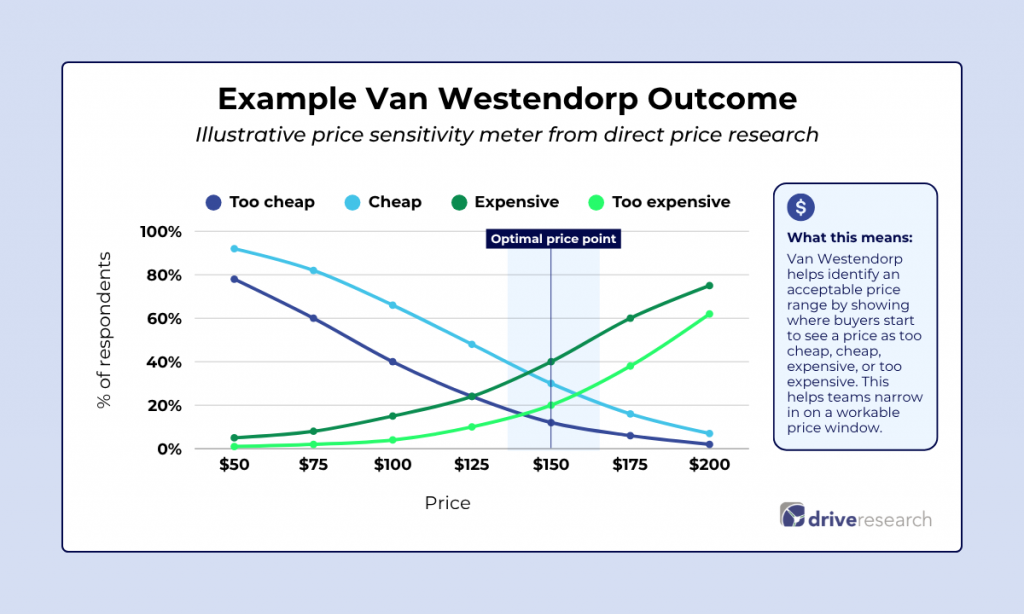
1. Van Westendorp Price Sensitivity Meter
Van Westendorp is one of the most widely used WTP methods because it is relatively quick to field and produces intuitive results.
Respondents answer four questions about a product:
The price at which it seems too cheap to trust
The price at which it feels like a bargain
The price at which it starts to feel expensive
The price at which it is simply too much
Plotting those responses reveals an acceptable price range and a sweet spot that balances volume and margin.
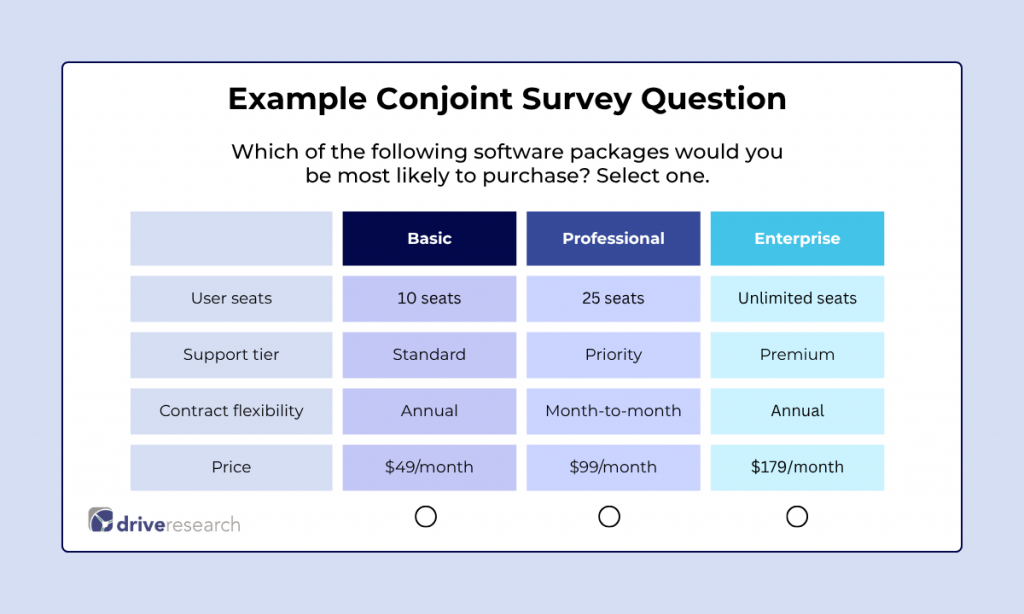
2. Conjoint Analysis
Conjoint analysis goes a step further by measuring how buyers trade off price against other product attributes.
Instead of asking people to evaluate price in isolation, it presents scenarios where price is one of several variables, including features, service levels, or contract terms.
The output tells you not just what people are willing to pay, but how much each product element is worth in dollar terms.
For companies designing tiered or bundled pricing, this is often the most valuable method available.
Useful resource Want a better understanding of conjoint analysis? Read our Guide to Conducting a Conjoint Analysis for an in-depth breakdown of this pricing strategy.
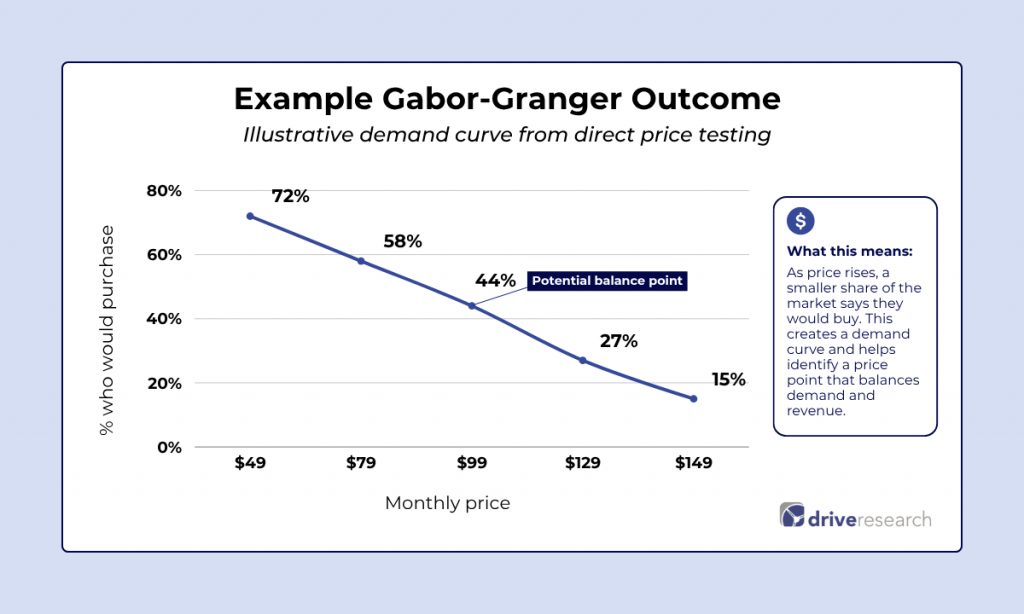
3. Gabor-Granger
Gabor-Granger is a direct approach that presents respondents with a specific price and asks whether they would purchase at that price.
By varying prices across the sample, researchers can build a demand curve showing purchase likelihood at each price point.
It works best when you already have a shortlist of price options and want to quantify the revenue implications of each.
4. Qualitative Research
Focus groups and in-depth interviews are not designed to produce a precise WTP number, but they are invaluable for understanding the reasoning behind price sensitivity.
What does value mean to your buyers?
What alternatives are they comparing you against?
What would make a higher price feel justified?
Qualitative research answers those questions and makes quantitative studies sharper by revealing how customers actually think and talk about pricing.
Curious which willingness to pay method fits your needs? Contact our market research firm for a recommendation.
The best way to understand what WTP research looks like in practice is to see it in context. Here are a few examples from projects our pricing research company has conducted.
Healthcare: Pricing a Direct-to-Consumer Service
A healthcare organization came to us looking to price a new direct-to-consumer service for patients with Inflammatory Bowel Disease. This was a sensitive audience with a specific set of concerns around cost and coverage, so the research design needed to be thoughtful.
We ran online focus groups to understand how patients thought about pricing and perceived value, then followed with a quantitative survey to measure WTP at scale.
The result was a clear, data-backed pricing recommendation along with messaging guidance to help communicate the service’s value in a way that made the price feel reasonable to that audience.
B2B Technology: SMB Decision-Makers and Payment Preferences
A data analytics and loss prevention platform company hired Drive Research to survey 400 decision-makers at small and medium-sized businesses.
The study covered a range of topics including POS system usage, gaps in existing technology, and key pain points, but willingness to pay and payment preferences were central objectives.
Understanding what SMBs were actually willing to spend, and how they preferred to pay, gave the client critical input for structuring their pricing and sales approach for that segment.
Home Care: Competitive Rate Intelligence
Sometimes willingness to pay research is less about surveying customers and more about understanding what the market will bear.
For a client in the home care industry, Drive Research conducted 347 calls to competitor locations across the US to gather current rate information.
That competitive pricing intelligence gave the client a clear picture of where they stood in the market and how much pricing flexibility they actually had.
How to Conduct Willingness to Pay Research
If you have never commissioned a willingness to pay study with a market research company like Drive Research before, it helps to know what the process looks like so you can plan accordingly.
Most projects run four to eight weeks from kickoff to final deliverable, though the timeline can vary depending on scope and complexity.
Kickoff meeting with dedicated project team
It starts with a discovery conversation. Before any research is designed, we work with clients to get clear on the decision they are trying to make.
Is this about setting an initial price for a new product?
Evaluating a potential price increase?
Understanding how to structure tiers?
The answer shapes everything that follows, from methodology to sample design to the questions we ask.
Design the research approach
From there, the research is designed. This step ranges based on the type of method.
For quantitative studies, this involves writing and testing the survey instrument, building out any conjoint or pricing scenarios, and defining the sample.
For qualitative components, it means developing a discussion guide and identifying the right respondents.
Collect the data or feedback
Fieldwork typically runs two to three weeks depending on how difficult your target audience is to reach. A general consumer panel can often close quickly. Whereas a study targeting VPs of Finance at mid-market manufacturing companies will take longer.
Report and analyze the findings
Once data collection is complete, the analysis phase begins. This is where the raw numbers get turned into something actionable.
At Drive Research, deliverables for a willingness to pay study typically include an interactive data dashboard and a presentation-ready report with clear pricing recommendations.
The goal is to give your team something you can actually use to make a decision and defend it internally.
Drive Research is a full-service market research firm with experience designing and executing willingness to pay studies for B2B and B2C organizations across industries including healthcare, technology, retail, and financial services. If you are ready to create a pricing strategy backed by data, we would be glad to talk through your objectives and put together a proposal.
What is the difference between willingness to pay and price sensitivity?
Willingness to pay is the maximum amount a buyer would spend on a product before walking away. Price sensitivity describes how much a buyer’s behavior changes in response to price changes. A customer can have a high willingness to pay and still be price sensitive, meaning a small increase in price significantly reduces their likelihood of buying. Good pricing research measures both and treats them as distinct inputs.
Is there a willingness to pay formula?
There is no single willingness to pay formula, but at its simplest, it refers to the maximum price a customer is willing to pay for a product or service. In research, it is often estimated through methods like Van Westendorp, Gabor-Granger, or conjoint analysis, which help identify acceptable price ranges and the point where purchase interest starts to decline.
How much does willingness to pay research cost?
Most quantitative WTP studies start in the range of $15,000 to $20,000 and can run higher for complex designs or multiple audience segments. Though cost varies depending on methodology, sample complexity, and study scope. A straightforward online survey with a consumer panel tends to cost less than a conjoint study targeting hard-to-reach B2B decision-makers. Qualitative components like focus groups add to that range. The best way to get an accurate number is to share your objectives with a research firm and request a scoped proposal.
How long does a willingness to pay study take?
Most projects take between six and eight weeks from kickoff to final deliverable. Consumer studies tend to move faster because recruiting is easier. B2B studies often require a longer fieldwork window to reach the right respondents. If you are working toward a specific launch date or internal deadline, it is worth sharing that upfront so the timeline can be built around it.
How To Conduct Pricing Research [Methods + Benefits]
Blog Posts
Price Optimization: Be Confident the Price is Right
Blog Posts
Pricing Sensitivity Surveys: How to Price Your Products & Services
When You Give Us A Cookie
We analyze more than data—we also track how our site is used to improve your experience. Cookies help us understand what’s working so we can deliver the most relevant insights. Click “Accept” to enable full functionality.
Functional
Always active
The technical storage or access is strictly necessary for the legitimate purpose of enabling the use of a specific service explicitly requested by the subscriber or user, or for the sole purpose of carrying out the transmission of a communication over an electronic communications network.
Preferences
The technical storage or access is necessary for the legitimate purpose of storing preferences that are not requested by the subscriber or user.
Statistics
The technical storage or access that is used exclusively for statistical purposes.The technical storage or access that is used exclusively for anonymous statistical purposes. Without a subpoena, voluntary compliance on the part of your Internet Service Provider, or additional records from a third party, information stored or retrieved for this purpose alone cannot usually be used to identify you.
Marketing
The technical storage or access is required to create user profiles to send advertising, or to track the user on a website or across several websites for similar marketing purposes.