In today’s rapidly evolving business landscape, staying ahead of the competition requires more than just a great product or service. It demands a deep understanding of the market, consumer behavior, and emerging trends. This is where the market research process becomes invaluable. In this blog post, we will delve more into market research and explore...
There is never a wrong time to do market research. However, most research projects are birthed because a company or organization is at a crossroads. Whether you’re a startup or Fortune 500 company, you’ll have critical decisions to make. This blog will detail common market research examples and how our clients have used them to...
Mother’s Day Statistics 2026: How Moms Want to Be Celebrated
Emily Rodgers
An original 2026 survey of 1,086 U.S. adults by Drive Research found that many moms want Mother’s Day to feel less like another obligation and more like a day that is actually for them.
The data shows mothers still value traditional gifts and family time, but many also want the holiday to feel more restful, more personal, and less tied to the work they often carry the rest of the year.
Ahead of Mother’s Day on Sunday, May 10, 2026, this article explores what moms really want, how that compares with what they got last year, and where gift givers may be at risk of missing the mark.
Top Mother’s Day Statistics
A card with a handwritten note (50%), gift card (48%), and flowers (40%) top the list of most wanted Mother’s Day gifts.
While the majority of moms want to spend Mother’s Day with their children (89%) and spouse (54%), 1 in 5 also want to spend some time alone.
Moms want to celebrate the day by going out to eat (52%), receiving gifts (48%), or doing an experience (44%).
Most celebrating Mother’s Day expect to spend at least $100 this year (66%).
Nearly 1 in 3 mothers are responsible for coordinating their own Mother’s Day plans(31%).
Over half of respondents (53%) agree that women with pets can be considered mothers.
What do moms want to do for Mother’s Day this year?
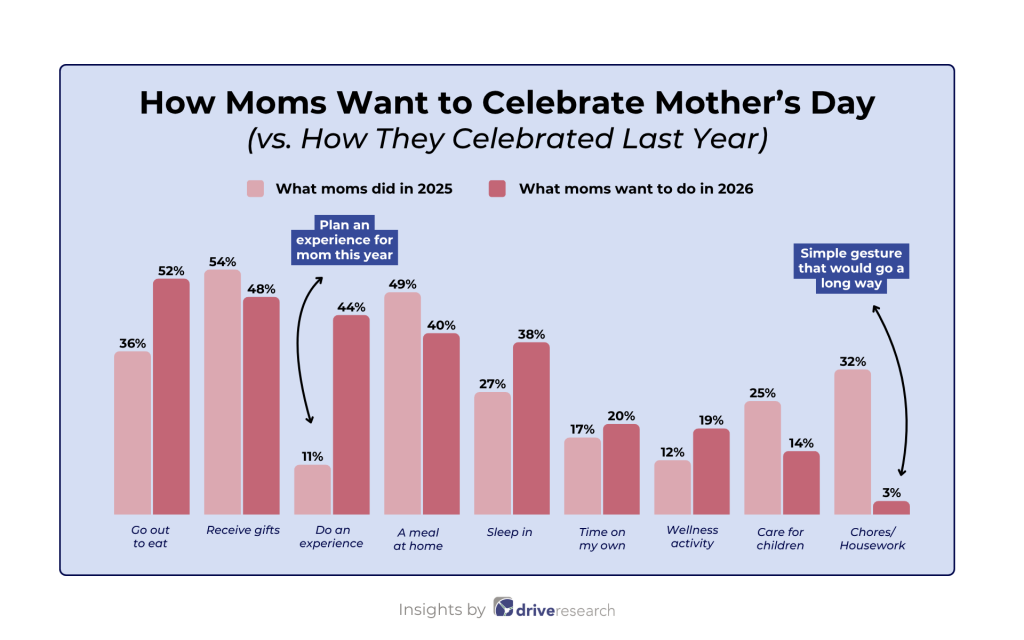
For Mother’s Day 2026, moms are more likely to say they want to go out to eat (52%), receive gifts (48%), do an experience (44%), have a meal at home (40%), and sleep in (38%).
Last year, the most common things moms did were received gifts (54%), had a meal at home (49%), went out to eat (36%), and did chores or housework (32%).
Our data suggests many moms are not looking to repeat last year’s version of the holiday, instead preferring a day that feels more special, restful, and experience-driven.
Some clear examples of this are:
Only 11% of moms say they spent last Mother’s Day doing an experience, such as a spa day, movie, or outing, but 44% say that is what they want this year.
Just 27% of moms say they slept in last Mother’s Day, compared with 38% who say they want to sleep in this year.
Nearly 1 in 4 moms say they spent last Mother’s Day taking care of children or grandchildren, but only 14% say they want to spend the day that way this year.
Nearly 1 in 3 moms say they spent last Mother’s Day doing chores or housework (32%), but almost none say that is how they want to spend the day this year (3%).
Who do moms want to spend Mother’s Day with?
Most moms still want the day centered on family. Among moms, 89% say they want to spend Mother’s Day with their children, 54% want to spend it with a spouse or partner, and 28% say their mother or mother figure.
Though, 1 in 5 say they want to spend some time on their own, which fits the broader theme of needing breathing room and relaxation built into the celebration.
That is part of what makes this year’s findings so interesting. Moms are not looking to be left alone so much as they are looking to be cared for, acknowledged, and given space to enjoy the day. Family still matters most, but so does relief.
What moms want as mother’s day gifts in 2026
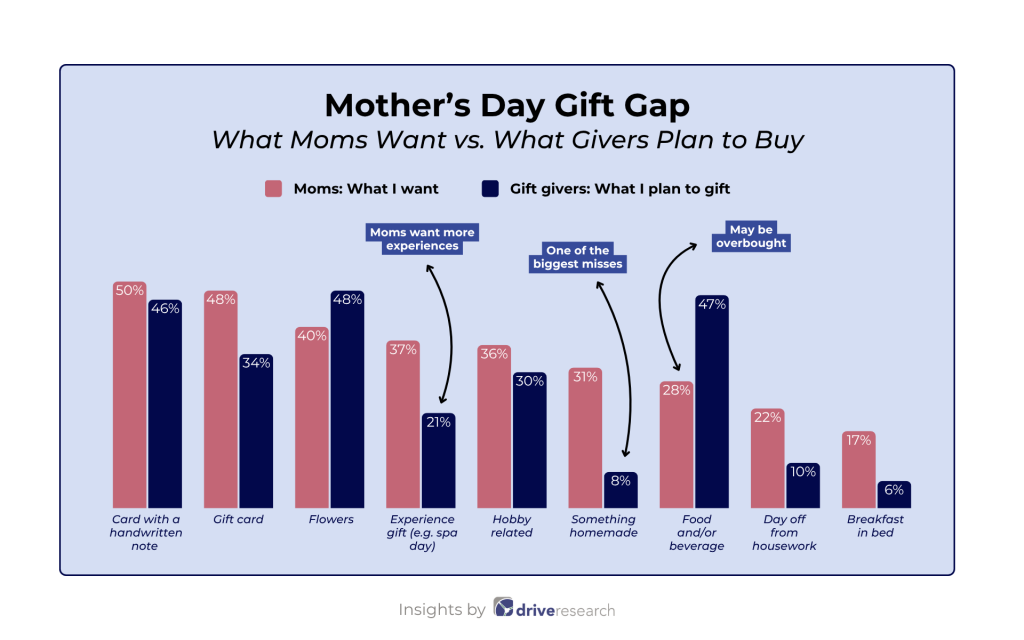
The most wanted gifts are a handwritten card (50%), gift cards (48%), flowers (40%), experience gifts (37%), and gifts tied to hobbies or interests (36%) such as reading or gardening.
But the data also makes it clear that a meaningful Mother’s Day gift does not have to be expensive. Many moms also say they would want something homemade (31%), a day off from household responsibilities (22%), or breakfast in bed (17%).
That is even more true for mothers in the thick of parenting. When compared to empty nesters, mothers with children in the household are…
4X more likely to want breakfast in bed (24%)
More than 3X more likely to want a day off from household responsibilities (31%)
1.7X more likely to want something homemade (37%)
What matters most when moms receive a gift
More than anything, moms want a gift that feels personal or thoughtful (81%), while 49% say sentimental value matters, 41% say it should reflect their interests, and 37% say it should show effort or planning.
By comparison, fewer than 1 in 10 moms say a gift that is high quality is important (8%), which suggests emotional meaning matters far more than buying something expensive if it does not reflect what she actually likes, uses, or values.
That helps explain why handwritten cards are the most sought after gift, and why something homemade or an experience can outperform more standard categories. The data suggests moms are not just evaluating the item itself. They are reading the intention behind it.
Where gift givers may miss the mark this year
Among non-mothers who expect to celebrate Mother’s Day this year, the most commonly planned gifts for the moms in their lives are flowers (48%), food or beverages (47%), handwritten cards (46%), gift cards (34%), and hobby-related gifts (30%).
That sounds thoughtful on the surface, but it also suggests many gift givers are still leaning on traditional defaults rather than the more tailored gestures moms describe wanting.
The biggest gaps show up in the gifts that require a little more thought or effort. Some clear examples of this are:
Moms are about 4X more likely to say they want something homemade (31%) than gift givers are to say they plan to make something (8%).
Moms are about 2X more likely to say they want a day off from household responsibilities (22%) than gift givers are to say they plan to offer one (10%).
Moms are nearly 2X more likely to say they want an experience gift (37%) than gift givers are to say they plan to give one (21%).
That mismatch is especially interesting because almost all gift givers are confident in their ability to choose a Mother’s Day gift that the person actually wants (99%).
That confidence is not entirely misplaced, because cards and flowers still resonate with a lot of moms. But the broader data suggests many people understand the broad outline of Mother’s Day while still missing some of the most meaningful details, especially around experiences, homemade gifts, and practical relief.
The mental and physical load of Mother’s Day
One of the clearest themes in the survey is that Mother’s Day can still come with a lot of work for the very people it is meant to celebrate. Nearly 1 in 3 mothers are responsible for coordinating their own Mother’s Day plans (31%).
Moms most often say they want cooking (33%), cleaning (31%), and planning meals or activities (18%) off their plate, which suggests the holiday still carries plenty of mental and physical load.
That tension shows up in how moms describe the day, too:
1 in 4 moms admit if there was zero social pressure or guilt, they would prefer to spend Mother’s Day entirely alone (25%).
Nearly 1 in 5 moms agree that they do more work on Mother’s Day than on a typical Sunday (19%).
Nearly 1 in 3 moms agree that they feel more pressure to make the day special for others than to enjoy it themselves (31%).
Seen through that lens, the appeal of rest, experiences, and a day off from household responsibilities makes a lot more sense, because many moms are not just asking for a gift, they are asking for a break.
Moms with children at home are more likely to want rest and alone time
For mothers with children still living at home, the appeal of Mother’s Day often comes down to getting a real break from the day-to-day demands of parenting.
What moms want to do on Mother’s Day
Children in the household
Children out of the household
Difference
Sleep in
47%
27%
1.7X more likely
A day off from household responsibilities
31%
9%
3.4X more likely
Spend some time on my own
24%
14%
1.7X more likely
Some moms are more likely to be overlooked on Mother’s Day
For mothers with children out of the household, the challenge is less about managing the day and more about whether the day is acknowledged at all, as 1 in 5 say they did not receive a gift last year (20%), 2X the share of mothers with children still living at home (10%).
A similar pattern appears by relationship status: 19% of single mothers say they received no gift last year, compared with only 11% of married moms, suggesting some mothers are more likely to be overlooked when there is no partner in the home helping drive the celebration.
How much do people spend on Mother’s Day?
The most common spending range is $50 to $149, selected by nearly half of Mother’s Day gift givers (44%). Another 19% plan to spend $25 to $49, and 13% expect to spend less than $25.
Though overall, the most plan to spendless than $100 on Mother’s Day this year (54%).
But, spend matters less than gift alignment. Moms consistently place more value on thoughtfulness (81%), sentiment, and effort than on expensive gift categories.
Value
Percent of non-moms
Less than $50
31%
$50 to $149
44%
$150 to $199
9%
$200 or more
12%
Unsure or don’t plan to spend money
4%
When do people start planning Mother’s Day, and where do they get gift ideas?
Planning for Mother’s Day usually starts earlier than people might assume. About 51% say they start planning a few weeks in advance, 23% start about a week ahead, and 14% start more than a month out. Some wait until the week of (11%).
As for inspiration for gift ideas, most people still trust themselves first. Over 3 in 5 say they come up with ideas on their own (65%), while 40% rely on past gifts that worked, and 36% say the person tells them what they want.
Social media (22%), online gift guides (21%), and AI tools or chatbots (9%) all trail behind instinct and habit, which may be one reason traditional gifts continue to dominate.
Are pet owners considered mothers on Mother’s Day?
A majority of people say yes. In our survey, 53% agreed that women who have pets can be considered mothers on Mother’s Day, while 27% disagreed and 20% remained neutral.
So the short answer is that pet owners are broadly considered part of the Mother’s Day conversation, but not without some debate. The data suggests the idea has more support than opposition, though it is far from unanimous.
About the Mother’s Day study
This survey was conducted online within the United States by Drive Research in April 2026, among 1,088 adults (n753 mothers, n304 not a mother, but expected to celebrate Mother’s Day in 2026).
Drive Research is a global market research company specializing in custom-built, quantitative and qualitative methodologies. Our market research firm takes pride in making organizations more successful by extracting insights from the data we collect to accelerate business strategy.
We analyze more than data—we also track how our site is used to improve your experience. Cookies help us understand what’s working so we can deliver the most relevant insights. Click “Accept” to enable full functionality.
Functional
Always active
The technical storage or access is strictly necessary for the legitimate purpose of enabling the use of a specific service explicitly requested by the subscriber or user, or for the sole purpose of carrying out the transmission of a communication over an electronic communications network.
Preferences
The technical storage or access is necessary for the legitimate purpose of storing preferences that are not requested by the subscriber or user.
Statistics
The technical storage or access that is used exclusively for statistical purposes.The technical storage or access that is used exclusively for anonymous statistical purposes. Without a subpoena, voluntary compliance on the part of your Internet Service Provider, or additional records from a third party, information stored or retrieved for this purpose alone cannot usually be used to identify you.
Marketing
The technical storage or access is required to create user profiles to send advertising, or to track the user on a website or across several websites for similar marketing purposes.