In today’s rapidly evolving business landscape, staying ahead of the competition requires more than just a great product or service. It demands a deep understanding of the market, consumer behavior, and emerging trends. This is where the market research process becomes invaluable. In this blog post, we will delve more into market research and explore...
There is never a wrong time to do market research. However, most research projects are birthed because a company or organization is at a crossroads. Whether you’re a startup or Fortune 500 company, you’ll have critical decisions to make. This blog will detail common market research examples and how our clients have used them to...
Opportunity Scoring 101: A Market Research Guide for Product Teams
Emily Rodgers
If you sit in enough roadmap meetings, you start to see a pattern. Everyone has a feature they care about.
Sales wants something for that big prospect.
Product wants to clean up technical debt.
Marketing wants the “wow” features.
Leadership wants whatever competitors just launched.
The hard truth is that most teams are not short on ideas. They are short on clarity about which ideas will actually matter to customers. When the wrong features win, you feel it in slower adoption, missed revenue, and churn that is hard to explain.
In my experience, the teams that break out of this cycle are the ones that bring customers into the prioritization process in a structured way. Instead of guessing, they measure which needs are truly most important and where people still feel underserved.
Opportunity scoring is one of the tools we use at Drive Research to do exactly that.
By asking customers to rate both the importance of specific outcomes and their satisfaction with current solutions, you get a clearer picture of where a new product or feature can create real value.
See how Drive Research can run opportunity scoring for your product roadmap.
Opportunity scoring is a way to quantify where your product has the most “room to run.”
In practice, you survey customers to rate:
How important a need or outcome is
How satisfied they are with the current options that try to meet that need
The biggest opportunities sit in that uncomfortable space where importance is high and satisfaction is low. In other words, these are “jobs” customers really care about but do not feel are solved yet.
In our experience, opportunity scoring fits especially well in three moments of new product development:
Early idea screening, when you have a long list of possible use cases or problem statements
Feature prioritization, when you need to decide what makes the next release
Product refresh projects, when growth is flattening and you want to find new angles for value
You are not just asking “Do you like this idea?” You are systematically mapping where the market feels underserved.
How opportunity scoring actually works
Let us make this concrete.
Imagine you are building a new analytics platform for ecommerce brands. Through internal brainstorming and some exploratory interviews, you identify a list of customer outcomes, such as:
“Quickly see which campaigns drive profitable orders”
“Compare performance across all countries in one view”
“Automatically flag anomalies in conversion rate”
In an opportunity scoring survey, each of these becomes a separate statement. Customers rate:
Importance, for example on a 1 to 10 scale
Satisfaction with current tools or processes, on a similar 1 to 10 scale
From there, you calculate an opportunity score. Different formulas exist, but the logic is similar:
High importance ➕ low satisfaction 🟰 high opportunity
Low importance ➕ high satisfaction 🟰 low opportunity
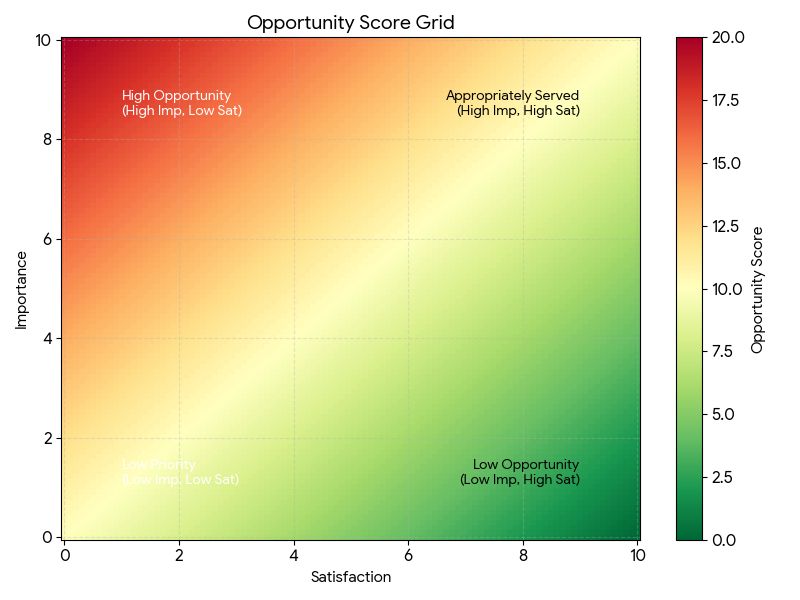
Our market research company often visualizes this on a simple grid:
Needs in the top left quadrant (high importance, low satisfaction) are your sweet spot.
When we run these studies at Drive Research, we usually present results in three tiers:
High opportunity needs that should inform near term roadmap decisions
“Maintain” needs that are important but already well served
Lower opportunity areas that may be deprioritized for now
The math helps remove some of the emotion from prioritization. Stakeholders can still debate execution, but there is clearer alignment on which customer problems actually deserve attention.
When is opportunity scoring worth the effort?
In theory, you could use this framework all the time. But reality, it shines in a few very specific situations.
1. You have too many ideas and not enough focus
This is the classic scenario with founder led or product led organizations. The backlog is overflowing with “good ideas,” but no one is sure which ones will really move the needle.
An opportunity scoring survey gives you an evidence based way to say, “Here is what our customers actually care about the most, and here is where they feel let down today.”
2. You are preparing a major launch
Before a significant release or new product launch, opportunity scoring can validate whether the features you are planning to market line up with true unmet needs. Given how many launches underperform, taking time to test fit against customer priorities is often a smart insurance policy.
3. You are refreshing a mature product
We see this often with established SaaS platforms and financial services products. Growth slows, competitors catch up, and the team is searching for “the next thing.”
Opportunity scoring gives you a structured lens on where to innovate next, grounded in customer experience rather than internal opinions.
Designing an opportunity scoring study
The quality of your opportunity scoring is only as strong as the inputs. Here is how we typically structure these projects.
1. Start with the right audience
You want feedback from the people who actually feel the pain you hope to solve. That might be:
Current customers
Prospects in specific segments
Users in a particular role or industry
When we work with B2B brands, we often recommend splitting the sample by key segments, such as company size or primary use case. That way you can see whether “high opportunity” needs look different for mid market accounts versus enterprise.
2. Define clear needs or outcomes
❌ This is where many teams struggle on their own. It is tempting to write statements that sound like features:
“A dashboard that sends real time alerts.”
In our experience, outcome statements work far better:
✅ “Get alerted quickly when performance changes so I can respond.”
The more you describe what customers are trying to achieve, rather than how you will solve it, the more transferable and future proof the results become.
A simple gut check: if you completely changed the underlying solution, would this still be a relevant need? If yes, you are on the right track.
3. Keep the survey experience realistic
Even the most well designed framework can fall apart if the survey is exhausting. A few practical tips:
Keep the list of needs manageable, usually in the 20 to 40 range, depending on your audience
Use clear, consistent rating scales
Start with screening and basic profiling questions before diving into the opportunity battery
On our projects, we also layer in data quality checks, such as attention checks and open ended validations, so the final dataset reflects genuine thought.
Explore a custom opportunity scoring survey designed by Drive Research.
Once the data is in, the real fun begins. This is where opportunity scoring stops being a research exercise and starts shaping decisions.
Rank and cluster your opportunities
We typically begin by ranking all needs by opportunity score, then grouping them into clusters. For example:
🥇 Tier 1: High opportunity needs that clearly stand out from the rest
🥈 Tier 2: Moderate opportunities worth monitoring or addressing over time
🥉 Tier 3: Lower opportunities that can be deprioritized for now
In workshops, product teams often find it easier to reason about clusters than to debate whether item 7 should outrank item 8.
Visualize the landscape
An importance versus satisfaction chart is still one of the simplest and most powerful tools in product strategy.
In a recent study for a software client, seeing needs plotted visually made it obvious that the team had been investing heavily in features that sat in the “high satisfaction, moderate importance” zone, while neglecting a handful of high importance pain points that customers felt were still unresolved.
That visual moment can be a turning point in roadmap discussions.
Translate findings into concrete actions
This is the bridge many organizations miss. The opportunity scores themselves are not the deliverable. The decisions and experiments they inform are the real output.
In practice, we encourage teams to map each high opportunity need to at least one of the following:
A potential feature or enhancement
A UX or workflow improvement
A service or onboarding change
A messaging or positioning angle for marketing
It is also helpful to label each as a “quick win” or a “strategic bet” so you can balance near term impact with longer term differentiation.
A simple example of opportunity scoring in action
Let us walk through a fictional scenario that mirrors what we see in real projects.
Imagine a mid-sized bank building a new mobile app for Gen Z customers. Internal stakeholders are excited about features like gamified savings challenges and in app financial education content.
During an opportunity scoring study, the team tests a range of needs, such as:
“Instantly see my real time account balance”
“Easily track spending by category over time”
“Quickly lock my card if I lose it”
“Get personalized tips for improving my credit score”
Gen Z respondents rate “quickly lock my card if I lose it” and “easily track spending by category” as both very important and poorly satisfied by their current bank.
The flashy gamification concepts, while interesting, land in the moderate importance range.
The outcome: The bank still moves forward with some differentiated features, but the early roadmap prioritizes rock solid controls and intuitive spend tracking. Marketing leans into safety, control, and visibility, not just “fun” banking.
From a distance, that sounds obvious. In the day to day of internal advocacy and personal preferences, having opportunity scores keeps the team grounded in what customers actually value.
How a research partner can help
Could you run a lightweight version of opportunity scoring on your own? Sure. Even a scrappy survey can be better than guessing.
But in our experience, teams see the biggest lift when they bring in a partner like Drive Research to:
Translate internal feature ideas into clean, customer friendly outcome statements
Recruit the right mix of customers and prospects, especially for niche audiences
Analyze the data in a way that connects naturally to roadmap and go to market decisions
There is also a broader payoff. Organizations that systematically collect and act on customer feedback tend to see stronger upsell, cross sell, and retention performance over time.
If you are curious what a tailored opportunity scoring study would look like for your product, a simple starting point is to map out the audience and top 20 to 30 needs you want to test.
Drive Research is a market research company that specializes in turning customer feedback into clear, decision ready insights.
If you are weighing a long list of product ideas, we can help translate your backlog into customer friendly outcomes, design the survey, and run a full opportunity scoring study with your target audience.
You receive a prioritized list of opportunities, along with practical recommendations that connect directly to your roadmap.
Reach out to our team to talk through what an opportunity scoring study could look like for your product.
We analyze more than data—we also track how our site is used to improve your experience. Cookies help us understand what’s working so we can deliver the most relevant insights. Click “Accept” to enable full functionality.
Functional
Always active
The technical storage or access is strictly necessary for the legitimate purpose of enabling the use of a specific service explicitly requested by the subscriber or user, or for the sole purpose of carrying out the transmission of a communication over an electronic communications network.
Preferences
The technical storage or access is necessary for the legitimate purpose of storing preferences that are not requested by the subscriber or user.
Statistics
The technical storage or access that is used exclusively for statistical purposes.The technical storage or access that is used exclusively for anonymous statistical purposes. Without a subpoena, voluntary compliance on the part of your Internet Service Provider, or additional records from a third party, information stored or retrieved for this purpose alone cannot usually be used to identify you.
Marketing
The technical storage or access is required to create user profiles to send advertising, or to track the user on a website or across several websites for similar marketing purposes.